
Prompt Engineering
Why Choose Our Programs?
!Key Highlights of Prompt Engineering
- Prompt Engineering Fundamentals
- Large Language Model Fundamentals
- Prompt Design and Structuring
- Zero-Shot and Few-Shot Prompting
- Role-Based and Instructional Prompting
- Context and Information Management
- Prompt Optimization and Testing
- AI Response Evaluation
- Reasoning and Advanced Prompting Techniques
- Structured Output Prompting
- AI Workflow and Automation
- Generative AI Applications
- Practical Prompt Engineering Projects
10+
Core Prompting Techniques
8+
AI Application Areas
Project-Based
Practical Learning
Generative AI
AI Skill Focus
What you'll earn after this course
Prompt Engineering professionals are among the most in-demand in the industry. Here's what the market pays.
Certifications
Boost your career with in-demand Agile Management certifications! The future is Agile Management — get on a promising career path with globally recognized credentials.
- Get certified by top global bodies
- Train with industry-leading experts
- Flexible learning schedule
- Affordable EMI options available
Connect with our team for any queries
Frequently Asked Questions
Everything you need to know. Can't find the answer? Reach out to us.
Generative AI is changing how people create content, analyze information, write code, automate tasks, and interact with digital tools. At the center of these interactions is the ability to communicate effectively with AI systems. Prompt engineering courses help learners understand how to write clear instructions, provide useful context, define expected outputs, and refine prompts to achieve more consistent results from generative AI models.
A prompt engineering course can introduce the fundamentals of working with large language models and other generative AI systems. Learners can explore how prompts are structured, how context influences responses, and how different instructions can produce different results. Instead of relying entirely on trial and error, learners can develop a more systematic approach to creating, testing, and improving prompts for specific tasks.
Learn Practical Prompt Design Techniques
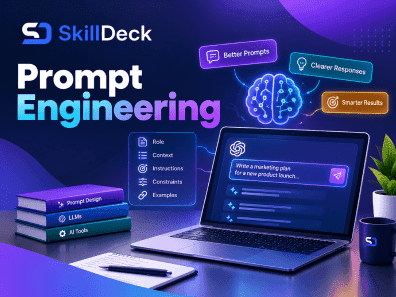
Effective prompting involves more than simply asking an AI tool a question. Prompt engineering training can cover techniques such as zero-shot prompting, few-shot prompting, role-based instructions, contextual prompting, output constraints, examples, and structured response formats. These approaches can help learners design prompts according to the complexity and requirements of a particular task.
For people looking for prompt engineering classes, practical exercises can be especially useful. Learners can experiment with different prompt structures, compare generated responses, identify inconsistencies, and modify instructions to improve the quality of results. This type of practice helps connect prompting concepts with everyday applications.
Understand Generative AI and Language Models
Prompt Engineering is closely connected with Generative AI and large language models. Generative AI courses can help learners understand how AI systems are used for content generation, summarization, research, coding assistance, information extraction, and other applications. Meanwhile, large language model courses can provide a broader introduction to how language-based AI systems process instructions and generate responses.
Learners do not necessarily need an advanced programming background to begin exploring Prompt Engineering. However, technical knowledge can become valuable when prompts are incorporated into APIs, automation workflows, software applications, or AI-powered products.
Develop Skills for Real-World AI Workflows
A strong prompt engineering program should provide opportunities to apply prompting techniques to realistic scenarios. Projects may involve creating reusable prompts, developing structured outputs, improving AI-generated content, extracting information from documents, designing AI-assisted workflows, or evaluating responses against specific requirements.
When comparing the best prompt engineering courses, learners should look beyond the course title. Curriculum depth, practical exercises, AI tools covered, model concepts, project work, evaluation techniques, and learning format can all influence the usefulness of a program. Beginners may prefer introductory courses, while professionals may look for advanced applications involving automation and AI workflows.
Choose a Learning Path That Fits Your Goals
Learners searching for prompt engineering training in India can compare programs based on their experience, learning objectives, duration, and preferred delivery format. A prompt engineering institute may provide instructor-led sessions and practical assignments, while a prompt engineering online course can offer greater flexibility for learners with busy schedules.
Those interested in formal credentials can explore prompt engineering certification programs, particularly when certification complements an existing technology or business skill set. An AI prompt engineering course can also be useful for learners who want to focus specifically on applying prompting techniques to modern AI tools.
SkillDeck brings together learning opportunities for people interested in Prompt Engineering, Generative AI, and language-model technologies. Explore the category to compare courses and find a program that matches your current knowledge, practical interests, and professional direction.
Connect With Reps
Rohith
Learning Advisor
- Global reach across 30+ countries
- Trusted by Fortune 500 companies
- Addressed 25k+ Queries
- 99.9% responds immediately