
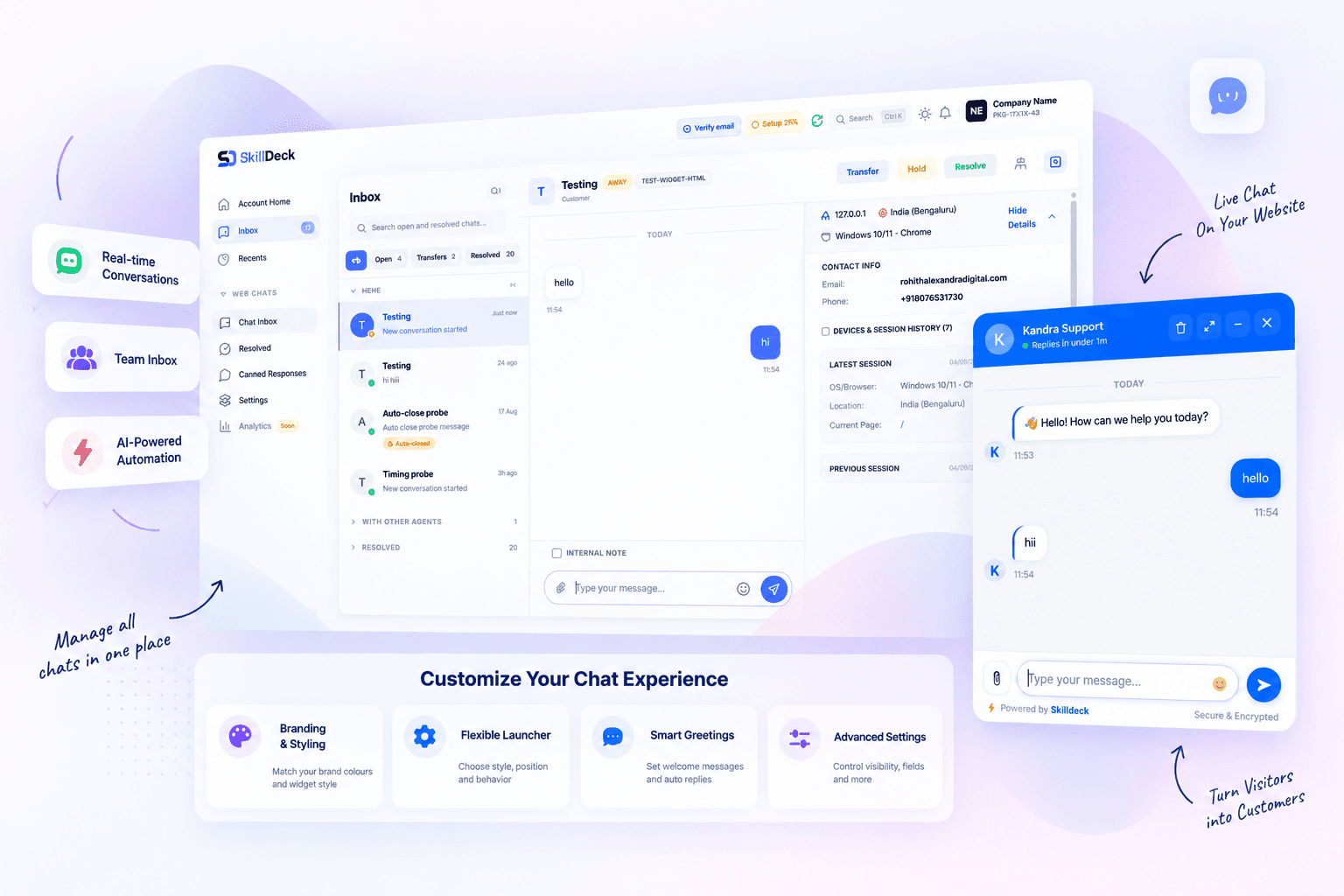
Why education providers need web chat
Admissions is a conversation, not a form. A prospective student comparing three institutions rarely fills in an enquiry form at each one and waits two days for a reply — they ask a question, and they enrol where the answer arrives first. Web chat puts that answer on the page while the person is still reading it.
The pressure is uneven, too. Enquiry volume for most institutions is concentrated into a handful of weeks around results day, intake deadlines and scholarship cut-offs, when the counselling team is least able to absorb it. Web chat carries the routine questions through those peaks so counsellors keep their time for the conversations that actually convert.
What web chat changes for an institution
Enquiries answered before interest cools
Fee structure, eligibility, intake dates, hostel availability, placement records, scholarship criteria — the same questions arrive thousands of times a season. Answering them instantly, on the course page the visitor is already looking at, removes the gap where a prospective student goes and asks a competitor instead.
Fewer abandoned applications
Application forms lose people at predictable points: document upload, payment, eligibility wording that is not quite clear. A chat prompt on those steps recovers applicants who would otherwise close the tab and not come back.
Coverage outside office hours
Working professionals research part-time programmes late at night. International applicants are in another time zone entirely. Chat captures those enquiries with full context and routes them to a counsellor for the morning, instead of losing them to a contact form nobody answers until Monday.
Parents and students, answered separately
Parents ask about safety, fees and outcomes. Students ask about curriculum, faculty and campus life. Routing rules put each to the person best placed to answer, rather than making both queue for the same generalist.
How it works
- Placed where decisions happen. The widget sits on course pages, fee pages and the application flow — not just the contact page.
- Context before the first reply. Counsellors see the pages visited, the campaign that brought the visitor in and the course being viewed, so the conversation starts informed.
- Every chat becomes a lead. Conversations are captured with source and campaign attribution and passed into the CRM, so nothing depends on someone remembering to log it.
- Routed by programme and intent. Undergraduate, postgraduate, executive education and international enquiries each reach the right desk.
- Measured against enrolment. Response times, chat-to-enquiry rate and enquiry-to-application rate are reported per programme, so the effect on admissions is visible rather than assumed.
Where it earns its place
Web chat is most valuable where the decision is considered and the cost of a slow answer is high: degree and diploma admissions, professional certification, test preparation, online course platforms, executive education and international student recruitment. In each case the enquiry is high-intent and the competitor is one browser tab away.
Getting the deployment right
Chat fails in education for consistent reasons, and all of them are avoidable. Deploy it on the pages where questions actually arise rather than sitewide. Staff it properly during peak intake instead of leaving a widget that nobody answers. Give the team accurate fee and eligibility information so answers do not have to be walked back later. Handle student data with the care its sensitivity demands, and be clear in the chat window about what is being collected and why. Done properly, web chat shortens the distance between a question and an enrolment.