Social media has become an important part of how businesses attract attention, communicate with audiences, promote services, and maintain relationships with customers. But maintaining an active presence across social channels requires much more than creating occasional posts. Marketing teams need to plan content, prepare creatives, write captions, coordinate publishing dates, review campaigns, respond to audiences, and measure what is working. When these activities are handled manually, social media management can quickly become repetitive and difficult to coordinate. Posts may be published late, important campaigns can be overlooked, and teams may spend too much time performing routine publishing tasks. A social media automation tool provides a more structured way to manage these activities. Instead of treating every post as a separate manual task, businesses can create a planned publishing workflow where content is prepared in advance, organized into a calendar, reviewed when required, and scheduled for publication. For businesses managing regular marketing campaigns, multiple content categories, or several social accounts, automation can make social media operations more consistent and easier to manage.
What Is a Social Media Automation Tool?
A social media automation tool is a platform that helps businesses organize and automate repetitive social media activities such as content scheduling, publishing, campaign planning, recurring posts, and performance monitoring. The main purpose is not to remove the human element from social media. Instead, automation reduces repetitive operational work so marketing teams can spend more time on strategy, creative development, audience engagement, and campaign optimization. A typical workflow can begin with planning upcoming content. The team prepares posts, assigns publishing dates, places them into a content calendar, reviews them, and schedules them. Once approved, scheduled content can follow the configured publishing workflow without requiring someone to manually publish every individual post at the exact time. This creates a more predictable process for businesses that want to maintain a regular social media presence.
Why Businesses Need Social Media Automation
Managing social media manually may seem manageable when a business publishes only a few posts each week. The workload becomes considerably more complicated as content volume increases. Marketing teams may have to manage:
- Multiple social media accounts
- Different content formats and campaigns
- Weekly and monthly publishing schedules
- Promotional announcements
- Product or service campaigns
- Educational and informational content
- Seasonal campaigns
- Recurring content
- Approval processes
- Performance reporting
Without a centralized workflow, these activities can become scattered across spreadsheets, documents, messaging applications, calendars, and individual social platforms. A social media automation tool brings these activities into a more organized environment. Teams can see what is planned, identify pending content, schedule upcoming publications, and coordinate responsibilities without relying entirely on manual reminders.
Build a Content Calendar Before You Publish
Consistent social media activity starts with good planning. Publishing content without a clear schedule can result in an unbalanced feed, inconsistent posting frequency, or last-minute content creation. A centralized content calendar helps marketing teams visualize their publishing pipeline. Teams can organize posts according to:
- Publishing date
- Campaign
- Content category
- Platform or account
- Responsible team member
- Approval status
- Publishing status
For example, a training company may plan educational tips on Mondays, industry insights on Wednesdays, course-related content on Fridays, and promotional campaigns around important enrollment periods. Instead of deciding what to publish every morning, the marketing team can prepare the content in advance and maintain a clearer view of the upcoming schedule.
Schedule Posts in Advance
One of the most useful capabilities of social media automation is scheduled publishing. Marketing teams can prepare content ahead of time and assign the intended publishing date and time. This reduces the need to repeatedly stop other work to publish individual posts manually. Advance scheduling is particularly useful when teams are managing:
- Weekly content calendars
- Monthly campaigns
- Product announcements
- Event promotions
- Course launches
- Seasonal campaigns
- Educational content series
- Recurring brand updates
Instead of working around individual publishing times, marketers can prepare batches of content during dedicated planning sessions. This creates a more efficient separation between content creation and content publishing.
Manage Multiple Social Accounts More Efficiently
Businesses often maintain more than one social media account. A company may have separate accounts for different brands, business units, products, regions, or audiences. Switching between different platforms repeatedly can increase operational workload. A centralized automation workflow can help teams organize content across multiple accounts while maintaining visibility into where and when content is scheduled. This is especially valuable for agencies and businesses with multiple brands. Rather than maintaining completely separate manual processes, teams can organize their publishing activities from a more centralized workspace. Content can still be adapted according to the audience and platform instead of simply publishing identical material everywhere.
Create a Structured Publishing Workflow
Social media content often passes through several stages before it becomes a published post. A typical process may involve:
Idea → Draft → Review → Approval → Schedule → Publish → Analyze
When these stages are handled informally, team members may not know which posts are ready, which require changes, or which are waiting for approval. A structured workflow gives each piece of content a clear status. For example, a marketing executive can prepare a post and send it for review. A manager can make changes or approve it. Once approved, the content can move into the scheduling queue. This approach helps reduce confusion between content creators, designers, marketing managers, and business stakeholders.
Reduce Repetitive Social Media Tasks
Not every social media task requires a team member to perform it manually. Automation can reduce repetitive activities such as:
- Scheduling prepared posts
- Maintaining recurring content schedules
- Organizing publishing queues
- Sending workflow reminders
- Tracking content status
- Maintaining campaign calendars
- Monitoring basic publishing activity
The objective is to reduce administrative effort rather than automate every creative decision. Marketing professionals can continue deciding what the business should communicate, how campaigns should be positioned, and how audiences should be engaged while the platform handles more of the routine workflow.
Keep Recurring Content Organized
Some businesses regularly publish content with a recurring purpose. Examples include weekly tips, monthly announcements, educational series, frequently asked questions, or regular promotional reminders. Manually remembering these posts can create unnecessary work. A social media automation tool can help organize recurring publishing workflows so teams can plan repeatable content more systematically. Recurring content should still be reviewed periodically. Messaging, offers, dates, and business information can change. Automation works best when repeatable processes remain under appropriate human supervision.
Coordinate Marketing Teams and Approvals
Social media management becomes more complicated when several people contribute to the same publishing process. A content writer may prepare the caption, a designer may create the creative, a marketing executive may schedule the post, and a manager may need to approve it. Without clear ownership, a post can remain stuck between team members. A centralized workflow can provide better visibility into responsibilities and status. Teams can identify which content is being prepared, what requires approval, and what is already scheduled. This can be particularly useful for marketing departments, agencies, franchises, training businesses, and companies running multiple campaigns simultaneously.
Organize Social Media Campaigns
Social media works better when individual posts support a broader marketing objective. Instead of treating every publication as an isolated update, businesses can organize posts around campaigns. A campaign may focus on:
- A new product or service
- A course launch
- An upcoming event
- A seasonal promotion
- Brand awareness
- Lead generation
- Educational content
- Customer engagement
Campaign-based organization helps teams understand why particular content is being published and how different posts contribute to the same marketing objective. It also makes it easier to review campaign performance after the publishing period.
Maintain Brand Consistency
Consistency is not simply about publishing frequently. Businesses also need consistency in messaging, tone, visual direction, campaign themes, and publishing standards. A centralized social media workflow gives marketing teams a common environment for organizing content. Teams can establish internal guidelines for:
- Brand messaging
- Caption style
- Visual requirements
- Campaign terminology
- Content categories
- Approval procedures
- Publishing responsibilities
This becomes increasingly important when several employees or external contributors are creating social media content.
Plan Content Around Different Audiences
A business may communicate with several audience groups through social media. Training companies, for example, may speak to students, working professionals, corporate clients, instructors, and business partners. A single content approach may not be appropriate for every audience. A good automation workflow allows teams to organize content according to campaign objectives and audience needs. For example, one campaign can focus on educational information while another promotes a training program. A separate campaign may communicate with corporate decision-makers. Automation supports the publishing process, while the marketing team remains responsible for creating relevant messages for each audience.
Track Social Media Performance
Scheduling content is only one part of effective social media management. Businesses also need to understand how their content performs. Performance tracking can help teams evaluate areas such as:
- Content engagement
- Audience response
- Campaign performance
- Publishing activity
- Content consistency
- Performance trends
These insights can influence future content planning. For example, if educational content consistently receives stronger audience interaction than promotional posts, the marketing team may choose to increase the proportion of educational content in future calendars. The value of automation therefore extends beyond publishing. It can help create a more organized feedback loop between planning, publishing, measurement, and improvement.
Benefits of Using a Social Media Automation Tool
A well-designed social media automation system can provide several operational benefits.
More Consistent Publishing
Advance scheduling makes it easier to maintain an organized publishing rhythm rather than relying on last-minute posting.
Less Manual Work
Teams spend less time repeating routine scheduling and publishing activities.
Better Content Planning
A centralized calendar gives marketers a clearer view of upcoming content and campaigns.
Improved Team Coordination
Content creators, reviewers, designers, and marketing managers can work through a more structured process.
Fewer Missed Publishing Opportunities
Planned schedules and workflow visibility can reduce the possibility of forgetting important content.
Better Marketing Visibility
Teams can understand what has been published, what is scheduled, and what still needs attention.
Easier Scaling
As content volume and the number of managed accounts increase, automation can help businesses handle a larger publishing workload without increasing manual effort at the same rate.
Social Media Automation for Training and Education Businesses
Training institutes, academies, and professional learning businesses can benefit from structured social media automation because their marketing calendars often contain recurring campaigns. For example, an institute may need to promote:
- New course launches
- Upcoming batches
- Webinars
- Student success stories
- Educational tips
- Industry updates
- Free resources
- Admissions campaigns
- Events and workshops
Instead of manually preparing and publishing every update, the marketing team can build content calendars around these activities. This makes social media part of a broader marketing workflow rather than an isolated daily task.
Social Media Automation for Growing Businesses
Small and growing businesses often face a different challenge: limited marketing resources. A small team may be responsible for content creation, social media management, lead generation, website updates, email communication, and other marketing activities. Automation can help such teams make better use of their available time. Rather than spending several short periods throughout the week logging into platforms and publishing individual posts, the team can dedicate specific time to content planning and schedule upcoming publications. This allows marketers to focus more attention on strategy, audience research, creative ideas, and campaign improvement.
What to Look for in a Social Media Automation Tool
Choosing an automation platform should go beyond simply checking whether it can schedule posts. Businesses should consider how well the platform supports their complete social media workflow. Important capabilities can include:
- Content calendar management
- Post scheduling
- Multiple account management
- Publishing workflows
- Approval management
- Team collaboration
- Recurring content support
- Campaign organization
- Content status tracking
- Performance reporting
- Role-based access
- Centralized management
The right platform should fit the team's existing process instead of forcing marketers to create complicated workarounds.
Manual Social Media Management vs Automation
Area Manual Management Automation-Based Management Content planning Often handled separately Centralized planning workflow Publishing Repeated manual activity Scheduled publishing Content calendar Spreadsheets or separate tools Integrated calendar Team coordination Messages and manual updates Structured workflow Recurring posts Requires repeated setup Can be organized through recurring workflows Performance review Often handled separately Connected with publishing activity Scaling Increasing manual workload More manageable as content volume grows Automation does not replace marketing strategy. It creates a stronger operational foundation for executing that strategy.
How Skilldeck Supports Social Media Automation
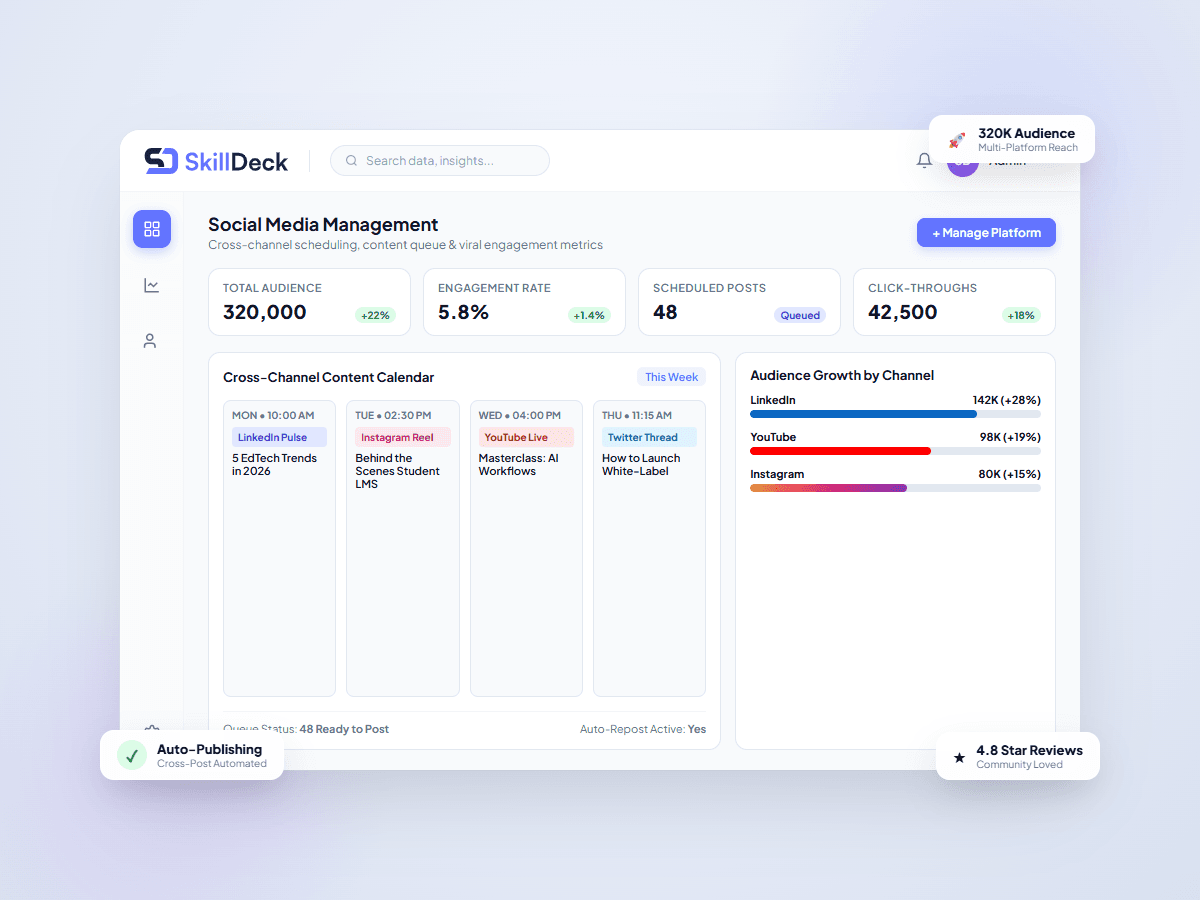
Skilldeck helps businesses create a more connected digital operating environment instead of relying on disconnected tools for every business activity. With a social media automation workflow, businesses can organize content planning, publishing activities, campaigns, team responsibilities, and marketing operations through a more centralized platform. The focus is on making repetitive processes easier to manage while giving teams better visibility into what is happening. For growing training businesses, academies, institutes, and other organizations, social media can also be connected to broader business operations. Marketing activities can work alongside website management, lead management, learner operations, and other workflows rather than remaining completely isolated. This creates a more structured foundation for businesses that want to manage digital growth from one environment.
Make Social Media Management More Predictable
The biggest advantage of social media automation is not simply saving a few minutes when publishing a post. Its larger value comes from creating a repeatable process. A business can move from:
“What should we post today?”
to:
“What are we publishing this week, which campaigns are active, who owns each item, and what needs attention?”
That shift changes social media from a reactive activity into a planned marketing process. Teams can prepare content earlier, coordinate responsibilities, schedule publishing, review performance, and continuously improve their approach.
Final Thoughts
A social media automation tool can help businesses bring greater structure to the way they plan, schedule, publish, and evaluate social media content. Instead of spending valuable marketing time on repetitive publishing tasks, teams can establish a consistent workflow that supports content planning, campaign execution, collaboration, and performance tracking. For businesses that are increasing their content volume or managing multiple accounts, automation can become an important part of maintaining an organized digital presence. Skilldeck provides a broader platform approach for businesses that want social media operations to work alongside their other digital and business workflows. By bringing technology, automation, and operational management into a connected environment, businesses can spend less time dealing with repetitive processes and more time building meaningful marketing strategies and sustainable growth.