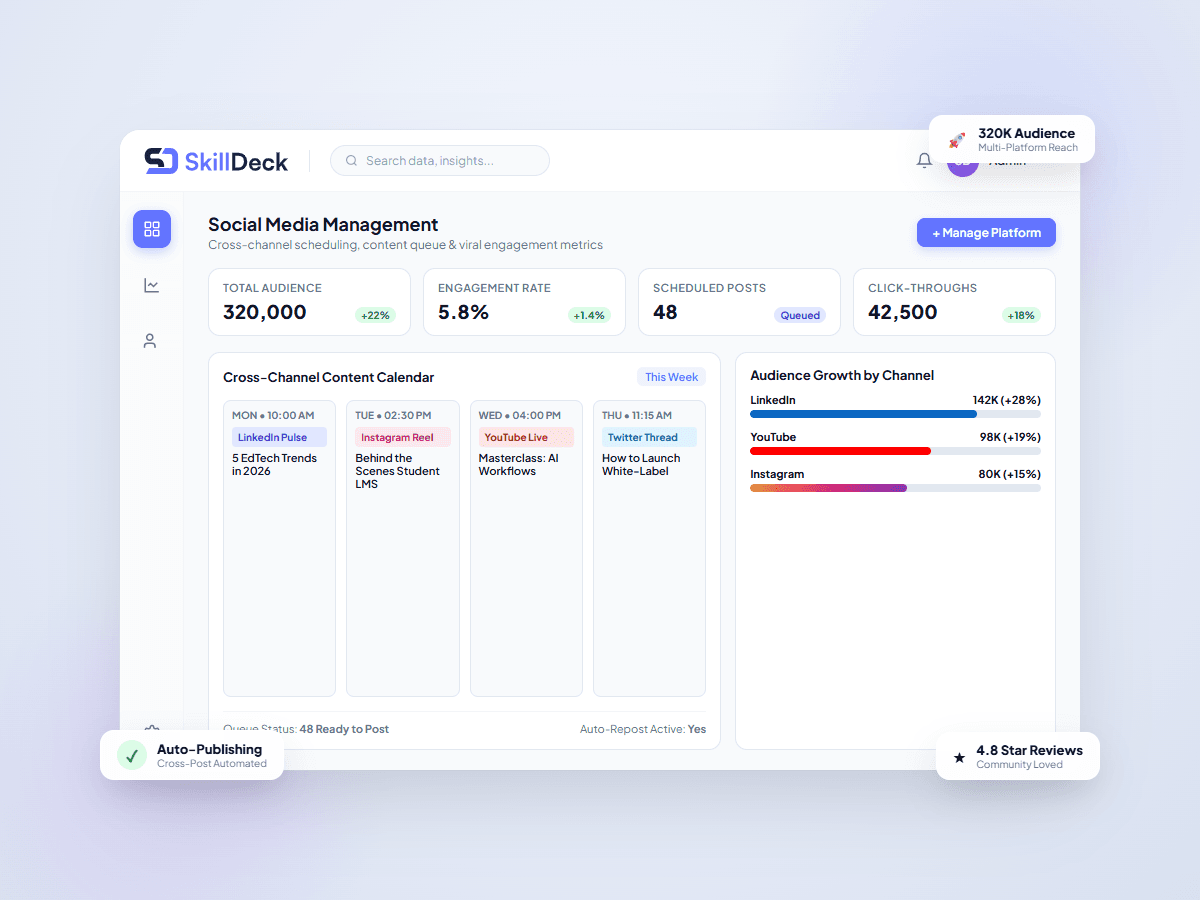
Social media publishing can quickly become a time-consuming activity when businesses manage content across multiple accounts, campaigns, and publishing schedules. A marketing team may have dozens of posts prepared for different dates, but manually publishing each one can interrupt other work and make it harder to maintain consistency. A social media scheduling tool provides a structured solution by allowing teams to prepare content in advance and organize when each post should be published. Instead of waiting for the right moment to log in and publish content manually, marketers can create a publishing queue that reflects their broader marketing plan. Scheduling also gives teams a better way to separate content creation from publishing. Marketing professionals can dedicate specific time to preparing content and then organize upcoming publications around campaigns, events, promotions, and audience communication.
What Is a Social Media Scheduling Tool?
A social media scheduling tool is software that allows businesses and marketing teams to prepare social media posts and assign them specific publishing dates and times. The tool acts as a bridge between content preparation and publication. A typical workflow can look like:
Create → Review → Schedule → Publish → Measure
Instead of manually publishing every post, the team can prepare content ahead of time and place it into a planned publishing schedule. Depending on the platform, scheduling workflows may also include content calendars, multiple account management, approval processes, campaign organization, publishing queues, and analytics. The result is a more organized way to handle recurring social media activity.
Why Schedule Social Media Posts?
Manual publishing can become difficult when a business has a regular content strategy. Marketing teams may need to publish educational content, promotional messages, product updates, announcements, event information, and other posts throughout the week. Without scheduling, someone needs to remember each publishing date and manually complete the task. Scheduling changes that workflow. Teams can prepare content ahead of time and organize it according to their publishing plan. This can reduce repetitive work and give marketers more time to focus on strategy and content quality. Advance scheduling can be especially useful for:
- Weekly content plans
- Monthly campaigns
- Product launches
- Service promotions
- Event announcements
- Seasonal campaigns
- Educational content series
- Course marketing
- Brand communication
Plan Publishing Around a Content Calendar
Scheduling works best when it is connected to content planning. A content calendar provides the larger picture, while the scheduling tool helps turn that plan into actual publishing activity. For example, a marketing team may plan a month's content around several themes:
- Week 1: Educational content
- Week 2: Product or service information
- Week 3: Customer-focused content
- Week 4: Promotional campaign
The team can then assign specific posts and publishing dates to each theme. This makes it easier to understand how individual posts fit into the overall content strategy. A calendar also helps identify periods where too much content is scheduled or where additional content may be needed.
Create a Publishing Queue
A publishing queue provides a practical way to manage upcoming social media posts. Instead of treating every post as an isolated task, marketers can arrange content according to priority and publishing date. The queue can include posts that are:
- Being prepared
- Waiting for review
- Approved
- Scheduled
- Ready for publishing
- Already published
This creates greater visibility into the publishing pipeline. Marketing managers can quickly see what is coming next without having to search through individual accounts or spreadsheets.
Schedule Content in Advance
Advance scheduling allows businesses to prepare social media content before the actual publishing date. This can be particularly valuable during busy marketing periods. For example, a company launching a new service may prepare several posts weeks before the launch. These posts can introduce the service, explain its benefits, share supporting information, and provide reminders as the launch date approaches. By scheduling these posts in advance, the marketing team does not need to manually publish each update while simultaneously managing the launch. The same approach can be used for webinars, events, course enrollments, workshops, promotions, and other time-sensitive campaigns.
Manage Multiple Social Media Accounts
Businesses rarely limit their social presence to a single account. A company may manage several brand accounts, regional accounts, product-focused accounts, or accounts targeting different audiences. Handling each account separately can increase the amount of time spent on routine publishing. A social media scheduling tool provides a more centralized way to organize scheduled content across managed accounts. This makes it easier for marketing teams to understand which posts are planned for which account and when they are expected to be published. The content can still be customized according to the audience and channel rather than relying on identical messaging everywhere.
Keep Different Campaigns Organized
A busy social media calendar can contain several campaigns at the same time. For example, a training company could be promoting a new course while also publishing educational content and preparing for an upcoming webinar. Without clear organization, these campaigns can overlap or compete for attention. A scheduling tool can help marketers organize posts according to campaigns. Each campaign can have its own publishing timeline, content requirements, and objectives. This makes it easier to coordinate the sequence of posts and maintain a logical progression from initial awareness to the desired action.
Coordinate Important Dates
Some social media posts are tied directly to important business dates. These may include:
- Product launches
- Course enrollment openings
- Webinars
- Workshops
- Events
- Seasonal promotions
- Company announcements
- Special campaigns
Scheduling allows marketers to prepare these posts in advance and align them with the relevant date. For campaigns that require several supporting posts, marketers can create a sequence instead of publishing everything at the last minute. This provides greater control over campaign timing.
Reduce Manual Publishing Work
One of the primary reasons businesses use scheduling tools is to reduce repetitive publishing activity. Without scheduling, a marketer may need to:
- Open a social platform
- Prepare the post
- Upload the creative
- Add the caption
- Publish the content
- Repeat the process for the next account
When this happens repeatedly throughout the week, a significant amount of time can be spent on publishing rather than marketing. A scheduling workflow allows prepared content to be organized in advance. This does not eliminate the need for human involvement. Teams still decide what to publish, review messaging, manage campaigns, and respond to audiences. Scheduling simply makes the execution stage more efficient.
Maintain a Consistent Publishing Routine
Consistency is an important part of social media management. Businesses do not necessarily need to publish constantly, but they should have a publishing routine that matches their strategy and audience. A scheduling tool helps turn that routine into a planned process. For example, a business may decide to publish several educational posts each week and promotional content at specific points during a campaign. Once these activities are planned, the team can schedule the content instead of relying on daily reminders. This makes publishing less dependent on whether someone remembers to post on a particular day.
Schedule Content for Different Audiences
Different audiences may require different messages. A training company could communicate with students, working professionals, corporate customers, instructors, and other groups. Each audience may respond to different topics and offers. A scheduling tool helps marketers organize content around these audience segments. For example:
- Student-focused content can highlight learning opportunities.
- Professional content can focus on career-oriented programs.
- Corporate content can communicate training solutions.
- Educational content can provide useful industry knowledge.
This allows the publishing schedule to reflect the broader audience strategy instead of treating every follower as one audience group.
Manage Recurring Social Media Content
Many businesses have content formats that appear regularly. Examples include:
- Weekly tips
- Industry insights
- Educational series
- Frequently asked questions
- Monthly updates
- Regular announcements
Scheduling makes these recurring activities easier to organize. Instead of creating a new publishing plan from scratch every time, marketers can establish a repeatable workflow for recurring content. However, recurring content should still be reviewed regularly. Information, offers, dates, and messaging can change, so automation should support human oversight rather than replace it.
Use Analytics to Understand Scheduled Content
Scheduling answers the question of when content should be published. Analytics helps answer what happened afterward. A scheduling platform with analytics can help marketers examine how published content performs. Useful areas can include:
- Post engagement
- Campaign performance
- Audience response
- Content trends
- Publishing activity
- Performance changes
These insights can improve future scheduling decisions. For example, if a particular type of content consistently generates stronger engagement, marketers may decide to allocate more space for that content category in future calendars. The scheduling process therefore becomes part of a larger improvement cycle.
Optimize Future Publishing Schedules
A social media schedule should not remain fixed forever. Audience behavior, campaign priorities, business objectives, and content performance can change over time. Teams can use performance information to review their existing publishing patterns. They may discover that:
- Some content categories perform better than others.
- Certain campaigns require more supporting content.
- Some periods have too much promotional content.
- Educational content deserves greater visibility.
- Some publishing slots are not producing the expected response.
The team can then adjust its future schedule. This makes social media scheduling an ongoing process rather than a one-time setup.
Social Media Scheduling for Training Companies
Training institutes, academies, and professional learning businesses often have recurring marketing activities that benefit from advance scheduling. A monthly publishing plan might include:
- New course announcements
- Upcoming batch promotions
- Student success stories
- Instructor introductions
- Learning tips
- Webinar promotions
- Workshop announcements
- Enrollment reminders
Instead of manually publishing each update, the marketing team can prepare the content around upcoming learning programs and organize it into a publishing schedule. This can help connect social media activity with admission periods, course launches, and broader business campaigns.
Social Media Scheduling for Growing Marketing Teams
As marketing teams expand, social media responsibilities are often distributed across several people. One person may manage content, another may handle design, and another may be responsible for publishing and reporting. A scheduling tool can provide a shared view of upcoming content and publishing responsibilities. This reduces dependence on individual memory and makes the workflow easier to monitor. Managers can see what is scheduled, while team members can focus on the content assigned to them. This becomes increasingly valuable when businesses operate multiple campaigns simultaneously.
Benefits of Using a Social Media Scheduling Tool
Saves Repetitive Work
Teams can prepare content in advance instead of manually publishing every post.
Improves Publishing Consistency
Planned schedules make it easier to maintain a regular social media presence.
Supports Better Campaign Timing
Posts can be organized around product launches, events, promotions, and other important dates.
Improves Team Coordination
A shared scheduling workflow helps team members understand upcoming publishing activities.
Provides Better Visibility
Marketers can see upcoming content and scheduled activity from a central environment.
Supports Continuous Improvement
Analytics can provide insights that help teams improve future content and publishing decisions.
Common Social Media Scheduling Challenges
Even with a scheduling tool, businesses should avoid treating scheduling as the entire social media strategy. Common challenges include:
Over-Scheduling
Publishing too much content simply because it can be scheduled can overwhelm audiences.
Ignoring Current Events
Pre-planned content may need to be adjusted when important business or industry developments occur.
Repetitive Content
Scheduling similar posts repeatedly can make a social presence feel predictable.
Insufficient Review
Content should be checked before publishing, particularly when campaigns contain time-sensitive information.
Ignoring Performance
A schedule should evolve based on actual content performance rather than remaining unchanged.
What to Look for in a Social Media Scheduling Tool
The scheduling capability itself is important, but businesses should also consider the surrounding workflow. Useful capabilities may include:
- Post scheduling
- Visual content calendar
- Multiple account management
- Publishing queues
- Campaign organization
- Approval workflows
- Team collaboration
- Recurring content support
- Content status tracking
- Analytics and reporting
- Role-based access
The right platform should make daily social media operations easier rather than introduce another disconnected tool for the marketing team to maintain.
Manual Publishing vs Scheduled Publishing
Area Manual Publishing Scheduled Publishing Publishing process Requires action at publishing time Content prepared in advance Time management Repeated daily activity Planned publishing workflow Campaign timing More dependent on manual execution Easier to coordinate Content visibility May require separate planning Connected to publishing schedule Team coordination Often handled separately Can follow a shared workflow Scaling More manual effort as volume grows Easier to manage larger content queues Manual publishing may work for very small content volumes, but scheduled publishing becomes increasingly useful when businesses need to manage regular campaigns and multiple accounts.
How Skilldeck Supports Social Media Scheduling
Skilldeck helps businesses manage digital operations through a connected technology environment. For social media teams, this can provide a structured foundation for organizing content, publishing schedules, campaign activities, collaboration, and marketing workflows. Instead of maintaining separate processes for every marketing activity, businesses can create a more centralized approach to digital operations. For training companies, academies, institutes, and other learning businesses, social media scheduling can also work alongside website management, lead management, learner operations, and other business workflows. This helps businesses treat social media as part of their wider digital growth process rather than as an isolated publishing activity.
Build a Smarter Social Media Publishing Workflow
Effective scheduling is about more than filling a calendar with posts. A strong workflow connects business objectives with content and publishing decisions:
Goal → Content Plan → Creation → Review → Schedule → Publish → Analyze → Optimize
The business first determines what it wants to achieve. The marketing team then creates relevant content, reviews it, schedules it, and measures the results. The insights from published content can then influence the next scheduling cycle. This creates a continuous process that becomes easier to manage as the business develops a more mature social media strategy.
Final Thoughts
A social media scheduling tool gives marketing teams a practical way to prepare, organize, and publish content without relying on repeated manual actions. By connecting scheduling with content calendars, campaign planning, collaboration, and analytics, businesses can create a more predictable publishing workflow. For growing teams, the value of scheduling goes beyond saving time. It provides greater visibility, improves campaign coordination, supports consistent publishing, and gives marketers more opportunity to focus on strategy and audience engagement. Skilldeck provides a broader environment for businesses that want social media activities to work alongside their wider digital operations. By creating more connected workflows, businesses can reduce fragmented processes and build a scalable foundation for ongoing marketing and digital growth.