Managing social media becomes more demanding as a business grows. What starts with a few occasional posts can turn into a continuous marketing operation involving multiple accounts, campaigns, content formats, team members, publishing schedules, approvals, audience interactions, and performance reports. When these activities are handled separately, marketers may spend considerable time switching between platforms, checking spreadsheets, communicating with team members, and manually compiling performance information. Social media management software brings these activities into a more structured environment. It gives businesses a central place to organize social media operations, coordinate teams, schedule content, manage campaigns, monitor activity, and understand performance. The goal is not simply to publish more posts. It is to help marketing teams manage social media as an ongoing business function with clearer processes, better coordination, and stronger visibility.
What Is Social Media Management Software?
Social media management software is a platform designed to help businesses manage different aspects of their social media operations from one centralized environment. Instead of treating publishing, content planning, collaboration, and analytics as separate activities, the software connects them into a broader workflow. Depending on the platform and business requirements, social media management can involve:
- Content planning
- Post creation and organization
- Social media scheduling
- Publishing management
- Campaign coordination
- Team collaboration
- Approval workflows
- Content calendars
- Audience activity monitoring
- Performance analytics
- Reporting
This centralized approach becomes particularly useful when social media activity is no longer handled by one person and starts involving a larger marketing team.
Why Growing Teams Need a Centralized Social Media System
Growth introduces complexity. A small business may have one person handling social media from content creation to publishing. As the organization expands, responsibilities are usually divided among writers, designers, marketing executives, managers, analysts, and other stakeholders. At this stage, using individual platform dashboards and spreadsheets for everything can make coordination difficult. A centralized social media management system helps teams establish a common workflow. Instead of asking:
“Who is handling this post?”
teams can work around clearer processes such as:
Content Idea → Creation → Review → Approval → Scheduling → Publishing → Analysis
Each stage can have an owner and a defined purpose. This gives marketing managers a better understanding of what is happening without requiring them to follow every conversation manually.
Manage Multiple Social Media Activities From One Place
Social media management involves much more than posting content. A marketing team may simultaneously need to manage an upcoming campaign, review existing posts, schedule new content, monitor audience activity, prepare reports, and coordinate with designers. Moving between multiple tools for these activities can fragment the workflow. Social media management software provides a centralized environment where teams can organize these activities more systematically. This makes it easier to move between planning, execution, collaboration, and measurement without losing sight of the overall marketing objective.
Bring Content and Publishing Together
Content creation and publishing are closely connected. A team may create excellent content but still struggle with maintaining a consistent publishing process if content is stored in one location and publishing schedules are maintained somewhere else. Social media management software can connect content organization with the publishing workflow. Marketing teams can prepare content, associate it with a campaign, assign a publishing date, send it for approval, and move it toward scheduled publication. This creates a more predictable process and reduces the amount of manual coordination required between content production and publishing.
Manage Social Media Scheduling
Scheduling helps businesses prepare social media content in advance rather than publishing everything manually as each post becomes ready. Teams can organize upcoming posts according to their marketing calendar and schedule them around planned campaigns. Scheduling is useful for:
- Regular brand updates
- Educational content
- Product promotions
- Service announcements
- Event campaigns
- Seasonal content
- Course promotions
- Customer-focused posts
Advance scheduling also allows teams to separate content-production time from day-to-day publishing tasks. Instead of repeatedly interrupting other work to publish individual posts, marketers can prepare and schedule content during dedicated planning sessions.
Coordinate Marketing Teams
Social media management often requires collaboration between different roles. For example, a writer may prepare the caption while a designer develops the creative. A marketing executive may organize the post, while a manager reviews it before publication. If these responsibilities are managed through disconnected conversations, content can become delayed. A management platform can give team members better visibility into their responsibilities. Content can be assigned to specific users and moved through defined stages. Managers can identify pending work, review progress, and understand which content requires attention. This makes the platform useful not only for marketers but also for teams that need a structured content-production process.
Create Approval Workflows
Growing businesses often need greater control over what is published under their brand. A social media post may require review for messaging, branding, campaign accuracy, offers, or other business considerations. An approval workflow can introduce a review stage before content reaches the publishing queue. For example:
- The content creator prepares the post.
- The relevant team member reviews the content.
- The manager approves or requests changes.
- The approved post moves to scheduling.
- The scheduled post enters the publishing workflow.
This provides a clearer process for teams that need multiple people involved in social media publishing.
Organize Social Media Campaigns
Individual posts become more meaningful when they are part of a broader campaign. A campaign may support a specific business objective such as promoting a service, generating awareness, launching a product, attracting event registrations, or communicating an important announcement. Social media management software can help teams group related content around campaign objectives. A campaign dashboard or organized campaign workflow can make it easier to identify:
- Campaign content
- Publishing timelines
- Responsible team members
- Pending content
- Scheduled posts
- Published content
- Campaign performance
This gives marketers a campaign-level view instead of forcing them to evaluate every post independently.
Keep Brand Communication Consistent
As more people contribute to social media, maintaining a consistent brand voice can become challenging. Different team members may interpret messaging differently, especially when several campaigns are running simultaneously. A centralized management process allows businesses to establish internal standards for content creation and review. Teams can maintain consistency around:
- Brand messaging
- Communication style
- Campaign language
- Visual direction
- Content categories
- Approval requirements
- Publishing responsibilities
Consistency becomes easier when content is reviewed through a common process rather than being published independently by different team members.
Monitor Audience Activity
Social media management does not end after content is published. Audiences may respond through comments, messages, reactions, and other forms of engagement. Depending on the channels and capabilities being used, businesses may need to monitor this activity as part of their broader social media workflow. Centralized management can help teams keep track of audience interactions and identify conversations that require attention. For customer-facing businesses, this can be particularly important because social media can function as an extension of customer communication. Marketing teams can distinguish between routine engagement and interactions that may require support, sales, or another internal team.
Turn Social Media Analytics Into Marketing Insights
Publishing content without measuring its performance makes it difficult to understand whether the strategy is working. Analytics gives marketers an opportunity to examine how content and campaigns perform over time. Useful areas of analysis may include:
- Post performance
- Audience engagement
- Campaign results
- Content trends
- Publishing activity
- Audience response
- Performance changes over time
The purpose of analytics is not simply to collect numbers. The information should help marketers make better decisions. For example, a business may discover that educational content generates stronger engagement than direct promotional content. The marketing team can use that insight when planning future campaigns.
Create Reports for Marketing Decisions
Marketing managers often need to communicate social media performance to business stakeholders. Without centralized reporting, gathering information from different accounts and platforms can become a manual process. A social media management system can provide a more organized way to review campaign and publishing performance. Reports can help teams understand:
- What content was published
- Which campaigns were active
- How audiences responded
- Which content performed better
- How activity changed over time
These insights can support discussions around future content strategy and marketing priorities.
Manage Different Content Formats
Modern social media strategies can include several types of content. A business may publish:
- Educational posts
- Short-form updates
- Promotional content
- Product information
- Industry insights
- Customer stories
- Event announcements
- Video-based content
- Visual campaigns
A management platform helps teams organize these different content types within their broader publishing workflow. Content categories can also help marketers maintain variety and avoid filling the calendar with the same type of post repeatedly.
Manage Social Media for Multiple Brands
Agencies and organizations with multiple brands often face an additional layer of complexity. Each brand may have different audiences, campaigns, content calendars, and communication requirements. A centralized social media management environment can help teams separate these workflows while maintaining a common operational process. This can make it easier to identify which content belongs to which brand and which team member is responsible for each activity. For agencies, this type of organization can be particularly useful when managing social media activities for multiple clients.
Support Data-Driven Content Planning
Good social media management connects previous performance with future planning. Instead of creating a content calendar based entirely on assumptions, marketers can use historical performance to identify patterns. For example, the team may compare different content categories and determine which topics generate stronger audience responses. These observations can influence future planning. The process becomes:
Publish → Measure → Understand → Adjust → Publish Again
This continuous cycle allows businesses to refine their content strategy rather than treating each campaign as an isolated activity.
Social Media Management for Training and Education Businesses
Training institutes, academies, EdTech businesses, and professional learning companies can use social media management software to organize marketing around their courses and learning programs. Their social media activities may include:
- Course announcements
- New batch promotions
- Webinar campaigns
- Educational tips
- Student achievements
- Instructor introductions
- Learning resources
- Industry updates
- Enrollment campaigns
A centralized management system can help marketing teams coordinate these activities around course launches, admission periods, events, and other business priorities. This also allows content planning to become part of a larger digital marketing workflow instead of operating independently.
Benefits of Social Media Management Software
Centralized Operations
Teams can manage important social media activities through a more connected workflow rather than relying on scattered tools.
Better Team Productivity
Clear responsibilities and organized processes can reduce unnecessary coordination work.
Consistent Publishing
Scheduling and planning help businesses maintain a more deliberate publishing routine.
Improved Campaign Visibility
Marketing teams can understand how individual posts fit into larger campaigns.
Stronger Decision-Making
Analytics and reporting provide information that can support future content decisions.
Easier Scaling
A structured system can help teams manage increasing content volume, campaigns, and account activity more effectively.
Common Problems Without Social Media Management Software
Businesses can encounter several challenges when social media is managed through disconnected processes.
Scattered Content
Captions, creatives, content ideas, and publishing information may exist in different locations.
Unclear Responsibilities
Team members may not know who is expected to complete the next stage of a post.
Last-Minute Publishing
Without advance planning, marketers may repeatedly create and publish content at the last moment.
Limited Campaign Visibility
Individual posts can become disconnected from the larger campaign strategy.
Manual Reporting
Teams may spend unnecessary time collecting performance information from different sources.
Difficulty Scaling
As publishing volume increases, manual processes can become harder to maintain.
What to Consider When Choosing Social Media Management Software
The right platform should support the way a business actually operates. Before selecting software, teams should evaluate:
- Content planning capabilities
- Publishing and scheduling workflows
- Team collaboration
- Approval management
- Campaign organization
- Multiple account management
- Audience activity tracking
- Analytics and reporting
- Role-based access
- Ease of daily use
- Scalability
It is also important to consider whether the platform can support the organization's future requirements. A solution that works for a small team may become limiting when the company adds more accounts, campaigns, employees, or clients.
Social Media Management Software vs Separate Tools
Area Separate Tools Social Media Management Software Content planning Often distributed Centralized Scheduling Managed independently Part of the broader workflow Team collaboration Requires additional communication Built into the management process Campaign tracking Can be fragmented Organized around campaigns Analytics May require multiple reports Centralized performance view Workflow visibility Limited across tools Easier to monitor Separate tools can still serve specific purposes, but managing too many disconnected systems can increase operational complexity. A unified approach can make the overall workflow easier to understand and manage.
How Skilldeck Supports Social Media Management
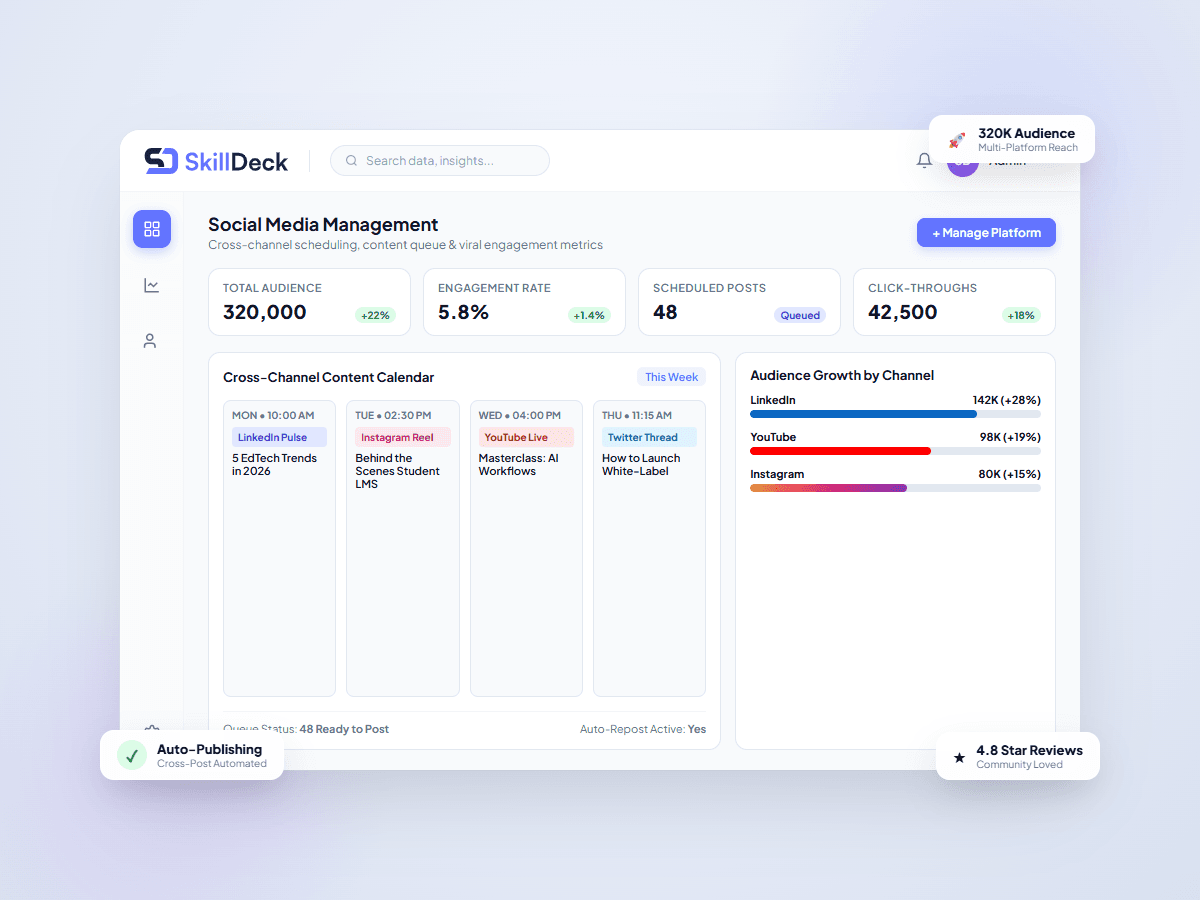
Skilldeck is designed to help growing businesses manage digital operations through a connected technology environment. For social media teams, this means creating a more organized workflow around content, publishing, collaboration, campaigns, and marketing activity. Rather than treating social media management as an isolated task, businesses can make it part of their broader digital operating process. Skilldeck can support organizations that need to manage marketing activities while also handling other business processes such as website operations, lead management, customer information, learning activities, and related workflows. For training companies, academies, institutes, and other learning businesses, this connected approach can be particularly useful because social media often plays an important role in generating awareness and attracting prospective learners.
Build a Scalable Social Media Workflow
Social media management should evolve as the business grows. A practical workflow can begin with:
Strategy → Content → Collaboration → Approval → Scheduling → Publishing → Engagement → Analytics → Optimization
Each stage has a different purpose. Strategy determines what the business wants to achieve. Content turns those objectives into communication. Collaboration brings different team members together. Approval protects quality and brand consistency. Scheduling organizes publishing. Engagement helps teams understand audience responses. Analytics reveals performance, and optimization improves future campaigns. When these stages are connected, social media becomes a repeatable business process instead of a collection of disconnected tasks.
Final Thoughts
Social media management software gives growing teams a centralized way to manage publishing, scheduling, collaboration, campaigns, audience activity, and analytics. Instead of relying on scattered workflows, businesses can create a clearer process for managing social media from planning through performance analysis. As content volume and marketing responsibilities increase, having an organized management system can help teams maintain consistency while reducing unnecessary operational complexity. Skilldeck brings social media management into a broader digital business environment, helping organizations connect marketing activities with their wider operational workflows. This provides a practical foundation for teams that want to organize their social presence while building a scalable approach to digital growth.