Discover how certificate management software helps training companies automate certificate creation, verification, tracking, and delivery while reducing administrative work and improving the learner experience.

Certificates are an important part of many training programs. They provide learners with formal recognition of course completion and can help training companies demonstrate the value of their programs.
However, certificate management can become complicated when a training company handles hundreds or thousands of learners across multiple courses and batches.
Administrators may need to verify completion, prepare certificates, add student information, issue certificates, maintain records, respond to verification requests, and track certification status. When these processes are handled manually, they can consume significant time and increase the possibility of errors.
This is where certificate management software for training companies becomes valuable.
A certificate management platform can automate certificate generation, maintain digital records, streamline distribution, and make verification easier. It can also connect certification with other parts of the learner journey, such as course enrollment, assessments, attendance, and completion.
In this guide, we explore the essential features of certificate management software, its benefits and limitations, factors to consider when selecting a platform, and how Skilldeck can help training companies simplify certification while reducing their technology burden.
Certificate management software is a digital solution that helps organizations create, issue, store, manage, track, and verify certificates.
For training companies, it can connect certificates with learner and course information.
Instead of manually designing and distributing certificates, training companies can use software to create a standardized and scalable certification workflow.
As training companies grow, certificate administration can become a significant operational task.
Consider a training provider that offers several courses every month. Each course may have multiple batches, trainers, assessments, and completion requirements. Once learners complete their programs, the company may need to generate hundreds of certificates.
Certificate management software addresses these problems by centralizing certification data and automating repetitive processes.
One of the most important features is automatic certificate creation.
The platform should be able to populate certificates using information such as:
Once predefined completion conditions are met, the system can generate the certificate without requiring administrators to create each document manually.
Training companies often want certificates that match their branding.
Certificate issuance should ideally be connected to course completion.
For example, once a learner completes the required modules and assessments, the system can trigger certificate generation.
This removes the need for administrators to manually check every learner before issuing certificates.
Modern learners expect quick access to their credentials.
Digital delivery eliminates the need to print and physically distribute every certificate.
Certificate verification is particularly important for professional training companies.
A verification system can allow employers, institutions, or other third parties to confirm whether a certificate was legitimately issued.
A certificate management system should maintain records of certificates issued to learners.
This creates a centralized certification history.
Some training programs require certificates to be renewed periodically.
Not all training programs require certificate expiration, so this feature may be more valuable for certain industries than others.
Certificate management becomes more powerful when connected to the rest of the training process.
This allows certificates to be issued based on actual learner completion rather than manual administrative checks.
Training companies need visibility into their certification activities.
Analytics can help management understand program completion and certification trends.
Certificates are official records and should be protected from unauthorized modification.
Security is particularly important when certificates contain personal learner information.
Automating certificate generation and delivery reduces repetitive administrative work.
Instead of creating certificates individually, staff can manage the process through predefined workflows.
Manual certificate creation can result in spelling mistakes, incorrect course names, wrong dates, or duplicate certificate numbers.
Automation reduces these risks.
Learners can receive their certificates faster after completing their programs.
Quick digital access can improve satisfaction and make the overall training experience more professional.
A training company can issue hundreds or thousands of certificates without proportionally increasing its administrative workload.
Templates help ensure that every certificate follows the company's branding and presentation standards.
Digital verification makes it easier for employers, clients, and learners to validate certificates.
Certificate management software provides significant advantages, but training companies should also consider potential limitations.
Setting up templates, workflows, certificate rules, and integrations may require initial configuration.
Organizations moving from spreadsheets or older systems may need to migrate historical certification records.
Some low-cost platforms may offer limited template customization.
Connecting certificate management with existing LMS, CRM, or business systems may require technical configuration.
Organizations must ensure that their selected platform follows appropriate security practices because certification records may contain sensitive learner information.
Some platforms may charge extra for advanced templates, integrations, storage, verification features, or large-scale certificate generation.
Before selecting a platform, training companies should evaluate several factors.
Look for automatic certificate generation and issuance based on predefined completion requirements.
Ensure the platform can produce certificates that match your company's brand and program requirements.
If certificates are used professionally, digital verification can add credibility and make validation easier.
Evaluate how the platform protects learner information and certificate records.
The system should continue to perform effectively as your number of learners, courses, and certificates increases.
Don't focus only on the software subscription.
Certificate management should ideally be part of a broader training ecosystem rather than another disconnected software tool.
Skilldeck is positioned as an all-in-one platform for training companies, bringing together website, LMS, CRM, and marketing capabilities. Its official website states that the platform is designed to replace multiple fragmented tools with one centralized solution.
This approach can be particularly valuable for training companies that want to connect certification with their broader learner and business operations.
Rather than managing certificates separately from training activities, Skilldeck can help training companies operate their learning business through a centralized platform.
Automation reduces repetitive work across training operations.
For a training company, this means less manual effort around learner management, training workflows, notifications, completion processes, and certification activities.
The broader objective is to let the training team focus on delivering quality programs instead of continuously managing administrative technology.
Certificate records need to be protected because they represent official evidence of training completion.
Skilldeck is designed as a centralized cloud platform for training companies, helping organizations avoid the complexity of independently building and maintaining multiple systems.
Training companies should still review the platform's current security, privacy, and compliance documentation against their specific requirements before implementation.
Performance matters when a training company manages large numbers of learners, courses, and certification records.
A centralized platform can reduce the need to move information between multiple disconnected systems, helping create a more streamlined operational environment.
Skilldeck positions its platform around helping training companies scale while reducing technology complexity.
Certificate management isn't only an administrative function. Professional certification can also strengthen a training company's brand.
A well-managed digital certification process can help create a more consistent learner experience and make course completion easier to communicate.
Skilldeck's broader platform includes website and marketing capabilities alongside its learning and CRM functionality, helping training companies connect their learning operations with their business growth activities.
A training company may begin by issuing a small number of certificates and eventually scale to thousands of learners.
Using a centralized platform can make it easier to expand without building separate systems for every operational requirement.
Skilldeck is designed specifically around training companies and aims to support them as they grow while replacing fragmented technology tools.
One of the biggest advantages of a managed platform is that training companies don't need to become technology companies themselves.
training companies can leave much of the technology responsibility to the platform.
Skilldeck specifically promotes an all-in-one approach and states that it provides website, LMS, CRM, and marketing capabilities in one platform. Its website also highlights no setup fees, free migration, and 24/7 support.
Using separate software for LMS functionality, CRM, website management, marketing, certificate administration, and other business operations can create multiple subscription and maintenance expenses.
An integrated platform can potentially reduce this fragmentation.
Skilldeck currently markets its platform as a way for training companies to reduce technology costs by replacing multiple tools with one platform. Current pricing and plan limitations should be reviewed directly before making a purchasing decision.
Area | Manual Management | Automated Software |
Certificate Creation | Manual | Automated |
Learner Data | Spreadsheets | Centralized |
Certificate Delivery | Manual emails | Automated delivery |
Verification | Manual checking | Digital verification |
Record Keeping | Files/spreadsheets | Centralized database |
Error Risk | Higher | Lower |
Scalability | Difficult | Easier |
Reporting | Time-consuming | Automated |
Branding | Manual templates | Reusable templates |
Administration | High workload | Reduced workload |
The best certificate management software for training companies should do more than generate attractive certificates. It should connect certification with learner enrollment, course completion, assessments, training records, communication, and reporting.
Manual certificate management may work for a small number of learners, but it becomes increasingly difficult as a training company grows. Errors, delayed issuance, inconsistent designs, record-management problems, verification challenges, technical maintenance, and additional administrative costs can reduce operational efficiency.
Choosing separate tools for certificates, LMS operations, CRM, website management, and marketing can also create fragmented data and multiple technology expenses.
Skilldeck offers a broader alternative by bringing key training-business functions into one platform. Its all-in-one approach combines website, LMS, CRM, and marketing capabilities, helping training companies reduce dependence on multiple disconnected tools.
For training companies, the biggest advantage is the reduction in technology burden. Instead of investing heavily in building, connecting, maintaining, and optimizing multiple systems, organizations can focus on training delivery, learner success, certification quality, marketing, and business growth.
With its centralized approach, automation capabilities, scalability, security-focused infrastructure, performance orientation, and reduced technical workload, Skilldeck can be a strong option for training companies looking to modernize their certification and overall training operations.
Skilldeck replaces 10+ software tools with one integrated, automated platform.
Skilldeck is a fully automated, budget-friendly plug-and-play solution designed for training institutes. It offers every essential feature needed to run and scale a training business, helping organizations accelerate growth with minimal effort and cost.
at a Fraction of the Cost
If you're seeking powerful tech and marketing automation that delivers results, Skilldeck is your go-to solution. Specifically built for training institutes, it offers everything you need in one place — from lead generation to operations — driving growth efficiently and affordably.
...and much more, all designed to scale your business effortlessly.
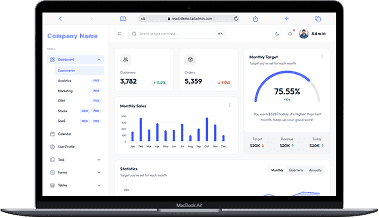
A perfect fit for someone who is getting started with a minimal budget, and looking for the premium features, UI/UX and scalability.
Training Institutes are finding Skilldeck.net quite useful, and are expediting their process & cutting down on the resources across all departments significantly. By reducing their expenses across all departments by at least 40%.
Skilldeck platform is developed by Manjunath Chowdary and team, Ex-Marketing head of Knowledgehut Upgrad, founder of KandraDigital Marketing solutions, and has built the tech and marketing strategies for various training companies.

Manjunath Chowdary
Founder & CEO, SkillDeck
Learn how to digitize a traditional training institute using online learning, student management, automation, and digital marketing to simplify operations and support business growth.

Alex
Discover how virtual classroom software helps training institutes manage live classes, trainers, learners, attendance, communication, and online learning from one platform.
Natasha
Discover how training scheduling software helps providers manage courses, batches, trainers, calendars, sessions, and learner schedules while reducing administrative work.
Alex
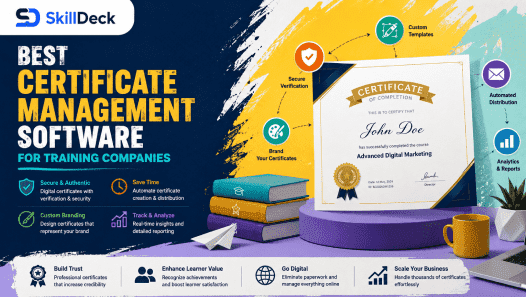
Discover how certificate management software helps training companies automate certificate creation, verification, tracking, and delivery while reducing administrative work and improving the learner experience.
Natasha
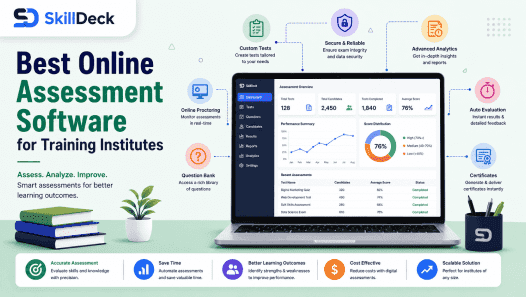
Explore how online assessment software helps training institutes create tests, evaluate learners, track performance, automate results, and improve training outcomes.
Alex
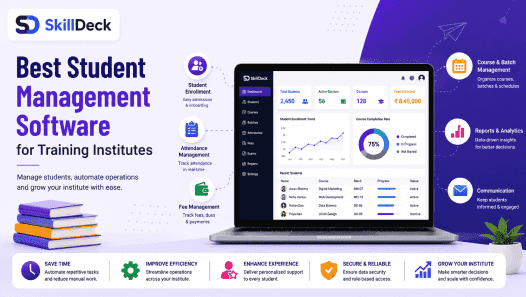
Discover how student management software can simplify enrollment, batch management, attendance, communication, assessments, and reporting while helping training institutes improve efficiency and scale.
Natasha