Managing enquiries and converting them into admissions is one of the most important processes for a coaching institute. Students and parents may discover an institute through Google, social media, advertisements, referrals, websites, phone calls, or walk-ins. Each enquiry can require several conversations before the student finally decides to enroll.
As the number of enquiries increases, managing these interactions through spreadsheets, notebooks, messaging applications, and individual counsellor records can become difficult. Important follow-ups may be missed, enquiry details may become scattered, and management may have limited visibility into the admission pipeline.
This is where CRM for coaching institutes becomes valuable.
A coaching CRM can centralize prospective student information, organize enquiries, assign leads to counsellors, manage follow-ups, track counselling activity, monitor admission stages, and provide useful insights into lead sources and conversion performance.
In this guide, we explore what CRM for coaching institutes means, the important capabilities to consider, its benefits and limitations, factors to evaluate when selecting a CRM, and how Skilldeck can help coaching businesses connect CRM with their wider training operations.
What Is CRM for Coaching Institutes?
CRM for coaching institutes is a customer relationship management solution designed to help coaching and training businesses manage prospective students and their interactions with the institute.
The system can organize the complete admission journey, starting from the first enquiry and continuing through counselling, follow-ups, registration, and enrollment.
Typical CRM functions include:
- Enquiry management
- Lead capture
- Student and parent profiles
- Counsellor assignment
- Lead qualification
- Follow-up scheduling
- Admission pipeline management
- Course interest tracking
- Communication history
- Lead-source tracking
- Counsellor activity monitoring
- Conversion reporting
- Lead re-engagement
Instead of maintaining separate records for every enquiry, institutes can create a structured workflow where each prospect has a clear status, owner, history, and next action.
Why Do Coaching Institutes Need CRM Software?
A coaching institute may receive hundreds or thousands of enquiries during an admission season. Managing these enquiries manually can become increasingly difficult as the institute adds more courses, counsellors, batches, and marketing channels.
For example, a student may enquire about a course today, speak with a counsellor tomorrow, ask for the fee details later, postpone the decision, and return when a new batch is announced.
Without a centralized system, it can be difficult to remember every interaction and determine what should happen next.
Manual enquiry management can result in:
- Missed follow-ups
- Unassigned enquiries
- Duplicate records
- Lost counselling information
- Delayed responses
- Poor visibility into admission stages
- Difficulty tracking counsellor activity
- Unclear lead sources
- Forgotten old prospects
- Time-consuming reporting
A CRM helps bring these activities into one structured environment so that admission teams can manage prospects more consistently.
Important Features of CRM for Coaching Institutes
1. Centralized Lead Capture
Coaching institutes can receive enquiries from several channels. A CRM should make it easier to collect these enquiries into one place.
Lead sources may include:
- Website forms
- Search advertising
- Social media
- Phone calls
- Walk-ins
- Referrals
- Online campaigns
- Landing pages
- Education portals
Centralized lead capture reduces the need for counsellors to check multiple platforms before beginning their work.
2. Detailed Prospect Profiles
A useful CRM should store more than basic contact information.
Counsellors may need to understand what the student is looking for before continuing a conversation.
A prospect profile can contain:
- Student name
- Parent details
- Contact information
- Course of interest
- Preferred batch
- Learning preference
- Location
- Enquiry source
- Counselling notes
- Previous interactions
- Expected joining period
This information can help counsellors provide more relevant responses instead of repeatedly asking the same questions.
3. Lead Qualification
Every enquiry does not have the same admission potential.
Some students may only be researching available courses, while others may be ready to join immediately. CRM software can help classify prospects according to their current level of interest.
Qualification can consider:
- Course requirement
- Joining timeline
- Counselling response
- Batch preference
- Budget discussions
- Interaction history
- Admission readiness
This allows counsellors to prioritize prospects who require immediate attention while maintaining visibility over longer-term enquiries.
4. Counsellor Assignment
When several counsellors handle admissions, clear ownership becomes important.
A CRM can help assign enquiries to individual counsellors and provide visibility into their current workload.
This can help institutes avoid situations where multiple counsellors contact the same prospect or where an enquiry remains unattended because nobody knows who is responsible for it.
5. Follow-Up Scheduling
Students frequently require multiple interactions before making an admission decision.
A CRM can help counsellors schedule their next action instead of relying on personal reminders or memory.
Follow-up activities can include:
- Callback reminders
- Counselling appointments
- Pending responses
- Fee discussions
- Batch updates
- Course information
- Registration follow-ups
Structured follow-up management can make the admission process more consistent.
6. Admission Pipeline Tracking
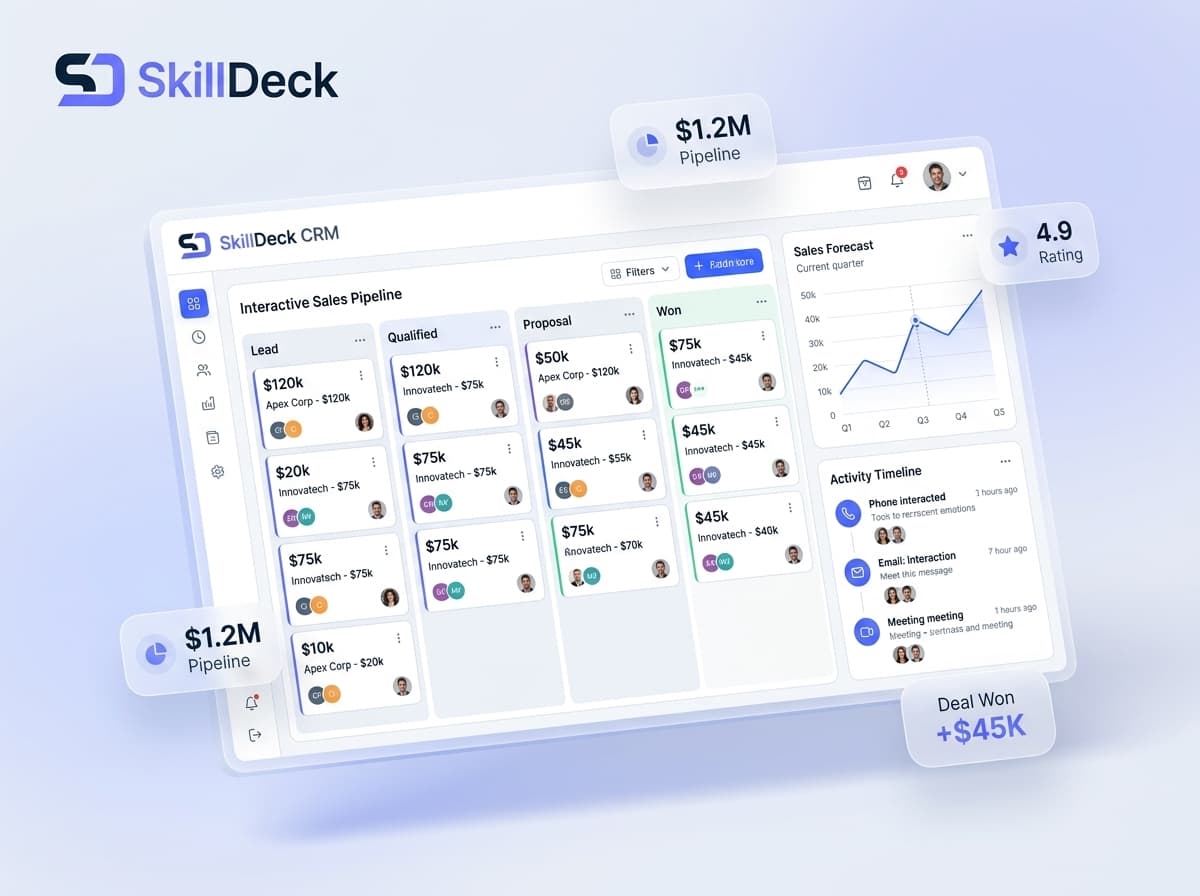
A CRM can provide a visual representation of how prospective students move through the admission process.
A typical pipeline might include:
New Enquiry → Contacted → Counselling → Interested → Follow-Up → Registration → Enrolled
Institutes can customize these stages according to their own admission process.
Pipeline visibility can help management understand where prospects are progressing and where potential admissions are being lost.
7. Course and Batch Tracking
Coaching institutes often operate multiple courses and batches simultaneously.
A CRM can connect prospects with their preferred course, schedule, learning mode, and batch.
This can help counsellors quickly identify alternatives when a student's preferred batch is full or unavailable.
8. Communication History
A student may communicate with an institute several times before joining.
Recording previous interactions can give counsellors the context they need for future conversations.
The history may include:
- Calls
- Counselling discussions
- Information shared
- Follow-up outcomes
- Student questions
- Registration conversations
This reduces repetitive communication and helps different team members continue the conversation more effectively.
9. Lead Source Tracking
Marketing teams need to know where enquiries are coming from.
A CRM can associate prospects with their acquisition source, allowing institutes to compare different marketing channels.
For example, an institute may receive enquiries through search advertising, social media, organic traffic, referrals, and offline campaigns. Tracking these sources can help management understand which channels are contributing to meaningful admission opportunities.
10. Automated Communication
Routine communication can consume considerable time when handled manually.
CRM automation can support predefined messages for common situations such as enquiry acknowledgements, counselling confirmations, follow-up reminders, course information, and batch announcements.
Automation does not replace personal counselling. Instead, it can reduce repetitive communication and allow counsellors to concentrate on conversations requiring individual attention.
11. Lead Re-Engagement
Not every prospect is ready to enroll immediately.
Some students may postpone their decision because of exams, timing, budget, family discussions, or batch availability.
A CRM can retain these prospects so that the institute can reconnect with them when a relevant course or batch becomes available.
This makes older enquiries useful for future admission campaigns rather than allowing them to disappear from the database.
Benefits of CRM for Coaching Institutes
Organizes Admission Enquiries
A CRM provides a centralized location for prospective student information, making it easier for counsellors to manage their daily admission activities.
Improves Follow-Up Discipline
Scheduled activities and pipeline stages can reduce the possibility of promising enquiries being forgotten after the initial conversation.
Creates Better Counselling Context
Access to previous interactions and student preferences allows counsellors to continue conversations with greater awareness of the prospect's requirements.
Provides Admission Visibility
Management can monitor how many prospects are at different stages and identify bottlenecks in the admission process.
Helps Evaluate Marketing Channels
Lead-source information can show which campaigns and channels are generating enquiries and contributing to conversions.
Supports Counsellor Accountability
Centralized activity records can help managers understand enquiry distribution, follow-up activity, and admission performance across the counselling team.
Extends the Value of Old Leads
Historical enquiries can be re-engaged when new batches, courses, schedules, or promotional campaigns become available.
Challenges and Limitations
CRM software can significantly improve admission management, but coaching institutes should also consider the practical challenges involved.
Initial Configuration
The CRM may need to be configured according to the institute's courses, admission stages, counsellor roles, lead sources, and follow-up process.
Data Quality
Incorrect or incomplete information can affect CRM reports and lead management. Teams need consistent processes for entering and updating prospect information.
Team Adoption
Counsellors need to use the CRM regularly. If staff continue maintaining separate personal spreadsheets or records, the organization may not receive the full benefit of centralized data.
Existing Data Migration
Institutes already using spreadsheets or older systems may need to clean and organize historical enquiry records before transferring them into a new platform.
Integration Requirements
Some coaching businesses may want their CRM connected with websites, lead forms, LMS platforms, marketing systems, communication tools, or payment processes. Depending on the existing technology environment, integration may require additional configuration.
How to Choose the Best CRM for a Coaching Institute
Before selecting a CRM, institutes should evaluate their actual admission workflow rather than focusing only on the number of features offered.
1. Understand Your Enquiry Process
Map the journey from the first enquiry to enrollment. Identify how leads arrive, how they are assigned, how counselling happens, and how follow-ups are handled.
2. Evaluate Lead Management
Check whether the platform can capture enquiries, maintain prospect profiles, categorize leads, assign counsellors, and track current status.
3. Review Follow-Up Tools
Look for scheduling, reminders, activity tracking, and visibility into pending follow-ups.
4. Examine Reporting
The CRM should help management understand enquiry volume, admission stages, counsellor activity, lead sources, and conversion patterns.
5. Check Automation
Evaluate whether repetitive communication and workflow activities can be automated without removing the personal element of student counselling.
6. Consider Scalability
The system should be able to accommodate additional courses, counsellors, batches, campaigns, and student enquiries as the institute grows.
7. Look at the Complete Training Ecosystem
A coaching institute may require more than CRM functionality. Consider whether the platform can connect admissions with the website, LMS, marketing, student management, and other business operations.
Why Skilldeck Is a Strong Choice for Coaching Institutes
CRM works best when it is connected to the wider operations of a training business instead of functioning as an isolated sales application.
Skilldeck brings together website, LMS, CRM, and marketing capabilities within one platform designed for training businesses. This integrated approach can help coaching institutes reduce fragmentation between student acquisition, learning operations, and business management.
Connected Admission and Training Operations
A coaching institute can manage prospective students, courses, admissions, learning activities, and business operations within a more connected environment.
This can make it easier to move from an initial enquiry toward enrollment and then into the learner's training journey.
Automation for Admission Teams
Routine admission activities can require significant staff time. Automation can help with lead workflows, notifications, follow-up activities, and other repetitive processes.
This allows counsellors to spend more time on student conversations instead of manually coordinating every administrative step.
CRM Alongside Website and Marketing
When CRM, website, and marketing functions operate in disconnected systems, information can become fragmented.
Skilldeck's broader platform approach allows training businesses to connect their marketing and website activities with CRM and learning operations, creating a more unified business environment.
Scalable for Growing Institutes
As a coaching institute expands its courses, batches, counsellor teams, and marketing campaigns, managing separate applications for every new requirement can increase complexity.
A centralized platform can provide a foundation that grows alongside the training business.
Reduced Technology Burden
Managing CRM, LMS, website, marketing automation, hosting, integrations, updates, and multiple software vendors independently can create additional technical responsibilities.
Skilldeck promotes an all-in-one approach that combines key training-business functions and aims to reduce dependence on multiple disconnected tools.
Cost Efficiency
Using separate platforms for CRM, website management, learning management, marketing, and automation can result in multiple subscriptions and additional integration requirements.
An integrated platform can potentially reduce this fragmentation. Institutes should still review current pricing, features, plan limitations, and implementation requirements before making a final decision.
Traditional Lead Management vs. CRM for Coaching Institutes
Area | Traditional Approach | CRM-Based Approach |
|---|---|---|
Enquiry Capture | Scattered across sources | Centralized |
Lead Assignment | Manual | Structured |
Student Information | Spreadsheets | Unified profiles |
Follow-Ups | Personal reminders | Scheduled activities |
Counselling History | Separate notes | Centralized record |
Admission Pipeline | Manual tracking | Stage-based tracking |
Lead Sources | Difficult to compare | Trackable |
Old Enquiries | Easily overlooked | Available for re-engagement |
Reporting | Manual preparation | Centralized reporting |
Team Visibility | Limited | Shared visibility |
Final Verdict
The best CRM for coaching institutes should do more than maintain contact information. It should help manage the complete prospect journey from the first enquiry and counselling conversation to follow-ups, registration, admission, and future engagement.
Manual lead management may work when enquiry volumes are small. As a coaching business grows, however, scattered information and inconsistent follow-ups can make it difficult to maintain admission efficiency.
A dedicated CRM can provide a structured way to organize enquiries, assign counsellors, monitor admission stages, maintain communication history, evaluate marketing sources, and reconnect with prospective students who are not immediately ready to enroll.
Skilldeck provides a broader approach by combining CRM, LMS, website, and marketing capabilities for training businesses. This can help coaching institutes connect their admission processes with the wider learning and business ecosystem rather than managing each function through a separate tool.
For coaching institutes, the real value of CRM is not simply storing leads. It is creating a more organized and measurable student acquisition process while reducing repetitive administrative work. With the right CRM strategy and supporting technology, institutes can manage enquiries more effectively, give counsellors better information, and build a stronger path from initial interest to enrollment.