Learn how to measure corporate training ROI by defining objectives, calculating total costs, tracking business outcomes, and evaluating the financial value generated by employee training.

Corporate training requires investment in trainers, learning materials, employee time, technology, and programme administration. To understand whether that investment is worthwhile, organisations need to measure the results of training against its costs.
The return on investment (ROI) of corporate training measures the financial benefits attributable to a training programme relative to its total cost. However, completing a course or receiving positive participant feedback does not automatically mean that the training has improved business performance.
A reliable measurement process connects training objectives to business outcomes, records performance before and after training, calculates the full investment, and estimates the financial value of any improvement.
Corporate training ROI is the percentage return generated by a training programme compared with the cost of delivering it.
It helps organisations assess whether training has contributed measurable financial value, such as increased revenue, reduced operational costs, fewer errors, or improved productivity.
For example, a customer service training programme may help employees resolve enquiries faster. If the improvement reduces the cost of handling customer requests, the organisation can estimate the financial benefit and compare it with the cost of training.
ROI should not be confused with course completion, employee satisfaction, or assessment scores. These are useful indicators, but financial ROI requires measurable benefits and costs.
Start by identifying the business problem the training is intended to solve. Without a clear objective, it becomes difficult to determine which results to measure.
Increasing sales conversion rates.
Reducing customer service handling time.
Lowering the number of operational errors.
Reducing product defects or rework.
Shortening the time required for new employees to become productive.
Improving compliance with required procedures.
Choose an objective that connects learning to an observable business outcome.
For example, instead of setting the objective as “improve customer service skills,” define a target such as “reduce average enquiry resolution time while maintaining service quality.”
The specific target should be based on the organisation's actual needs and available performance data, not an arbitrary benchmark.
A baseline is the starting measurement used to evaluate whether performance changes after training.
Collect relevant data before the programme begins. The data should relate directly to the training objective.
Training objective | Baseline metric |
Improve sales performance | Conversion rate or sales per employee |
Reduce service delays | Average resolution time |
Improve operational accuracy | Error or rework rate |
Increase productivity | Output per employee or time per task |
Improve compliance | Number of process violations |
Use a consistent measurement period and definition for both baseline and post-training results.
For example, if the objective is to reduce processing errors, record the existing error rate before training. After the programme, measure the same type of errors using the same method.
Without baseline data, organisations may struggle to determine whether the observed improvement represents a genuine change.
A meaningful ROI calculation must include the full cost of delivering the programme, not just the invoice from an external training provider.
Trainer or vendor fees: Charges for instructors, consultants, or external training providers.
Content development: Costs of designing or adapting training materials.
Learning technology: Relevant LMS licences, virtual training tools, or content subscriptions.
Employee time: The cost of employee hours spent attending training.
Internal administration: Staff time spent coordinating sessions, registrations, and reporting.
Facilities and logistics: Venue, travel, equipment, and materials where applicable.
Assessment and follow-up: Costs of evaluating learning and providing additional support.
Calculate employee time cost using an appropriate hourly employment cost.
For example, if 30 employees attend eight hours of training and their average employment cost is ₹500 per hour:
Employee time cost = 30 × 8 × ₹500 = ₹1,20,000.
Add this amount to the other relevant expenses. Avoid counting the same cost twice if it is already included in another category.
Total training cost = All relevant programme expenses, including participant time.
After the programme, measure whether employees have applied what they learned and whether the targeted business metric has changed.
Use different types of evidence depending on the training objective.
Pre-training and post-training assessments
Practical skill demonstrations
Knowledge checks
Completion of required learning modules
Manager observations
Quality reviews
Changes in task completion time
Accuracy of work
Use of the trained process or skill
Revenue changes
Reduced operating costs
Lower error-related expenses
Reduced rework
Productivity improvements
Allow sufficient time for employees to apply their learning. A technical training programme may need time before its effects appear in operational results, while some process changes may be measurable sooner.
The measurement period should reflect the nature of the training and the business process being evaluated.
The next step is to estimate the monetary value of the improvement linked to the training programme.
The method depends on the business outcome.
Suppose employees make fewer errors after completing process training. Calculate the reduction in errors and multiply it by the average cost of correcting each error.
Errors before training: 200 per month
Errors after training: 140 per month
Reduction: 60 errors per month
Average correction cost: ₹400 per error
Estimated monthly savings = 60 × ₹400 = ₹24,000.
If the improvement continues for six months, the estimated gross savings over that period are ₹1,44,000, assuming the monthly reduction and correction cost remain consistent.
Suppose employees spend less time completing a routine task after training.
Measure the time saved, estimate the value of that time using an appropriate employment cost, and determine whether the saved capacity creates a genuine business benefit.
Time saved should not automatically be treated as cash savings. The organisation must establish whether it reduces overtime, increases productive output, or avoids another measurable cost.
If sales training improves conversion rates, estimate the additional revenue attributable to the improvement and use an appropriate contribution margin or profit measure when calculating financial benefit.
Avoid treating all additional revenue as profit. Account for relevant costs and consider other factors that may have influenced sales.
[
\text{ROI (%)} =
\frac{\text{Benefits}-\text{Costs}}
{\text{Costs}}\times100
]
Benefits are the financial benefits attributed to the training programme.
Costs are the total costs of delivering and evaluating the programme.
Net benefit is the difference between attributable benefits and total costs.
Assume a company spends ₹2,00,000 on a training programme. After measuring the results, it estimates that ₹3,20,000 in financial benefits can reasonably be attributed to the training.
Calculation | Amount |
Attributable financial benefits | ₹3,20,000 |
Total training cost | ₹2,00,000 |
Net benefit | ₹1,20,000 |
ROI | 60% |
[
\frac{₹3,20,000-₹2,00,000}
{₹2,00,000}\times100=60%
]
The programme generated an estimated net benefit equal to 60% of its cost during the measured period.
This result depends on the accuracy of the cost and benefit estimates. It should not be presented as proof that training alone caused the entire improvement unless the evaluation supports that conclusion.
Business performance can change for reasons unrelated to training. Sales may improve because of a new campaign, error rates may decline after a software update, or productivity may increase because of changes in staffing.
Comparison groups: Compare trained employees with a similar group that did not receive the same training, where practical.
Before-and-after trends: Review performance over a suitable period before and after training.
Manager and participant estimates: Ask informed stakeholders to estimate the share of improvement attributable to training, documenting the assumptions used.
Adjustment factors: Apply a conservative attribution percentage when the training's exact contribution cannot be established.
For example, if an estimated improvement is worth ₹3,20,000 but the evaluation suggests that only 70% is attributable to training, use ₹2,24,000 as the attributable benefit in the ROI calculation.
Document how the attribution percentage was determined. A transparent estimate is more useful than claiming that all improvements resulted from training.
Not every valuable training outcome can be converted reliably into money. Leadership development, communication, teamwork, and employee confidence may create meaningful benefits that are difficult to quantify directly.
Participant reaction: Did employees find the training relevant and useful?
Learning: Did their knowledge or skills improve?
Workplace behaviour: Did they apply those skills on the job?
Business results: Did the intended operational or commercial metric improve?
Financial ROI: Did the attributable financial benefit exceed the programme cost?
This approach helps organisations understand not only the financial return but also why a programme did or did not deliver the intended results.
Report non-financial outcomes separately when there is insufficient evidence to assign them a defensible monetary value.
Accurate ROI measurement depends on having consistent training and performance records. When data is scattered across spreadsheets, attendance systems, learning platforms, and separate reports, collecting evidence can become time-consuming.
Employee enrolment and course completion
Assessment results
Learning progress
Training participation
Course and programme records
These records help establish whether employees participated in the programme and whether their learning improved. They should be combined with operational or financial data to establish business impact.
Skilldeck provides LMS capabilities for managing courses, learner records, assessments, and lesson-level progress. These features can support the collection of training data, although financial ROI still requires separate cost information, business performance metrics, and a credible method for attributing benefits.
Counting only direct fees: Excluding employee time and internal administration understates costs.
Using satisfaction as ROI: Positive feedback does not establish financial return.
Skipping baseline measurements: Without starting data, changes are difficult to verify.
Crediting every improvement to training: Other business changes may influence results.
Choosing irrelevant metrics: Course completion alone may not demonstrate business impact.
Ignoring the measurement period: Benefits and costs must be assessed over a clearly defined period.
Using unsupported monetary estimates: Financial assumptions should be documented and reasonable.
Measuring corporate training ROI requires a clear business objective, reliable baseline data, a complete cost calculation, measurable post-training outcomes, and a credible estimate of the financial benefits attributable to training.
Start with one programme and one or two relevant business metrics. Compare performance before and after training, account for other influences, and apply the ROI formula using documented assumptions. Where benefits cannot be reliably converted into money, report learning and workplace improvements separately.
The purpose is not simply to produce a positive percentage. It is to understand whether training delivered the intended value, where improvements occurred, and what should change in future programmes.
Skilldeck replaces 10+ software tools with one integrated, automated platform.

Skilldeck is a fully automated, budget-friendly plug-and-play solution designed for training institutes. It offers every essential feature needed to run and scale a training business, helping organizations accelerate growth with minimal effort and cost.
at a Fraction of the Cost
If you're seeking powerful tech and marketing automation that delivers results, Skilldeck is your go-to solution. Specifically built for training institutes, it offers everything you need in one place — from lead generation to operations — driving growth efficiently and affordably.
...and much more, all designed to scale your business effortlessly.
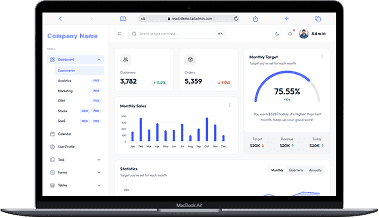
A perfect fit for someone who is getting started with a minimal budget, and looking for the premium features, UI/UX and scalability.
Training Institutes are finding Skilldeck.net quite useful, and are expediting their process & cutting down on the resources across all departments significantly. By reducing their expenses across all departments by at least 40%.
Skilldeck platform is developed by Manjunath Chowdary and team, Ex-Marketing head of Knowledgehut Upgrad, founder of KandraDigital Marketing solutions, and has built the tech and marketing strategies for various training companies.

Manjunath Chowdary
Founder & CEO, SkillDeck

Learn how to measure corporate training ROI by defining objectives, calculating total costs, tracking business outcomes, and evaluating the financial value generated by employee training.
Alex

Learn practical ways to improve student retention in training institutes through structured onboarding, engaging classes, regular progress monitoring, responsive support, and consistent communication.

Natasha
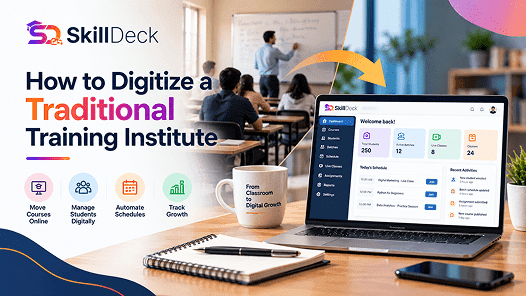
Learn how to digitize a traditional training institute using online learning, student management, automation, and digital marketing to simplify operations and support business growth.
Alex
Discover how virtual classroom software helps training institutes manage live classes, trainers, learners, attendance, communication, and online learning from one platform.
Natasha
Discover how training scheduling software helps providers manage courses, batches, trainers, calendars, sessions, and learner schedules while reducing administrative work.
Alex
Discover how certificate management software helps training companies automate certificate creation, verification, tracking, and delivery while reducing administrative work and improving the learner experience.
Natasha