Compare TalentLMS vs Docebo - Which Platform Is Better for Training Companies in 2026, institutes, and academies focused on scalable growth.

As digital learning continues to evolve, training companies, coaching institutes, academies, and enterprise learning providers need more than just an LMS. They require a complete operational ecosystem that can manage learners, automate workflows, scale training programs, and support business growth.
Two well-known platforms in the LMS market are TalentLMS and Docebo. Both have established themselves as capable learning management systems, but they serve different audiences and business needs.
In this detailed comparison, we'll examine TalentLMS vs Docebo across key areas including LMS functionality, automation, website management, scalability, pricing, and business operations. We'll also explore why many modern training organizations are moving toward comprehensive platforms like SkillDeck that combine LMS, CRM, CMS, automation, and marketplace visibility under one centralized system.
TalentLMS is a cloud-based LMS designed for organizations that need a straightforward way to deliver online training. It focuses on ease of use, rapid deployment, and employee training programs.
The platform is popular among small businesses and organizations looking for a simple learning management solution without extensive customization requirements.
Docebo is an enterprise-focused LMS that emphasizes AI-powered learning experiences, personalized training, and advanced learning delivery.
The platform is widely used by larger organizations seeking sophisticated learning management capabilities and enterprise-grade features.
Feature | TalentLMS | Docebo |
Learning Management | Strong | Advanced |
AI-Powered Features | Limited | Extensive |
Corporate Training | Excellent | Excellent |
Website Management | Basic | Limited |
CRM Functionality | External Tools Required | External Tools Required |
Business Operations Management | Minimal | Moderate |
Factor | TalentLMS | Docebo |
Entry Cost | Lower | Higher |
Enterprise Pricing | Moderate | Premium |
User-Based Scaling | Available | Available |
Additional Integrations | Often Required | Often Required |
Website Infrastructure | Separate Solution Needed | Separate Solution Needed |
CRM Costs | Additional Software | Additional Software |
Pricing may vary based on users, features, and organizational requirements.
When comparing LMS capabilities alone, both platforms perform well.
For organizations focused purely on content delivery, both platforms provide strong learning management capabilities.
However, many training businesses eventually discover that an LMS alone does not solve operational challenges such as lead management, admissions, website updates, marketing automation, student lifecycle tracking, and batch management.
One major limitation of both TalentLMS and Docebo is their reliance on external systems for CRM and business automation.
Most training organizations using these platforms need additional tools for:
This often creates fragmented workflows and operational complexity.
within a single platform.
Instead of connecting multiple third-party applications, training organizations can manage their entire student journey from inquiry to certification using one centralized system.
This significantly improves operational efficiency and reduces software costs.
A major difference between traditional LMS platforms and modern training business platforms is website management.
TalentLMS primarily focuses on learning delivery. Organizations typically require external website builders or CMS platforms for marketing websites.
Docebo provides branding options but is not designed as a dynamic website management platform.
for their public-facing websites.
This removes the dependency on drag-and-drop builders and enables institutions to manage large-scale content ecosystems efficiently.
For growing academies and training companies, this creates a significant operational advantage.
One area often overlooked when evaluating LMS platforms is discoverability.
TalentLMS helps deliver courses but does not provide marketplace visibility.
Docebo focuses on learning management rather than lead generation through marketplace discovery.
SkillDeck introduces an additional growth channel through its marketplace ecosystem.
For training businesses looking to grow enrollments, marketplace-driven visibility can become a valuable competitive advantage.
Scalability involves much more than increasing user counts.
Works well for straightforward training programs but may require additional systems as operations expand.
Handles enterprise learning environments effectively but still requires external tools for broader business management.
This makes it particularly suitable for institutes, academies, and training businesses operating at scale.
TalentLMS is widely recognized for simplicity and quick onboarding. Teams can start creating and delivering courses with minimal learning curves.
Docebo offers more sophisticated functionality, which naturally introduces greater complexity.
SkillDeck balances usability with operational depth.
Instead of managing multiple disconnected systems, teams work from a unified platform that centralizes learning, CRM, content management, automation, and operations.
This reduces administrative overhead while improving organizational efficiency.
Across industry discussions and user reviews, several themes emerge:
Users of both platforms frequently mention:
These challenges become more noticeable as organizations grow.
While TalentLMS and Docebo excel as learning management systems, SkillDeck addresses the broader operational needs of training businesses.
For organizations aiming to build a complete training business rather than simply deliver courses, these capabilities can significantly improve efficiency and growth potential.
The TalentLMS vs Docebo comparison ultimately depends on your organizational goals.
TalentLMS is an excellent choice for businesses seeking simplicity, quick deployment, and effective training delivery.
Docebo is ideal for enterprises requiring advanced learning experiences, AI-powered capabilities, and sophisticated training environments.
However, if your goal is to build and scale a modern training organization, academy, coaching institute, or learning business, a traditional LMS may not be enough.
SkillDeck offers a more comprehensive infrastructure by combining LMS functionality with CRM, CMS, automation, marketplace visibility, batch management, and operational workflows in a single platform.
For training businesses focused on sustainable growth, operational efficiency, and institutional scaling, SkillDeck provides a broader and more future-ready solution than TalentLMS or Docebo alone.
Skilldeck replaces 10+ software tools with one integrated, automated platform.
Skilldeck is a fully automated, budget-friendly plug-and-play solution designed for training institutes. It offers every essential feature needed to run and scale a training business, helping organizations accelerate growth with minimal effort and cost.
at a Fraction of the Cost
If you're seeking powerful tech and marketing automation that delivers results, Skilldeck is your go-to solution. Specifically built for training institutes, it offers everything you need in one place — from lead generation to operations — driving growth efficiently and affordably.
...and much more, all designed to scale your business effortlessly.
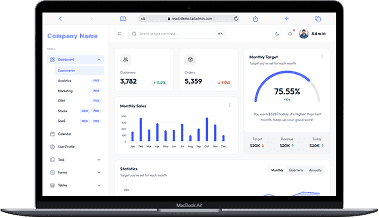
A perfect fit for someone who is getting started with a minimal budget, and looking for the premium features, UI/UX and scalability.
Training Institutes are finding Skilldeck.net quite useful, and are expediting their process & cutting down on the resources across all departments significantly. By reducing their expenses across all departments by at least 40%.
Skilldeck platform is developed by Manjunath Chowdary and team, Ex-Marketing head of Knowledgehut Upgrad, founder of KandraDigital Marketing solutions, and has built the tech and marketing strategies for various training companies.

Manjunath Chowdary
Founder & CEO, SkillDeck

Learn practical ways to improve student retention in training institutes through structured onboarding, engaging classes, regular progress monitoring, responsive support, and consistent communication.
Natasha
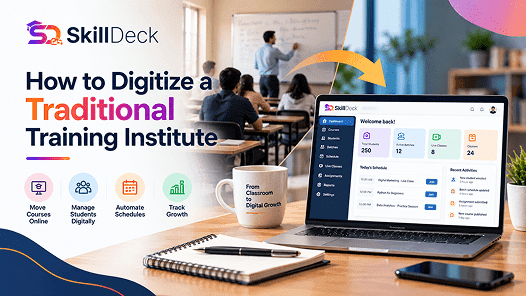
Learn how to digitize a traditional training institute using online learning, student management, automation, and digital marketing to simplify operations and support business growth.

Alex
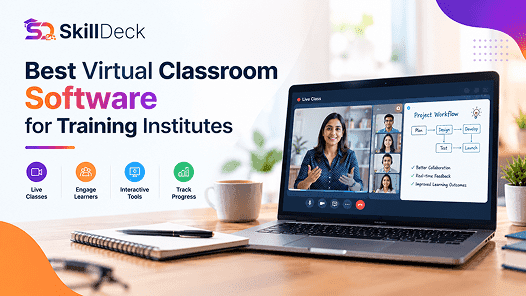
Discover how virtual classroom software helps training institutes manage live classes, trainers, learners, attendance, communication, and online learning from one platform.
Natasha
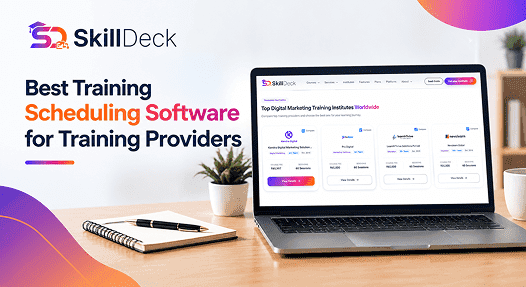
Discover how training scheduling software helps providers manage courses, batches, trainers, calendars, sessions, and learner schedules while reducing administrative work.
Alex
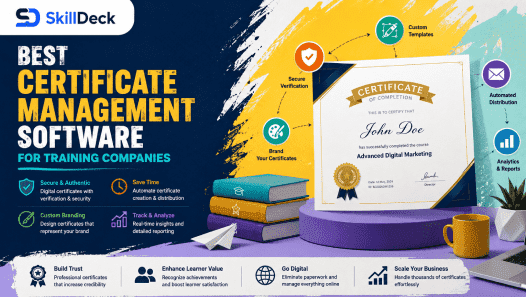
Discover how certificate management software helps training companies automate certificate creation, verification, tracking, and delivery while reducing administrative work and improving the learner experience.
Natasha
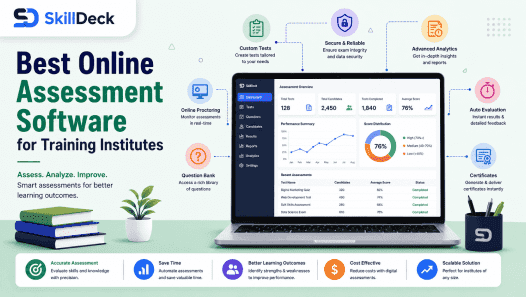
Explore how online assessment software helps training institutes create tests, evaluate learners, track performance, automate results, and improve training outcomes.
Alex