Compare Thought Industries vs Docebo - Which Platform Is Better for Training Companies in 2026, institutes, and academies focused on scalable growth.

The learning technology landscape is changing rapidly. Training companies are no longer searching for just an LMS. They need a complete business operating system that manages websites, enrollments, marketing, learners, instructors, operations, and growth.
This is where many organizations struggle while evaluating Thought Industries vs Docebo.
Both platforms are established players in the learning technology market. However, their approaches differ significantly, and neither fully addresses the operational complexity of modern training businesses.
Today's training institutes, academies, certification providers, and enterprise learning businesses require more than content delivery. They need an integrated ecosystem.
This is why many growing organizations are now considering platforms like SkillDeck, which combines LMS, CRM, CMS, automation, and marketplace capabilities into one centralized infrastructure.
In this article, we'll compare Thought Industries and Docebo while also exploring why SkillDeck is emerging as one of the strongest Thought Industries vs Docebo alternatives for institutional growth.
Thought Industries is a customer education platform designed primarily for external training programs. It focuses heavily on branded learning experiences, monetization, and delivering educational content to customers and partners.
It works well for organizations selling educational products and certifications.
Docebo is an AI-powered enterprise LMS focused on corporate training and workforce development.
It serves enterprises looking to train employees, partners, and customers at scale.
SkillDeck was built specifically for growing training businesses instead of simply delivering courses.
It centralizes every operational component into one platform.
Instead of connecting five to eight different tools, organizations operate from one unified system.
Feature | Thought Industries | Docebo | SkillDeck |
Dynamic Website Architecture | Limited | Limited | Advanced Dynamic System |
LMS Capabilities | Strong | Strong | Advanced |
Built-in CRM | Partial | Partial | Full CRM |
Marketplace Lead Generation | No | No | Available |
Batch Management | Basic | Limited | Advanced |
Multi-Team Operations | Moderate | Good | Enterprise Grade |
Pricing Factor | Thought Industries | Docebo | SkillDeck |
Entry Pricing Transparency | Custom | Custom | Flexible |
Additional Tool Dependency Cost | High | High | Low |
CRM Cost | Extra Integration | Extra Integration | Included |
Website Management Cost | Additional | Additional | Included |
Automation Cost | Additional Tools | Additional Tools | Included |
Total Ownership Cost | High | High | Cost Efficient |
Thought Industries excels at creating customer education experiences with strong monetization options.
Its course delivery engine is modern and highly customizable.
However, as training businesses expand, administrators often require additional systems for operational workflows.
Docebo provides a robust enterprise LMS with AI-powered recommendations and advanced learning pathways.
Large organizations appreciate its extensive integration ecosystem.
However, managing external websites, sales processes, and institute operations requires separate software.
SkillDeck approaches LMS differently.
Instead of functioning as a standalone LMS, it becomes the operational backbone of the entire organization.
Everything is connected to business operations.
Modern training businesses cannot survive with disconnected systems.
CRM functionality is dependent on integrations.
This increases operational complexity.
Docebo integrates well with enterprise CRM systems but doesn't replace them.
Companies still need multiple software subscriptions.
SkillDeck includes native CRM capabilities.
This significantly reduces software fragmentation.
This is one of the biggest differences.
Most training businesses underestimate the importance of website infrastructure.
Offers website customization but relies heavily on predefined structures.
Advanced modifications often require technical resources.
Website management is not a core product focus.
Organizations usually integrate external CMS platforms.
SkillDeck provides a dynamic website architecture.
Teams are not restricted by rigid page builders.
Content can be managed centrally.
Organizations can create:
All dynamically generated.
This improves operational efficiency and SEO scalability.
Lead generation is becoming one of the biggest challenges for training companies.
Neither Thought Industries nor Docebo offers marketplace exposure.
SkillDeck introduces a marketplace ecosystem.
This transforms the platform from an LMS into a growth engine.
Scales customer education programs effectively but becomes dependent on external tools.
Scales enterprise learning exceptionally well.
SkillDeck was designed for institutional scaling.
Everything runs through one centralized system.
This is especially valuable for fast-growing training businesses.
Area | Thought Industries | Docebo | SkillDeck |
Initial Setup | Moderate | Complex | User Friendly |
Team Collaboration | Good | Good | Excellent |
Workflow Centralization | Moderate | Moderate | Excellent |
Learning Curve | Medium | High | Medium |
Administrative Efficiency | Moderate | Good | Excellent |
Across various review platforms and user discussions, common observations emerge.
The biggest shift happening is that organizations are moving away from purchasing isolated software products.
They want one platform that operates their entire business.
While Thought Industries and Docebo remain excellent LMS products, they still require additional systems for complete operational management.
SkillDeck closes this gap.
SkillDeck brings everything together under one ecosystem.
This reduces costs, simplifies operations, and accelerates institutional growth.
For organizations evaluating Thought Industries vs Docebo alternatives, SkillDeck presents a stronger long-term business infrastructure.
Best for customer education businesses selling learning experiences.
Best for enterprise workforce training.
Best for training companies, institutes, academies, and enterprise learning businesses that need a complete operational ecosystem.
If your goal is not just delivering courses but building a scalable training organization, SkillDeck offers a far more comprehensive foundation.
The future belongs to centralized platforms, and SkillDeck is built specifically for that future.
Skilldeck replaces 10+ software tools with one integrated, automated platform.
Skilldeck is a fully automated, budget-friendly plug-and-play solution designed for training institutes. It offers every essential feature needed to run and scale a training business, helping organizations accelerate growth with minimal effort and cost.
at a Fraction of the Cost
If you're seeking powerful tech and marketing automation that delivers results, Skilldeck is your go-to solution. Specifically built for training institutes, it offers everything you need in one place — from lead generation to operations — driving growth efficiently and affordably.
...and much more, all designed to scale your business effortlessly.
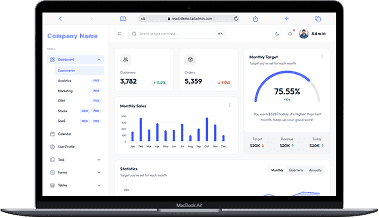
A perfect fit for someone who is getting started with a minimal budget, and looking for the premium features, UI/UX and scalability.
Training Institutes are finding Skilldeck.net quite useful, and are expediting their process & cutting down on the resources across all departments significantly. By reducing their expenses across all departments by at least 40%.
Skilldeck platform is developed by Manjunath Chowdary and team, Ex-Marketing head of Knowledgehut Upgrad, founder of KandraDigital Marketing solutions, and has built the tech and marketing strategies for various training companies.

Manjunath Chowdary
Founder & CEO, SkillDeck

Learn practical ways to improve student retention in training institutes through structured onboarding, engaging classes, regular progress monitoring, responsive support, and consistent communication.

Natasha
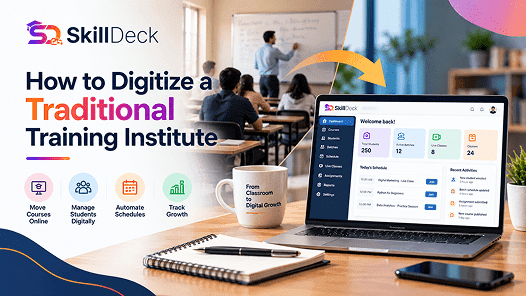
Learn how to digitize a traditional training institute using online learning, student management, automation, and digital marketing to simplify operations and support business growth.
Alex
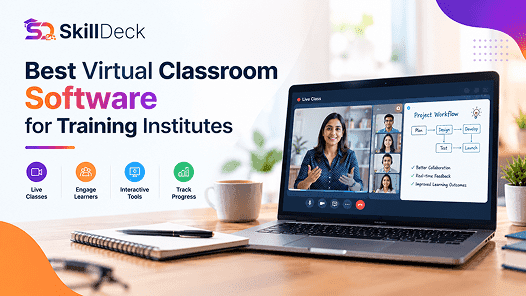
Discover how virtual classroom software helps training institutes manage live classes, trainers, learners, attendance, communication, and online learning from one platform.
Natasha
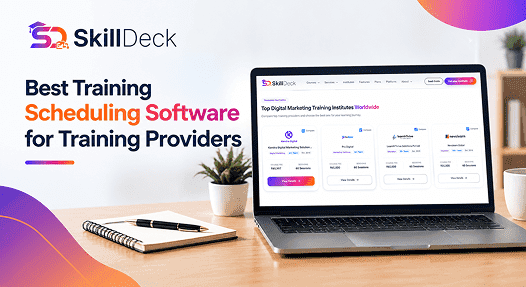
Discover how training scheduling software helps providers manage courses, batches, trainers, calendars, sessions, and learner schedules while reducing administrative work.
Alex
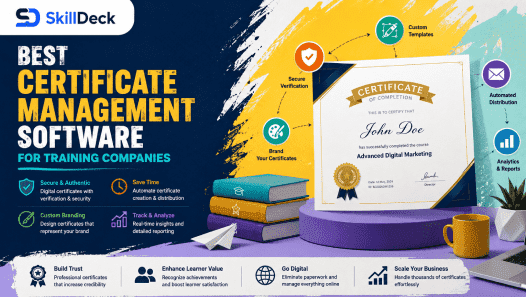
Discover how certificate management software helps training companies automate certificate creation, verification, tracking, and delivery while reducing administrative work and improving the learner experience.
Natasha
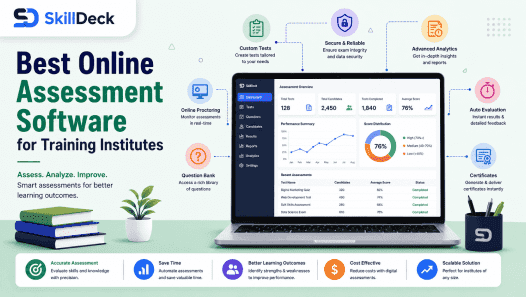
Explore how online assessment software helps training institutes create tests, evaluate learners, track performance, automate results, and improve training outcomes.
Alex