
A training company can have experienced instructors, well-designed courses, and a strong learning environment, but these strengths only create business opportunities when the right audience knows about them. Marketing plays an important role in connecting training providers with potential learners. For training companies, marketing involves much more than running advertisements. It can include understanding learner audiences, positioning courses, creating useful content, building digital visibility, generating enquiries, nurturing prospects, promoting programs, and measuring which activities contribute to enrollment. This makes marketing an ongoing business function rather than a one-time promotional activity. Marketing Services for Training Companies help institutes, academies, coaching centers, professional training providers, and EdTech businesses create a more structured approach to attracting and converting potential learners.
Why Training Companies Need Specialized Marketing
Marketing a training business is different from promoting many other types of products or services. A learner may spend considerable time researching a course before deciding to enroll. They may compare institutes, review course content, check instructors, consider fees, look for certification, and evaluate whether the program fits their career or learning goals. Because of this, training marketing needs to address different stages of the learner's decision-making process. A strong strategy can help a training business: Build awareness for its institute Increase visibility for individual courses Reach relevant learner segments Generate course enquiries Promote upcoming batches Build trust with potential learners Nurture prospects who are not ready to enroll Improve the flow from enquiry to admission Understand which marketing activities perform well The objective is to create a consistent connection between what the training company offers and what potential learners are searching for.
Start With a Clear Training Business Position
Before launching campaigns, a training company needs to understand what makes its offering relevant. A generic message such as "We provide quality training" may not communicate enough value. Marketing becomes more effective when the business can clearly explain: Who it serves What subjects it specializes in Which problems its courses address What type of learners it supports What makes its programs different Which learning formats it provides What outcomes learners can expect For example, a professional technology training company may position itself around practical technical training for career development, while a corporate training provider may focus on employee upskilling. Clear positioning gives marketing teams a stronger foundation for content, campaigns, landing pages, and promotional messages.
Understand the Learners You Want to Reach
Not every course is intended for the same audience. A training company may serve students, fresh graduates, working professionals, career changers, corporate teams, or experienced specialists. Understanding these audiences can help marketing teams create more relevant communication. Audience research can consider: Learning goals Current skill level Professional background Course interests Career objectives Preferred learning format Common questions Decision-making factors Training budget Enrollment timing The purpose is not simply to identify who might see an advertisement. It is to understand what motivates a potential learner to investigate a course and eventually make an enrollment decision.
Build a Strong Digital Presence
For many learners, digital channels are among the first places they encounter a training company. A professional digital presence can include the institute's website, course pages, social media profiles, educational content, landing pages, and other online channels. The information across these channels should work together. A potential learner should be able to move from discovering the institute to understanding its programs without encountering inconsistent or incomplete information. Important digital assets can include: Institute website Course landing pages Program pages Blog content Social media profiles Lead capture forms Webinar pages Course resources Testimonials and success stories Enquiry channels A connected digital presence gives marketing efforts a place to direct interested audiences.
Use Content to Build Learner Interest
Training businesses have a natural opportunity to use educational content as part of their marketing strategy. Instead of continuously promoting courses, institutes can create content that helps potential learners understand a subject. Content can include: Educational articles Skill guides Course explainers Instructor insights Short videos Learning tips Career-focused content Industry updates Webinar sessions Frequently asked questions Student experiences For example, an institute offering cybersecurity training could publish educational content explaining security concepts, career paths, certification options, and common beginner questions. A learner who discovers this content may later explore the institute's related training program. This creates a gradual relationship between content discovery and course interest.
Improve Course-Level Marketing
Marketing the training company as a whole is only one part of the process. Individual courses also need visibility. A course marketing strategy can focus on: Course topic Target learner Learning outcomes Curriculum Course format Duration Instructor Certification Projects or practical learning Upcoming batches Enrollment options Different programs can therefore have different marketing messages. A beginner course may focus on accessibility and foundational skills, while an advanced professional program may emphasize specialization and practical application. This course-level approach can make campaigns more relevant.
Generate Better Training Leads
Lead generation is an important part of training business marketing. However, the goal should not simply be to collect a large number of contacts. A useful lead-generation strategy aims to attract people who have genuine interest in the training company's programs. Potential lead-generation channels include: Course landing pages Search marketing Social media Educational content Webinars Online events Lead forms Course enquiries Promotional campaigns Referral activities Retargeting Once a prospect provides their information, the business needs a structured process for organizing and following up with that lead. This is where marketing and CRM operations need to work together.
Connect Marketing With Lead Management
A marketing campaign does not end when someone submits an enquiry. The prospect may need additional information, counselling, reminders, or a discussion with an admissions representative before deciding to enroll. Without a connected process, marketing-generated leads can become difficult to manage. A structured journey can look like: Marketing Campaign → Lead Capture → Lead Qualification → Counselling → Follow-Up → Enrollment Each stage provides useful information about the learner's progress. Marketing teams can understand which campaigns generate enquiries, while admissions teams can see where those prospects originated. This creates better visibility between marketing activity and enrollment outcomes.
Use Social Media Strategically
Social media can help training businesses remain visible to potential learners between enrollment cycles. However, effective social media marketing requires more than publishing course advertisements every day. Training companies can create a combination of content types, such as: Educational posts Course announcements Instructor content Student stories Short tutorials Industry insights Webinar promotions Workshop announcements Learning tips Course-related videos This mix can help build audience interest while still providing opportunities to promote relevant programs. Social media can also provide useful signals about which topics attract attention and which content formats generate engagement.
Support Search-Based Learner Discovery
Many learners begin their research with a question or course-related search. They may search for a training institute, certification program, technical course, professional skill, or learning option. Search-focused marketing can help training companies become visible during this research stage. A strong search strategy can include: Course-focused website pages Educational blog content Search-friendly landing pages Relevant topic clusters Location-specific course information where appropriate Helpful FAQs Structured course information The objective should be to provide useful information rather than simply inserting keywords into pages. When content answers genuine learner questions, it can support both discovery and trust.
Promote Webinars and Educational Events
Webinars can serve as both learning experiences and marketing opportunities. A training company can organize sessions around subjects that potential learners are already interested in. For example, an institute may host a webinar about: Emerging technologies Career development Certification preparation Industry skills Interview preparation Professional development New learning trends The webinar can introduce participants to the institute's instructors and teaching approach. After the event, interested participants can receive relevant information about courses or upcoming programs. This creates a natural transition from educational engagement to potential enrollment.
Nurture Learners Who Are Not Ready to Enroll
Not every prospect enrolls immediately. Someone may enquire about a course today but plan to begin learning several months later. Another person may be comparing programs or waiting for a new batch. Instead of treating these prospects as lost opportunities, training companies can develop nurturing workflows. Nurturing can involve: Course updates Upcoming batch notifications Educational content Webinar invitations New program announcements Relevant learning resources Follow-up communication Re-engagement campaigns The communication should remain relevant to the learner's interests rather than becoming repetitive promotional messaging.
Promote New Programs More Effectively
Launching a new course requires coordination between product planning and marketing. Before the launch, the institute can create awareness around the subject. During the launch, marketing can communicate the course structure, benefits, instructors, and enrollment information. After the launch, the business can evaluate learner response. A structured launch process might involve: Audience Research → Pre-Launch Content → Course Announcement → Campaigns → Enquiries → Enrollment → Performance Review This approach gives marketing teams a repeatable framework for introducing new programs.
Use Promotions Without Depending Only on Discounts
Promotional offers can encourage learners to take action, but training companies do not always need to compete primarily on price. Marketing can highlight value through: Free orientation sessions Introductory classes Workshops Course bundles Early enrollment benefits Additional learning resources Practical projects Mentorship opportunities Flexible learning options The right promotional approach depends on the course and target audience. A professional learner may care more about the depth of the curriculum and practical application than a small discount.
Measure the Complete Marketing Journey
Marketing performance should be evaluated beyond impressions and clicks. Training companies can examine the journey from initial awareness to enrollment. Useful measurements may include: Website traffic Course page visits Content engagement Enquiries Qualified leads Counselling sessions Registrations Enrollments Conversion rates Cost per lead Cost per enrollment Campaign performance This helps businesses understand which activities contribute to actual growth. For example, a blog article may generate substantial traffic but few enquiries, while a webinar may attract fewer visitors but produce highly interested prospects. Both activities can have value, but their roles are different.
Marketing Challenges Faced by Training Companies
Training businesses often encounter challenges when marketing is managed without a structured system.
Fragmented Marketing Activities
Content, advertising, social media, email, and lead generation may be managed separately, making the overall strategy difficult to coordinate.
Unclear Lead Sources
When enquiries come through different channels, teams may struggle to identify which campaigns generated them.
Inconsistent Course Promotion
Different teams may describe the same course differently across marketing channels.
Weak Follow-Up
A marketing campaign can generate interest, but slow or inconsistent follow-up can reduce the chance of conversion.
Limited Performance Visibility
Without connected data, it can be difficult to determine which marketing activities contribute to enrollment.
How Skilldeck Supports Training Company Marketing
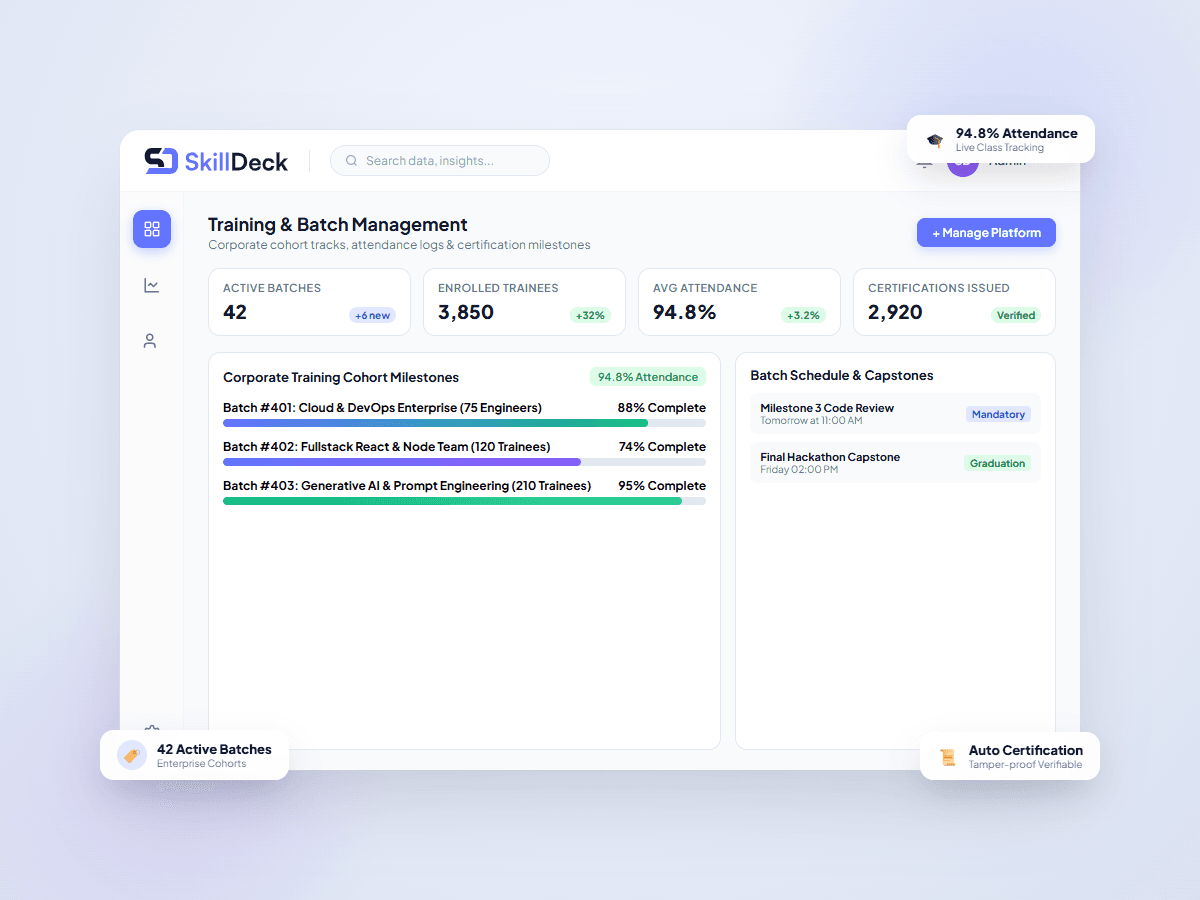
Skilldeck provides a broader digital environment that can help training companies connect their marketing activities with their operational workflows. Marketing can generate attention, but the resulting learner interest needs to move somewhere. Skilldeck can help connect areas such as: Marketing → Website/CMS → Lead Capture → CRM → Follow-Up → Enrollment → LMS This creates a more connected environment for training businesses. The CMS can support the institute's digital presence and course information. CRM capabilities can help organize learner enquiries and prospect interactions. LMS capabilities can support the learning experience after enrollment, while automation can reduce repetitive workflow tasks. For training companies, this means marketing does not have to operate as an isolated function. The broader goal is to create a connected digital journey from the first interaction with a potential learner through to enrollment and learning.
Choose Marketing Services Based on Business Goals
Not every training company requires the same marketing mix. An established institute may focus on improving its search visibility and increasing organic enquiries. A new academy may need brand awareness and initial lead generation. A professional training provider may focus on specialized course campaigns and corporate opportunities. Before selecting marketing services, businesses should identify their primary goals. These could include: Increasing brand awareness Generating course enquiries Filling upcoming batches Launching new programs Increasing website traffic Improving lead quality Expanding into new markets Re-engaging previous prospects Increasing enrollment Clear goals make it easier to decide which marketing activities deserve attention.
Build a Long-Term Marketing Engine
The strongest training marketing strategies are not built around a single campaign. A sustainable approach combines several activities that support one another. For example: Useful Content → Search Visibility → Social Engagement → Course Discovery → Enquiry → Follow-Up → Enrollment Over time, the business can learn which topics, campaigns, channels, and courses produce the strongest results. This creates a marketing system that becomes more informed as the training company grows. Instead of starting from zero every time a new course is launched, the institute can build on an existing audience, content library, marketing data, and lead-management process.
Final Thoughts
Marketing Services for Training Companies can help institutes move beyond occasional promotions and build a more structured approach to attracting learners. Digital presence, content marketing, social media, search visibility, campaign planning, lead generation, nurturing, and performance measurement can all contribute to a stronger learner acquisition process. The key is connecting these activities. Marketing should not stop at generating visibility. It should help move potential learners toward meaningful engagement, enquiries, counselling, and enrollment. With Skilldeck, training companies can connect their marketing presence with CMS, CRM, LMS, and automation capabilities, creating a more unified digital environment for managing the journey from audience discovery to learner enrollment and training.