A training company can offer excellent courses and experienced instructors, but potential learners still need to find the business online before they can consider enrolling. Search engines have become an important discovery channel for people researching courses, certifications, institutes, skills, and professional training programs. This makes search visibility an important part of a training company's digital growth strategy. SEO and backlink services can help training businesses improve how their websites appear in search results, strengthen their online authority, and attract visitors who are actively researching relevant learning opportunities. For training institutes, SEO is not simply about ranking for a few keywords. It involves creating useful content, improving website structure, building relevant external references, optimizing course pages, and developing a sustainable organic search presence.
What Are SEO & Backlink Services?
SEO services focus on improving a website's ability to be discovered through search engines. Backlink services focus on building relevant external references from other websites to useful pages on the training company's website. Together, these activities can support several important areas: Search visibility Organic website traffic Course discovery Website authority Brand awareness Referral traffic Learner enquiries Long-term digital growth For a training company, the strategy should be built around its courses, subject expertise, learner audiences, and business goals. A technical training institute, for example, may need a different SEO strategy from a management academy or a corporate training provider.
Why SEO Matters for Training Companies
Learners often begin their research before deciding which institute to contact. They may search for: Training institutes Specific courses Professional certifications Skill-development programs Course comparisons Learning resources Career-related questions Subject-specific information Online training options Classroom training programs If a training company's website does not appear when potential learners conduct these searches, competitors may receive that attention instead. SEO creates an opportunity to make the institute's courses and educational resources more discoverable during different stages of the learner's research journey.
Build Search Visibility Around Course Intent
One of the most important parts of training SEO is understanding what learners are actually searching for. A website should not target only broad terms related to "training." It can build visibility around different types of search intent. For example: Course Search: A learner is looking for a specific course or certification. Information Search: A learner wants to understand a particular subject. Comparison Search: A learner is comparing different learning options. Provider Search: A learner is looking for a training institute or provider. Enrollment Search: A learner is ready to enquire or register. Creating content and landing pages around these different intents gives training businesses more opportunities to appear throughout the learner journey.
Optimize Course Pages for Search
Course pages are some of the most valuable SEO assets for training companies because they directly represent the programs being offered. A well-optimized course page can clearly communicate: Course name Program overview Learning outcomes Curriculum Skills covered Course duration Eligibility Learning format Instructor information Certification Projects or practical learning Upcoming batches Enquiry options Search optimization should support the page's usefulness rather than interfere with readability. The learner should be able to understand the course naturally while search engines can identify the subject, purpose, and relevance of the page.
Create Content Around Learner Questions
Training companies have an advantage when developing SEO content because learners naturally have many questions about education and professional skills. A training business can create articles around questions such as: How do I start learning this skill? What should beginners know before taking this course? Which concepts should I learn first? What is the difference between two related technologies? How does a particular certification work? What skills are useful for a particular career? What projects can learners work on? Which learning format is suitable for this subject? These articles can attract people who are still researching their options. Some visitors may later explore the institute's relevant course pages, creating a natural connection between educational content and course discovery.
Build Topic Clusters Around Training Expertise
Instead of publishing unrelated articles, training businesses can organize content around their core areas of expertise. Suppose an institute specializes in data analytics. Its website could develop content around: Data analytics fundamentals Data visualization Analytics tools Beginner learning paths Industry applications Practical projects Certification preparation Career-oriented questions These related pages can create a broader topical structure around the subject. A similar approach can be applied to cybersecurity, cloud computing, software development, digital marketing, finance, management, design, or other training areas. The objective is to demonstrate depth rather than simply increase the number of blog posts.
Use Internal Links to Connect the Learning Journey
SEO is not limited to external backlinks. Internal linking can help connect related pages within the training company's website. For example: Educational Article → Related Guide → Course Page → Enquiry Page An article explaining a particular skill can link to a deeper guide. That guide can introduce a relevant course. The course page can then provide an enquiry or registration option. This structure helps visitors navigate related information while giving search engines clearer signals about the relationship between pages. Internal links can also help distribute attention across important sections of the website.
What Makes a Good Backlink?
A backlink is a link from another website to a page on the training company's website. However, not every backlink has the same value. For training companies, relevant backlinks can come from websites connected to areas such as: Education Technology Careers Professional development Industry publications Learning communities Business Specialized subject areas Relevance matters because the strongest external references are those that make sense within the surrounding content. A link from a relevant industry article can provide more meaningful context than a link placed on an unrelated website.
Use Guest Posting to Build Authority
Guest posting can be an important part of a backlink and authority-building strategy. Training companies can contribute original articles to relevant external publications and industry websites. For example, a cybersecurity training provider could contribute an educational article about security skills. A management training company could discuss leadership development. A technology institute could publish an article about practical learning in a specific technical field. The article should provide genuine value to the host audience. The training company can then benefit from: Brand exposure Referral traffic Expert positioning Relevant external references New audience discovery Greater online visibility This makes guest posting useful beyond simply acquiring links.
Build Backlinks Through Original Resources
Training companies can also create resources that other websites may naturally want to reference. Useful assets can include: Industry guides Learning roadmaps Skill checklists Educational reports Course comparison resources Glossaries Research summaries Training guides Practical tutorials Expert insights For example, an institute could create a detailed learning roadmap for beginners entering a technical field. If the resource is genuinely useful, other websites may reference it when creating their own educational content. This approach can help develop backlinks organically rather than relying entirely on outreach.
Improve the Authority of the Training Brand
Search visibility and brand authority can reinforce one another. When a training company consistently publishes useful content and earns relevant external references, it can become more recognizable within its subject area. Authority can be developed through: Expert-written articles Instructor contributions Industry publications Educational resources Guest articles Original insights Practical guides Consistent subject coverage For training companies, this is particularly valuable because learners are choosing an organization based partly on perceived expertise. The content itself becomes an opportunity to demonstrate that expertise.
Optimize for Local Training Searches
Training companies serving specific geographic markets can also consider location-based search intent. A learner may search for a course combined with a city, region, or local area. Location-focused pages can provide useful information about: Available training formats Local programs Batch information Classroom facilities Course availability Regional learner requirements However, location pages should contain meaningful information rather than simply changing the city name across duplicate pages. The goal should be to provide genuine local relevance.
Strengthen the Website Technical Foundation
Content and backlinks are important, but they work best when the website itself provides a strong foundation. Training companies should pay attention to areas such as: Page structure Mobile usability Website navigation Page loading experience Broken links Indexability Metadata URL structure Duplicate content Image optimization Clear internal linking A technically disorganized website can make it harder for users and search engines to navigate important course information. SEO should therefore consider the complete website rather than only blog content.
Create SEO-Friendly Training Resources
Training companies can turn their existing knowledge into resources that support organic search. An instructor's classroom explanation could become a detailed guide. A common student question could become a FAQ article. A course module could become an introductory learning resource. A webinar could become a series of educational articles. This creates a useful process: Instructor Expertise → Educational Resource → Search Visibility → Course Discovery It also reduces the need to constantly create completely new ideas because existing training knowledge can be transformed into valuable digital resources.
Target Different Stages of Learner Research
SEO can support learners at different points in their decision-making process.
Early Research
The learner is exploring a subject and wants basic information. Educational articles and beginner guides can address this stage.
Skill Research
The learner is trying to understand what skills or technologies they should learn. Learning roadmaps and skill guides can be useful.
Course Research
The learner is comparing programs and providers. Detailed course pages, comparisons, and program guides can support this stage.
Enrollment Intent
The learner is ready to contact an institute. Course landing pages, enquiry forms, batch information, and clear calls to action become important. This makes SEO a long-term acquisition channel rather than a tactic focused only on top-level website traffic.
Connect SEO With Content Marketing
SEO and content marketing should work together. SEO identifies opportunities based on search intent, website structure, and audience requirements. Content marketing provides the information that answers those requirements. For training companies, this relationship can look like: Search Intent → Topic Research → Content Creation → Optimization → Discovery → Course Interest Guest posting can then extend the strategy beyond the company's own website. This creates an ecosystem where owned content and external content support the same areas of expertise.
Track SEO Performance Beyond Rankings
Search rankings are useful, but they should not be the only measurement. Training companies can monitor: Organic traffic Course page visits Search impressions Click-through rates Ranking visibility Backlink growth Referral traffic Enquiries Lead sources Course conversions A page that ranks well but generates no meaningful learner interest may need a different approach from a page that brings highly relevant visitors. The ultimate objective is to connect search visibility with business outcomes.
Common SEO Challenges for Training Companies
Training businesses often face challenges when SEO is handled without a structured strategy.
Too Many Broad Keywords
Trying to compete for extremely broad terms can make it difficult to establish meaningful visibility.
Thin Course Pages
Pages containing only basic course details may not provide enough useful information for learners or search engines.
Duplicate Location Pages
Creating nearly identical pages for different locations can result in weak content quality.
Low-Quality Backlinks
Building large numbers of irrelevant links does not necessarily create meaningful authority.
Inconsistent Publishing
Publishing content randomly makes it harder to develop strong topic coverage.
Ignoring Existing Content
Older pages can often be improved instead of continually creating new content.
Refresh Existing Training Content
SEO growth does not always require publishing new articles every week. Training companies can review existing pages and identify opportunities to improve them. An older course page may need updated curriculum information. An educational article may benefit from additional examples. A guide may need new sections based on changing learner questions. An outdated resource may need revised information. This process can help the website maintain a stronger and more useful content library.
How Skilldeck Supports SEO Growth for Training Companies
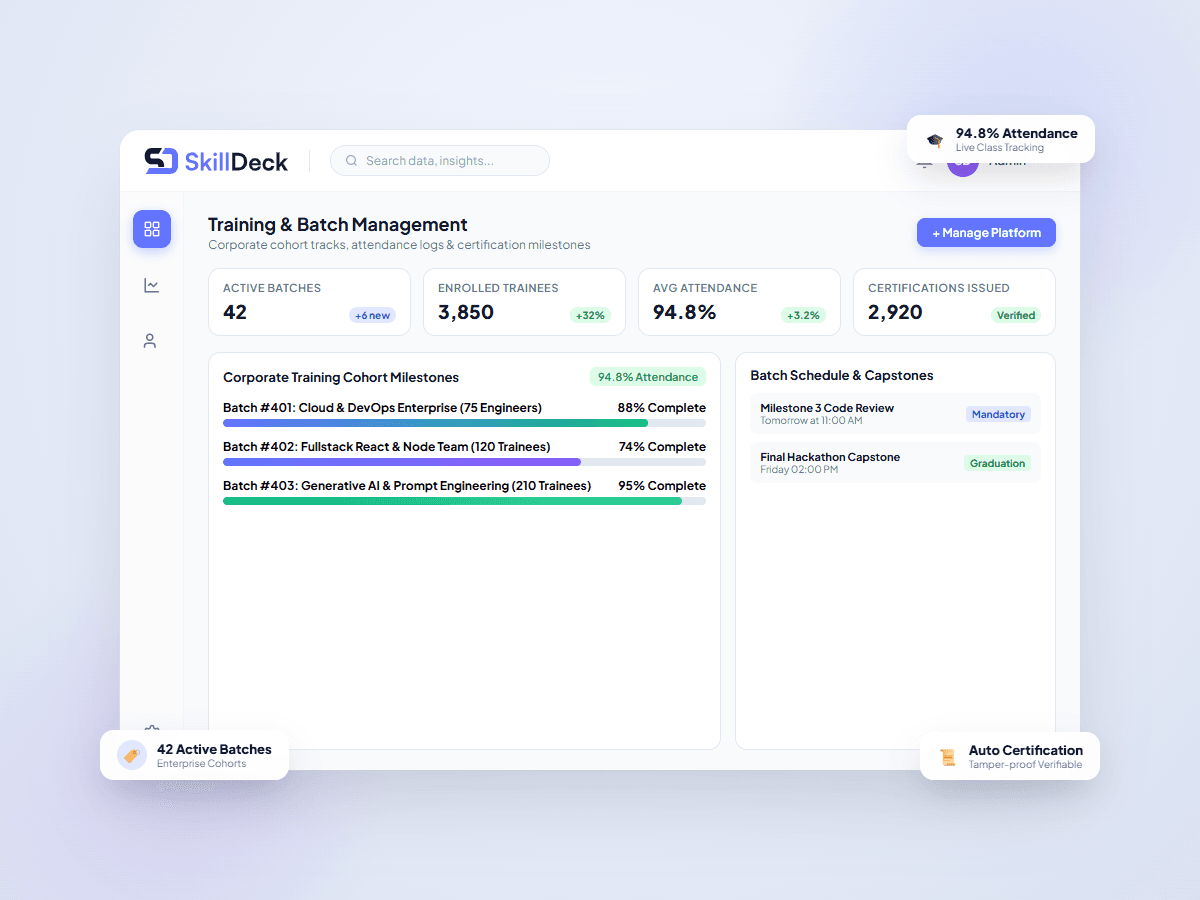
Skilldeck provides training businesses with a broader digital platform where their website, course information, learner enquiries, and training operations can work within a connected environment. SEO can bring a potential learner to the website, but the next stages of the journey are equally important. A typical journey can be: Search → Website → Course Discovery → Enquiry → CRM → Follow-Up → Enrollment → LMS Skilldeck's CMS capabilities can support the management of website and course content, while CRM functionality can help organize enquiries generated through organic search. LMS capabilities can then support the learner after enrollment. This creates a connection between organic visibility and the broader training business workflow. For training companies, this can reduce the gap between attracting website visitors and managing the learner relationships that result from that traffic.
Develop a Sustainable Backlink Strategy
Backlink development should be treated as an ongoing process rather than a one-time campaign. Training companies can build a sustainable strategy through: Relevant guest articles Expert contributions Industry relationships Original research Educational resources Digital PR opportunities Useful guides Partner references Professional communities The emphasis should remain on relevance and quality. A smaller number of meaningful references can support a stronger brand profile than a large collection of unrelated links.
Combine SEO With the Rest of Your Digital Strategy
SEO becomes more powerful when it is connected with other marketing activities. An article can generate organic traffic and then be promoted through social media. A webinar can create content opportunities. A course page can receive traffic from search, social, email, and referrals. A useful resource can earn external references while also supporting lead generation. This creates a connected digital strategy: SEO + Content + Backlinks + Social + Lead Generation + CRM Training businesses can therefore use SEO as a foundation that supports multiple acquisition channels.
Final Thoughts
SEO and backlink services can help training companies build stronger organic visibility, attract relevant learners, increase course discovery, and develop authority within their subject areas. Search-focused course pages, educational content, internal linking, guest posting, relevant backlinks, and technical optimization all contribute to a more complete SEO strategy. The objective should not be to chase rankings alone. A successful strategy should connect search visibility with useful learner experiences and measurable business opportunities. With Skilldeck, training companies can connect their SEO-driven website traffic with CMS, CRM, LMS, and automation capabilities, creating a structured journey from organic discovery to course enquiry, enrollment, and learning.