Training institutes often invest heavily in creating quality courses, building instructor teams, and delivering strong learning experiences. However, having good programs is only one part of growing a training business. Learners also need to discover those programs before they can consider enrolling. A Training Marketplace for Institutes creates an additional channel where training companies can showcase their courses and make them easier for prospective learners to find. Instead of depending entirely on an institute's own website, social media campaigns, or direct enquiries, a marketplace can bring different training offerings into a structured discovery environment. For institutes, this creates an opportunity to present courses to a broader audience, organize program information, highlight areas of specialization, and generate new enrollment opportunities. For learners, it provides a convenient way to explore different courses and compare available learning options based on their interests.
What Is a Training Marketplace for Institutes?
A training marketplace is a digital platform where training providers can list and promote their courses while learners discover programs that match their requirements. The marketplace can bring together offerings from multiple training institutes, academies, professional educators, and specialized training companies. Each provider can showcase information such as course name, subject area, duration, delivery format, eligibility, curriculum, instructor information, and other relevant details. Rather than functioning only as a course management system, the marketplace focuses on course discovery and provider visibility. For a training institute, this can mean having another digital presence where its programs can be presented to people actively looking for learning opportunities.
Why Institutes Need a Marketplace Presence
Building visibility for individual courses can be difficult when an institute relies on only one website or a limited set of marketing channels. A marketplace can complement existing marketing efforts by creating another place where courses can be discovered. Institutes can benefit from a marketplace presence when they want to: Introduce courses to new audiences Promote specialized training programs Generate additional learner enquiries Increase visibility for newly launched courses Showcase multiple programs in one place Reach learners outside their existing marketing network Create another channel for course discovery Support the promotion of online, offline, or blended programs This does not mean a marketplace replaces an institute's website or marketing strategy. Instead, it can work alongside those channels and give the institute another route to potential learners.
Turn Course Offerings Into Discoverable Listings
One of the most important aspects of a training marketplace is how courses are presented. A basic listing with only a course name provides limited information to a prospective learner. A well-structured marketplace listing can communicate the value and structure of a program before the learner contacts the institute. Institutes can organize important course information such as: Course title Course category Short description Detailed overview Skills covered Curriculum or modules Course duration Learning format Instructor information Eligibility requirements Certification details Available batches Pricing information Enrollment or enquiry options This structured approach helps learners understand what an institute offers without having to search through multiple pages or contact the institute for basic information.
Help Learners Find Relevant Training Programs
A marketplace becomes more useful when learners can navigate it according to their interests. Training providers can offer programs across different categories, while learners may arrive with very specific requirements. One person may be looking for a programming course, while another may want a professional certification, language program, management course, or technical skill. Organizing courses by relevant categories and attributes can make discovery easier. A marketplace can support discovery through areas such as: Course categories Skills Learning formats Training levels Professional domains Course duration Institute or provider Program type This creates a more structured discovery experience than simply publishing courses as isolated pages.
Give Training Institutes Their Own Marketplace Presence
A marketplace should not only promote individual courses. It can also help learners understand who is providing the training. An institute profile can provide space for information such as the organization's background, specialization, training areas, available programs, instructors, learning formats, and other relevant details. This is particularly useful for institutes that have multiple courses. For example, a technical training company may offer programs in cloud computing, cybersecurity, data analytics, software development, and related areas. Instead of presenting every course independently, its marketplace presence can connect these programs under the same provider. Learners can therefore discover a course and explore other offerings from the same institute.
Promote Different Types of Training Programs
A training marketplace can support different business models and course formats. Training companies may use the platform to promote:
Professional Certification Programs
Institutes offering certification-oriented programs can present course objectives, curriculum, duration, and certification information to learners looking to develop professional skills.
Career-Focused Training
Career training providers can showcase programs designed around job-oriented skills, industry knowledge, and professional development.
Technical Courses
Technology institutes can promote programs in areas such as software development, cloud technologies, data, cybersecurity, testing, and other technical disciplines.
Academic and Entrance Preparation
Coaching institutes can use marketplace listings to present preparation programs, subject-focused training, examination coaching, and structured learning programs.
Corporate and Professional Training
Training companies can showcase programs intended for employee development, leadership, communication, technical upskilling, and organizational learning.
Make New Courses Easier to Promote
Launching a new course usually requires more than creating the curriculum. The institute must also communicate that the program exists. A training marketplace can provide a structured location for newly introduced courses. Instead of building a separate promotional process from scratch every time a new program is launched, the institute can create or update its marketplace listing with relevant course information. This is useful for institutes that frequently introduce: New certification programs Seasonal courses New batches Short-term workshops Specialized skill programs Advanced-level courses New learning formats A consistent listing process can make course promotion more organized as the institute's catalog grows.
Support Course Discovery Beyond the Institute Website
An institute's website remains important because it provides complete information about the organization and its offerings. However, learners do not always begin their search by visiting a specific institute's website. Some start by looking for a type of course, skill, certification, or training program. This is where a marketplace model can provide additional value. Instead of asking learners to already know the institute's name, the marketplace allows training providers to participate in a broader discovery environment. A learner can discover a relevant program first and then explore the institute behind it. This changes the starting point from provider-first discovery to course-first discovery.
Connect Course Promotion With Enquiry Generation
Course visibility becomes more valuable when interested learners can take the next step easily. Marketplace listings can include enquiry or interest actions that allow prospective learners to request additional information. Depending on the platform's workflow, an enquiry can capture information such as: Learner name Contact details Course of interest Preferred learning format Location Preferred batch Additional requirements This information can then support the institute's admission or sales process. Instead of simply generating page views, the marketplace can become a source of structured learner opportunities.
Manage Course Information From One Place
Training businesses frequently update their programs. Course schedules change. New batches open. Pricing may be revised. Course descriptions may need improvement. New instructors may join. Programs can also be temporarily unavailable. Managing these changes across multiple promotional channels can become difficult. A centralized marketplace environment gives institutes a structured way to maintain their course information. Administrators can update relevant listings and keep important details organized. This reduces the likelihood of learners finding outdated information across different promotional materials. For growing training companies, this centralized approach becomes increasingly useful as the number of courses and providers increases.
Give Learners More Information Before They Enquire
A strong marketplace listing can answer many initial questions before a learner contacts the institute. For example, a prospective student may want to know: What does the course cover? Who is the course designed for? How long does the program take? Is it online or classroom-based? What skills will be developed? Is there an assessment? Is certification provided? When is the next batch? What does the program cost? Providing this information within the listing creates a more informed discovery experience. It can also help institutes receive enquiries from learners who already understand the basic characteristics of the course.
Build Visibility Across a Growing Course Catalog
Training businesses rarely remain limited to a single program. An institute may begin with a few courses and gradually expand into new technologies, professional categories, locations, or learner segments. As the catalog grows, managing visibility becomes more important. A marketplace can give each course its own discoverable presence while maintaining a connection to the institute's overall profile. This creates a scalable structure: Training Institute → Course Categories → Individual Programs → Learner Enquiries Such an arrangement can make a large training catalog easier to navigate for both administrators and learners.
Use Marketplace Data to Understand Course Interest
Promotion should not stop at listing a course. Training businesses can benefit from understanding which programs attract attention and generate enquiries. Marketplace-related data can help teams examine areas such as: Popular courses Frequently viewed programs Enquiry volume Course category interest Learner preferences High-performing programs Underperforming listings Demand across different offerings These insights can influence future course development and marketing decisions. For example, if one specialization consistently attracts more interest than related programs, the institute may decide to introduce an advanced version, create a workshop, or expand its course catalog around that subject.
Who Can Use a Training Marketplace?
A marketplace model can be useful for many types of training businesses.
Training Institutes
Institutes can showcase multiple programs and attract learners looking for structured training.
Coaching Centers
Coaching businesses can promote examination preparation, academic programs, and specialized coaching.
Professional Training Companies
Professional training providers can list certification and skill-development programs for working professionals.
EdTech Businesses
EdTech companies can use marketplace visibility to introduce digital learning programs to a wider learner audience.
Specialized Academies
Academies focused on areas such as design, technology, management, finance, or other professional skills can organize their offerings within a broader discovery environment.
Marketplace vs. Promoting Courses Independently
Area Independent Course Promotion Training Marketplace Course discovery Depends mainly on the institute's channels Courses can be discovered through a shared marketplace Provider visibility Focused on the institute's existing audience Can introduce the provider to new audiences Course organization Managed through individual website pages and campaigns Structured listings can organize multiple programs Learner comparison May require visiting multiple websites Multiple offerings can be explored within one environment Enquiry opportunities Generated through individual marketing channels Marketplace listings can become another enquiry source The two approaches do not have to compete. Institutes can maintain their own websites and marketing campaigns while using a marketplace as an additional discovery and promotion channel.
What to Look for in a Training Marketplace Platform
Before choosing a marketplace platform, training businesses should consider how well it supports their operational and promotional requirements. Important areas include:
Simple Course Listing Management
Administrators should be able to create, edit, organize, and update course listings without unnecessary complexity.
Institute Profiles
The platform should provide a meaningful way to present the training provider alongside its courses.
Search and Discovery
Learners should be able to navigate courses through relevant categories, subjects, skills, and other useful filters.
Lead and Enquiry Management
Interest generated through marketplace listings should be manageable rather than remaining disconnected from the institute's sales workflow.
Course and Learner Data
The platform should provide a structured environment for managing course information and learner interactions.
Scalability
The marketplace should continue to support the institute as its number of programs, learners, teams, and locations increases.
How Skilldeck Supports a Training Marketplace
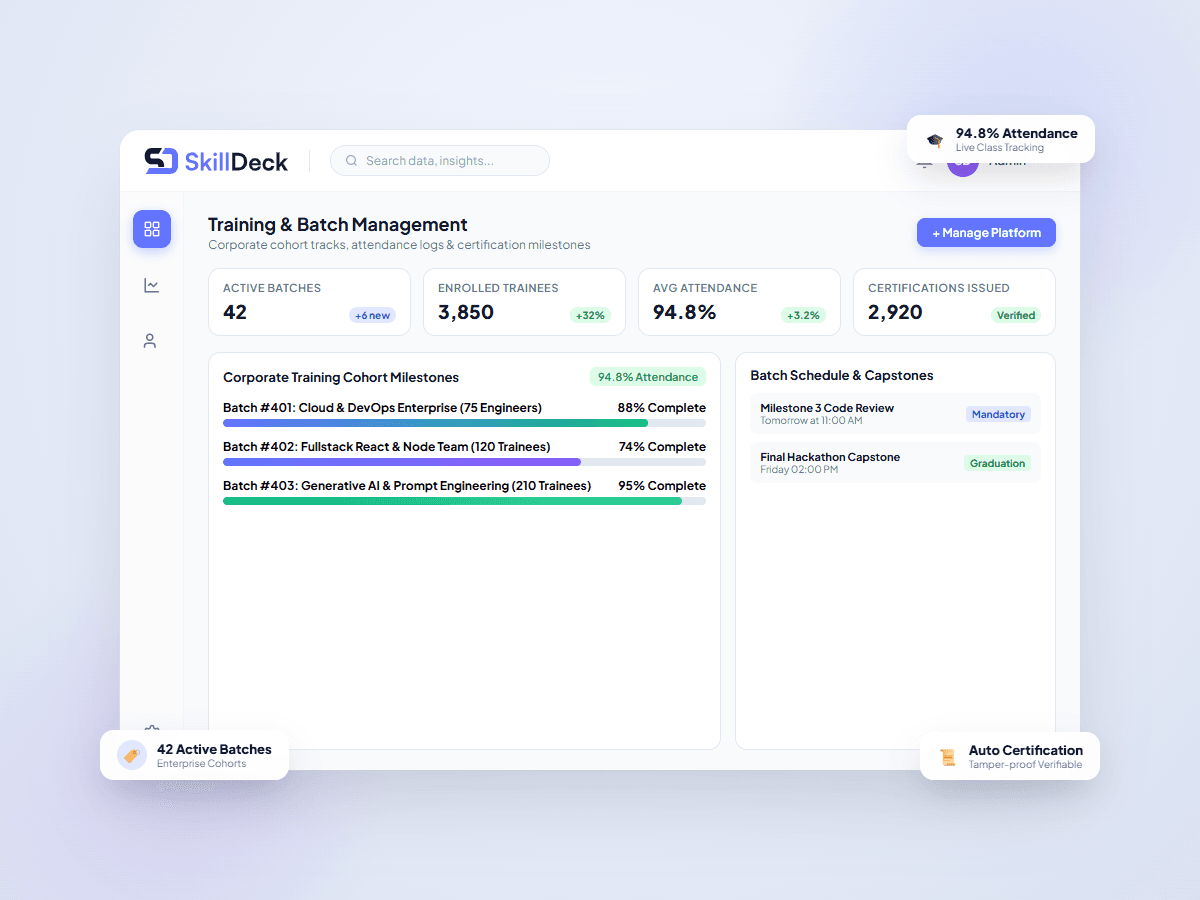
Skilldeck brings marketplace capabilities together with the broader technology requirements of training businesses. Instead of treating course promotion as a completely separate activity, Skilldeck can connect marketplace visibility with the systems institutes use to manage their operations. Training businesses can use the platform to organize course information, manage learner enquiries, maintain customer and student data, coordinate admissions, and connect marketplace activity with their wider learning operations. This is particularly useful for institutes that want more than a simple directory listing. A training business can build its course presence while also managing the workflows that happen after a learner shows interest. For example: Course Listing → Learner Discovery → Enquiry → Lead Management → Counselling → Enrollment → Learning Connecting these stages can reduce the gap between marketing and training operations. Skilldeck's broader LMS, CRM, CMS, and automation capabilities can also give training businesses a centralized technology environment rather than requiring multiple disconnected systems for different parts of their operations.
Turn Course Discovery Into a Repeatable Growth Channel
For training companies, sustainable growth depends on continuously bringing new learners into their programs. A training marketplace can become part of that process by creating a repeatable way to introduce courses to prospective learners. Instead of promoting every course only through individual campaigns, institutes can maintain a structured catalog that remains available for discovery. The long-term opportunity is not simply to publish more listings. It is to build a stronger connection between course visibility, learner interest, enquiry management, and enrollment operations. When these activities work together, course promotion becomes part of the institute's broader digital infrastructure.
Final Thoughts
A Training Marketplace for Institutes can give training companies a practical way to expand course visibility and create additional learner discovery opportunities. By bringing different programs into an organized marketplace, institutes can present their offerings more clearly while making it easier for learners to explore relevant training. For growing academies, coaching centers, professional training companies, and EdTech businesses, the value goes beyond listing courses. A well-connected marketplace can support the journey from discovering a program to submitting an enquiry and eventually becoming an enrolled learner. With Skilldeck, training businesses can combine course marketplace visibility with CRM, LMS, CMS, and automation capabilities, creating a more connected foundation for managing both course promotion and day-to-day training operations.