
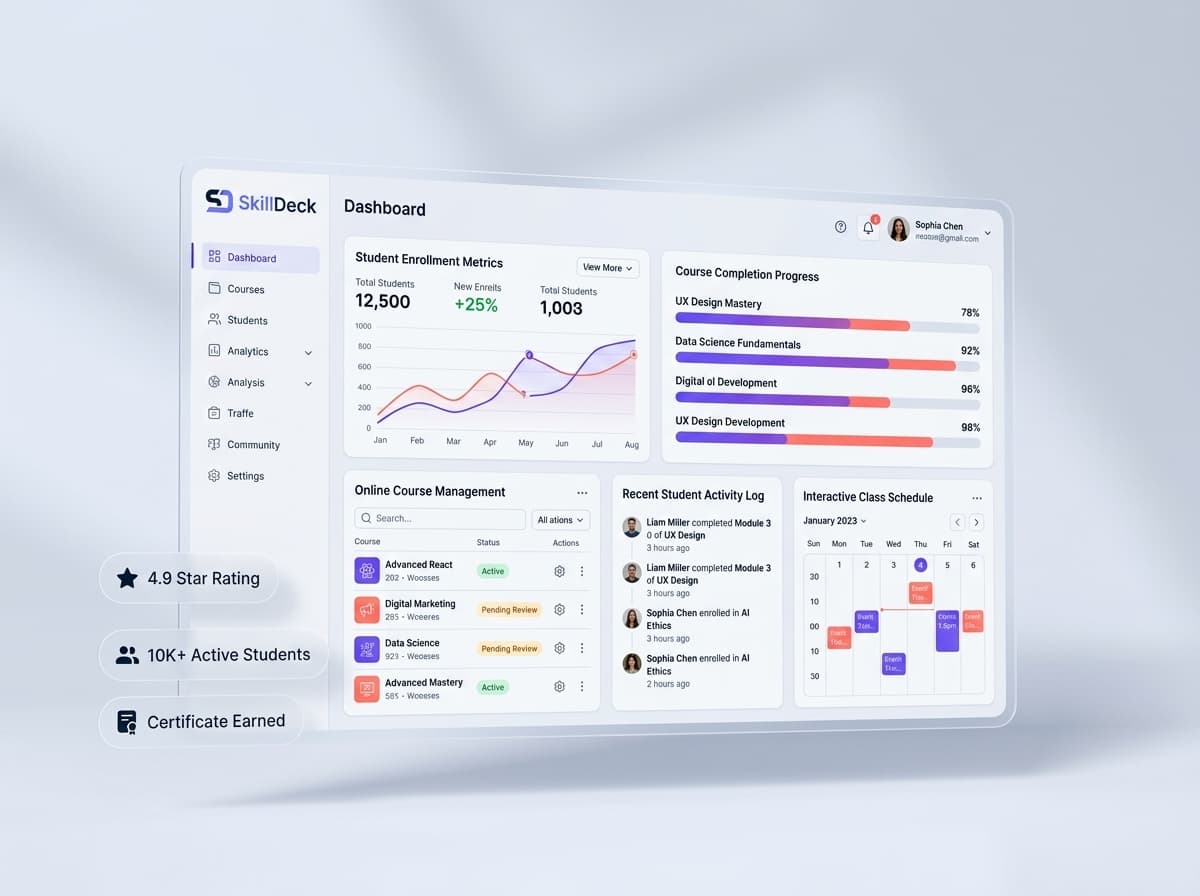
Attendance is one of the most important operational records for a coaching institute or training company. It helps organizations understand whether students are regularly participating in classes, whether batches are running as expected, and whether learners are maintaining the required attendance for their programs.
When attendance is recorded manually through registers, spreadsheets, separate applications, or trainer-maintained records, managing this information can become increasingly difficult as the number of students and batches grows.
Administrators may need to collect attendance from trainers, update student records, identify absentees, calculate attendance percentages, respond to attendance-related queries, and prepare reports for different batches. These activities can consume valuable administrative time and make it difficult to maintain consistent records.
This is where attendance management software becomes useful.
An attendance management platform can help training businesses record attendance, organize student participation data, monitor batch-level attendance, identify irregular attendance, and generate reports from a centralized system.
In this guide, we explore what attendance management software is, the important features training companies should consider, its benefits and limitations, factors to evaluate before choosing a platform, and how Skilldeck can help training businesses manage attendance alongside their wider training operations.
What Is Attendance Management Software?
Attendance management software is a digital system that helps organizations record, maintain, monitor, and analyze attendance information.
For training companies and coaching institutes, the software can connect attendance records with students, trainers, courses, batches, schedules, and learning activities.
Instead of maintaining attendance registers or manually updating spreadsheets after every class, administrators and trainers can manage attendance through a centralized digital system.
Typical functions include:
- Student attendance recording
- Batch-wise attendance
- Course-wise attendance
- Daily attendance tracking
- Trainer attendance management
- Attendance percentage calculation
- Absence monitoring
- Attendance reports
- Attendance history
- Late-arrival tracking
- Attendance notifications
- Student participation records
The exact features available will depend on the platform and the institute's requirements.
Why Do Training Companies Need Attendance Management Software?
Attendance becomes more complicated when a training business manages multiple courses, trainers, locations, and batches.
A single institute may have weekday and weekend batches, online and classroom sessions, different trainers, and hundreds of students. Maintaining accurate attendance across all these activities can become difficult without a structured system.
Manual attendance processes can create problems such as:
- Time-consuming data entry
- Missing attendance records
- Incorrect student information
- Difficult attendance calculations
- Delayed reporting
- Lost historical records
- Difficulty identifying frequent absences
- Duplicate or inconsistent records
- Additional administrative workload
A digital attendance system can bring these records into one place and provide administrators with easier access to attendance information.
Key Features of Attendance Management Software
1. Digital Attendance Recording
The foundation of an attendance platform is the ability to record student attendance digitally.
Instead of maintaining physical registers, trainers or authorized staff can mark attendance through the system.
Depending on the platform, attendance may be recorded according to the class, batch, date, session, or student.
This can help organizations:
- Reduce paperwork
- Standardize attendance recording
- Make records easier to access
- Reduce repetitive administrative work
The attendance process should remain simple enough for trainers to complete without interrupting the class.
2. Batch-Wise Attendance Management
Training businesses often operate several batches at the same time.
A useful system should allow administrators to view attendance according to individual batches.
For example, administrators may need to compare:
- Morning batches
- Evening batches
- Weekend batches
- Online batches
- Classroom batches
- Different course batches
Batch-level organization makes it easier to understand participation without searching through a single large attendance database.
3. Student Attendance History
A student's attendance should not only be visible for the current class.
The software should maintain historical records so that authorized users can review attendance over a specific period.
Historical information can help show:
- Classes attended
- Classes missed
- Attendance percentage
- Attendance trends
- Periods of irregular participation
This provides a more complete picture of a learner's participation.
4. Automatic Attendance Percentage Calculation
Manually calculating attendance percentages for hundreds of students can be unnecessarily time-consuming.
Attendance software can calculate percentages automatically based on recorded sessions.
For example, if an institute has defined attendance requirements for a particular course, administrators can quickly identify students who are approaching or falling below those requirements.
This reduces manual calculations and helps maintain consistency across batches.
5. Absence Monitoring
A good attendance system should make it easy to identify students who are repeatedly absent.
Rather than reviewing every attendance record individually, administrators can use attendance information to identify learners who require attention.
Absence monitoring can help institutes identify:
- Repeated absences
- Recent absenteeism
- Students with low attendance
- Attendance gaps
- Irregular participation
This can allow the institute to take action before attendance becomes a larger academic or operational issue.
6. Late Attendance Tracking
Some training organizations may need to distinguish between students who were present and those who arrived late.
Where supported, attendance software can maintain information about late arrivals according to the institute's defined policies.
This can be particularly useful for programs where regular participation and session punctuality are important.
7. Trainer and Staff Attendance
Attendance management does not always have to be limited to students.
Training businesses may also need to maintain attendance records for trainers and staff.
A centralized platform can help organizations maintain different attendance workflows for learners and employees, depending on the system's capabilities.
This can give management a broader view of attendance-related operations.
8. Attendance Reports
Reporting is important for organizations managing multiple batches.
Instead of manually preparing attendance summaries from registers or spreadsheets, administrators can generate reports from centralized records.
Reports may include:
- Student attendance reports
- Batch attendance summaries
- Course-level attendance
- Individual attendance history
- Absence reports
- Attendance percentages
- Trainer attendance
- Date-based attendance reports
The availability of specific reports will depend on the software.
9. Attendance Notifications
Attendance information becomes more useful when relevant people are informed at the right time.
Depending on the platform's communication capabilities, organizations may use notifications for attendance-related events.
Examples may include:
- Absence notifications
- Low-attendance alerts
- Attendance reminders
- Attendance-related communication
- Batch updates
This can reduce the need for administrators to communicate every attendance issue manually.
10. Integration with Course and Batch Information
Attendance should ideally be connected to the actual training structure.
A student enrolled in one course may belong to a specific batch, schedule, and trainer. Connecting these details can make attendance records more meaningful.
Attendance can be associated with:
- Student enrollment
- Course
- Batch
- Trainer
- Class schedule
- Session
- Learning program
This reduces the need to maintain separate attendance databases for different training activities.
11. Role-Based Access
Attendance records should be accessible according to organizational responsibilities.
For example, a trainer may need to mark attendance for their assigned batch, while an administrator may need access to broader reports.
Role-based access can help organizations control who can view, add, modify, or manage attendance information.
12. Centralized Attendance Records
One of the major advantages of digital attendance management is having attendance information in a centralized environment.
Instead of storing records across physical registers, individual spreadsheets, and different trainer files, the institute can maintain a consistent digital record.
This makes historical attendance easier to locate and can simplify administrative processes.
Benefits of Attendance Management Software
Reduces Administrative Work
Digital attendance recording can reduce repetitive paperwork and manual data entry.
Trainers and administrators can spend less time maintaining registers and preparing basic attendance calculations.
Improves Record Accuracy
Automated calculations and centralized records can reduce common manual errors such as incorrect totals, missing entries, and calculation mistakes.
Makes Attendance Easier to Monitor
Management can obtain a clearer view of student participation across courses and batches.
Identifies Irregular Attendance
Attendance information can help institutes identify students who are frequently absent or showing declining participation.
Simplifies Reporting
Centralized records can make it easier to generate attendance reports without compiling information from multiple sources.
Improves Student Follow-Up
When low attendance or repeated absence is identified, the institute can respond more quickly instead of discovering the issue much later.
Supports Growing Training Operations
A digital system can make attendance management easier to scale as the number of learners, courses, trainers, and batches increases.
Challenges and Limitations
Although attendance software can simplify daily operations, training companies should consider several practical factors before implementation.
Initial Setup
The system may need to be configured with students, courses, batches, trainers, schedules, attendance rules, and user roles.
Data Accuracy
The quality of attendance reports depends on accurate and timely attendance entries. If trainers do not update attendance consistently, the centralized system can still contain incomplete information.
Staff Adoption
Trainers and administrators need to become comfortable with the new attendance workflow. Poor adoption can reduce the effectiveness of the system.
Different Attendance Policies
Every training organization may have different rules for absence, late arrival, attendance requirements, makeup classes, or online participation. The selected system should support the institute's operational requirements.
Integration Requirements
Some businesses may want attendance to connect with LMS, CRM, scheduling, student management, or other systems. Integration requirements should be evaluated before implementation.
Additional Costs
Organizations should consider the complete cost of the solution, including setup, customization, integrations, support, users, and future requirements rather than looking only at the basic subscription price.
How to Choose the Best Attendance Management Software
Before selecting an attendance platform, training businesses should first understand their current attendance process.
1. Identify Attendance Requirements
Determine whether attendance needs to be managed by:
- Course
- Batch
- Student
- Trainer
- Session
- Location
- Learning format
This helps establish which capabilities are actually necessary.
2. Evaluate Ease of Use
Attendance is recorded frequently, so the process should be quick and straightforward for trainers and administrators.
A complicated interface can reduce staff adoption.
3. Check Reporting Capabilities
Make sure the system provides the reports management needs for students, batches, courses, and attendance percentages.
4. Review Access Controls
Consider which users should be able to mark, view, edit, or export attendance records.
5. Consider Integration
If the institute already uses an LMS, CRM, scheduling system, or student management platform, determine whether attendance can work alongside those systems.
6. Think About Scalability
The software should be capable of supporting additional students, batches, trainers, courses, and locations as the organization grows.
7. Compare Total Cost
Evaluate subscription charges alongside setup, support, integrations, customization, migration, and future expansion requirements.
Why Skilldeck Is a Strong Choice for Training Companies
Attendance management is only one part of running a coaching institute or training business. Student information, courses, learning activities, admissions, marketing, and business operations are closely connected.
Skilldeck takes an integrated approach by bringing together website, LMS, CRM, and marketing capabilities for training businesses. This can help organizations avoid creating separate technology environments for every part of their operation.
Connected Student Operations
Attendance becomes more useful when it exists alongside student and training information.
A connected platform can help organizations bring together areas such as:
- Students
- Courses
- Batches
- Learning activities
- Attendance
- Admissions
- CRM
- Marketing
- Business operations
This can reduce fragmentation and give training companies a broader operational view.
Automation
Manual attendance administration can involve repeated activities such as recording participation, calculating percentages, preparing reports, and following up on attendance issues.
Automation can reduce repetitive work and allow administrators to focus on activities that require direct attention.
Integrated Learning Environment
Because Skilldeck combines LMS and CRM capabilities with its wider training-business platform, attendance can be considered as part of the learner's broader journey rather than an isolated administrative record.
This integrated approach can be useful for organizations that want to connect student management with learning operations.
Performance-Oriented Platform
As the number of students and training activities increases, managing information across several disconnected applications can create additional operational complexity.
A centralized environment can help reduce unnecessary movement between systems and provide teams with a more consistent way to manage their information.
Easy to Market and Operate
Training businesses need to manage both learner operations and business growth.
With website, CRM, LMS, and marketing capabilities available within the broader Skilldeck ecosystem, organizations can connect student acquisition and learning operations instead of managing every function independently.
Scalable for Growing Training Businesses
A small institute may begin with a few batches and gradually expand into multiple programs, trainers, and locations.
Using an integrated platform can reduce the need to introduce separate systems whenever another operational requirement appears.
Minimal Technology Burden
Managing individual applications for attendance, CRM, LMS, website management, marketing, integrations, and infrastructure can create additional responsibilities for a training company.
Skilldeck promotes an all-in-one approach intended to reduce this technology fragmentation and the need for businesses to independently manage multiple systems.
Cost Efficiency
Separate software subscriptions for different training functions can increase technology costs and create additional integration requirements.
An integrated platform may help reduce this fragmentation, although organizations should evaluate current pricing, features, usage limits, and implementation requirements before making a purchasing decision.
Manual Attendance vs. Attendance Management Software
Area | Manual Attendance | Attendance Software |
|---|---|---|
Attendance Entry | Registers/spreadsheets | Digital recording |
Calculations | Manual | Automated |
Student History | Separate records | Centralized |
Absence Tracking | Manual checking | Easier monitoring |
Batch Management | Multiple files | Organized by batch |
Reports | Manually prepared | System-generated |
Data Access | Limited to records | Centralized access |
Record Search | Time-consuming | Faster retrieval |
Scalability | Difficult with growth | Easier to expand |
Administration | Higher workload | Reduced repetitive work |
Final Verdict
The best attendance management software should do more than replace a paper attendance register. It should help training companies maintain accurate student participation records, monitor attendance across batches, calculate attendance percentages, identify irregular participation, and generate useful reports.
Manual attendance can work for small training operations, but maintaining registers and spreadsheets becomes increasingly difficult as the number of learners, courses, batches, and trainers grows.
A digital attendance platform provides a more organized way to manage attendance while reducing repetitive administrative tasks. It can also give management better visibility into student participation and help teams identify attendance concerns earlier.
For training companies, integrating attendance with other student and learning operations can provide additional value. Instead of treating attendance as a completely separate administrative activity, organizations can connect it with courses, batches, student records, LMS operations, and broader business workflows.
Skilldeck offers an integrated approach by bringing together LMS, CRM, website, and marketing capabilities for training businesses. This can help organizations reduce dependence on multiple disconnected systems and manage their wider operations through a more centralized environment.
Ultimately, the right attendance management software should make attendance easier to record, simpler to monitor, and more useful for decision-making while reducing the administrative burden on trainers and institute teams.