Managing learning becomes significantly more complex when an organization operates across multiple countries, regions, offices, or markets. Different teams may follow different schedules, speak different languages, work in different time zones, and have training requirements influenced by local operations.
At the same time, the organization still needs consistency.
A global learning management system provides a centralized environment for delivering and managing learning across geographically distributed teams while giving regional groups the flexibility they need.
Instead of maintaining separate learning platforms for different locations, organizations can use a Global LMS to bring courses, learners, training programs, assessments, certifications, and reporting into one connected learning environment.
This makes it easier for global organizations to establish common learning standards while adapting delivery to regional requirements.
What Is a Global LMS?
A Global LMS is a learning management system designed to support training and learning operations across multiple countries, regions, locations, or distributed teams.
It provides a centralized framework for managing learning while accommodating differences in language, time zone, learner groups, departments, and regional training requirements.
For example, a company may have employees in India, the United States, the United Kingdom, Singapore, and Australia. Each location may have its own teams and operational requirements, but the organization may still want employees to complete common onboarding, product, technology, security, or professional development programs.
A Global LMS can provide the centralized infrastructure for managing those programs while allowing learning activities to be organized according to regional needs.
Why Organizations Need a Global LMS
International organizations often face a difficult balance between standardization and localization.
A completely centralized approach may not address regional requirements, while completely separate learning systems can create fragmented data and inconsistent processes.
A Global LMS helps bring these two needs closer together.
Organizations can use a global learning platform to:
- Deliver standardized corporate training
- Organize learners by country or region
- Support different departments and business units
- Provide localized learning content
- Manage distributed employee groups
- Track training across multiple locations
- Coordinate global onboarding
- Monitor compliance learning
- Manage certifications
- Compare learning activity across regions
- Centralize training information
- Give regional teams controlled access to relevant learning activities
This creates a common learning foundation without requiring every location to operate independently.
Core Capabilities of a Global LMS
1. Multi-Region Learner Management
A global organization may have thousands of learners spread across different countries and offices.
A Global LMS can organize learners according to relevant structures such as country, region, department, business unit, role, or team. This makes it easier to deliver the appropriate training to different groups.
Administrators can maintain a broader organizational view while regional teams can focus on the learners and programs relevant to them.
2. Country and Regional Organization
Training requirements can vary between locations.
The LMS should make it possible to structure learning operations around regional groups without creating completely separate systems.
For example, administrators may organize learners into geographical groups and assign relevant training programs based on their location or organizational responsibilities.
3. Multilingual Learning Support
Global learners may not share the same primary language.
Providing learning content in relevant languages can make training easier to understand and more accessible for employees across different markets.
A Global LMS can support organizations that need to manage multilingual courses, translated learning materials, or region-specific versions of training content.
4. Localized Course Delivery
Not every course needs to be identical across countries.
Organizations may need to adapt examples, policies, processes, or learning materials for particular markets.
A global platform can help maintain a common course framework while allowing relevant content to be tailored for different learner groups.
5. Time Zone-Aware Training Operations
Distributed teams often work across different time zones.
This becomes particularly important for scheduled training sessions, instructor-led programs, webinars, assessments, and learning deadlines.
A global LMS should help organizations manage training schedules in a way that reduces confusion for learners working in different locations.
6. Global Course Catalog
A centralized course catalog provides one place for managing the organization's learning library.
Courses can be organized by topic, department, role, region, skill area, or training requirement.
This allows employees to discover relevant learning while giving administrators greater control over the overall learning environment.
7. Region-Specific Course Access
Some learning programs may only apply to particular locations.
For example, a training program may be designed specifically for employees working in one country or business unit.
A Global LMS can help control course availability so that learners receive relevant programs rather than being presented with an unnecessarily large collection of unrelated content.
8. Global Onboarding
International organizations may need to provide both common and regional onboarding.
A global onboarding program can include organization-wide information such as company culture, security awareness, technology usage, and organizational policies.
Regional modules can then cover location-specific processes, workplace requirements, or operational information.
This creates a structured onboarding experience while preserving regional relevance.
9. Compliance Training
Compliance requirements can differ across countries and business units.
A Global LMS can help organizations manage mandatory training programs according to the requirements of different learner groups.
Administrators can monitor assigned training, completion status, pending requirements, and other learning information from a centralized environment.
10. Certification Tracking
Organizations may require employees to complete certifications as part of their roles.
A global learning platform can maintain certification information across different teams and locations.
This gives authorized administrators greater visibility into completed certifications and upcoming learning requirements.
11. Role-Based Learning
Employees in the same country may still have very different learning requirements.
A Global LMS can organize training based on job roles, responsibilities, departments, or skill requirements.
This helps organizations create learning journeys that are relevant to individual employee groups rather than relying on one generic training program.
12. Regional Administrator Access
Global learning operations often require multiple administrators.
A centralized LMS can provide appropriate access to global administrators, regional managers, trainers, and other authorized users.
This allows different teams to manage their responsibilities while maintaining a consistent overall learning structure.
13. Centralized Progress Tracking
Global L&D teams need to understand how training is progressing across the organization.
A Global LMS can provide visibility into learner participation, course progress, completion, assessments, and other learning activities.
This makes it easier to identify regions or teams that may require additional attention.
14. Global Learning Reports
Reporting becomes especially valuable when learning operations span multiple countries.
Administrators can use learning data to understand training activity across different regions, departments, courses, or learner groups.
Reports can help answer questions such as:
- Which regions have the highest training completion?
- Which programs have the largest number of pending learners?
- Which departments require additional training?
- How are employees progressing through mandatory programs?
- Which courses are being used most frequently?
These insights can support better planning and resource allocation.
15. Automated Notifications
Following up with learners across multiple countries manually can create significant administrative work.
Automated notifications and reminders can help learners stay aware of upcoming training, incomplete courses, assessments, and deadlines.
This is particularly useful when L&D teams are responsible for large and geographically distributed learner populations.
16. Learning Analytics
Global organizations generate learning data from multiple regions and learner groups.
Analytics can help L&D teams identify participation patterns, completion trends, assessment performance, and other indicators of learning activity.
Rather than looking at training as isolated regional activities, organizations can develop a broader view of their learning operations.
Global Standardization Without Losing Local Flexibility
One of the biggest advantages of a Global LMS is the ability to balance centralized control with regional flexibility.
An organization may want every employee to complete the same foundational training while allowing regional teams to add location-specific programs.
For example, a global technology company could provide common cybersecurity training to every employee while offering additional learning programs based on regional responsibilities.
This approach avoids two extremes.
The first is creating completely different learning systems for every country. The second is forcing every region to follow an identical learning structure regardless of its requirements.
A well-structured Global LMS can provide a common foundation while allowing appropriate variations.
Benefits of a Global LMS
One Learning Environment
A centralized platform can bring global learning activities together instead of requiring separate systems for different regions.
Better Organizational Visibility
Global L&D teams can gain a broader understanding of learning activity across countries, departments, and teams.
Consistent Training Standards
Organizations can establish common learning programs and standards while allowing relevant regional adaptations.
Easier Regional Coordination
Regional teams can manage relevant learning activities without losing connection with the organization's broader training structure.
More Organized Employee Onboarding
Employees in different countries can receive a structured onboarding journey that combines global and location-specific information.
Improved Compliance Monitoring
Centralized tracking makes it easier to identify outstanding training requirements across distributed teams.
Reduced Platform Fragmentation
Using one connected learning environment can reduce the operational complexity associated with maintaining separate LMS platforms for different locations.
Scalable Global Learning
As organizations expand into new countries or regions, a centralized LMS can provide a foundation for adding new learner groups and training programs.
Global LMS Use Cases
Multinational Companies
Large companies operating across several countries can use a Global LMS to coordinate employee training while maintaining regional structures.
Global Employee Onboarding
Organizations can combine corporate onboarding content with country-specific training for new employees.
International Compliance Programs
Global teams can manage mandatory learning requirements while accounting for differences between regions.
Partner and Channel Training
Companies can provide structured product, sales, technical, or certification training to partners operating in different markets.
Global Product Training
Organizations launching products across multiple markets can provide standardized product education while adapting content for regional teams.
Distributed Workforce Development
Remote and geographically distributed employees can access structured learning without depending on their physical location.
Professional Certification Programs
Organizations can use a global platform to manage certification-focused learning across different employee or learner groups.
Challenges of Managing Global Learning Without a Global LMS
International learning operations can become difficult when every location follows its own process.
Training data may be stored in different systems, regional teams may maintain separate learner records, and global administrators may struggle to obtain a consolidated view.
Content duplication can also become a problem. Multiple regions may independently create similar courses because they cannot easily access or reuse existing learning resources.
Communication creates another challenge. Coordinating reminders, deadlines, instructor-led sessions, and learning updates across time zones can require considerable manual effort.
A centralized Global LMS can help address these issues by providing a common technology foundation for learning management.
What to Consider When Choosing a Global LMS
Selecting a global learning platform requires attention to both centralized requirements and regional needs.
Global Organizational Structure
Determine whether the LMS can represent countries, regions, departments, business units, teams, and other structures used by your organization.
Localization
Evaluate support for multilingual content, regional course variations, and location-specific learning requirements.
Learner Segmentation
Check whether learners can be grouped according to country, role, department, business unit, or other relevant attributes.
Access and Permissions
Global organizations require careful control over who can view, manage, edit, and report on learning information.
Reporting
Make sure the platform can provide both global-level insights and more focused regional reports.
Automation
Evaluate whether assignments, reminders, notifications, and recurring learning activities can be automated.
Scalability
The platform should support additional learners, countries, courses, administrators, and training programs as the organization expands.
Integration
Consider how the LMS will connect with other systems used by the organization, including HR, CRM, communication, identity, or business applications.
Learner Experience
The platform should remain easy to use even when learners access training from different locations and devices.
Why Skilldeck for Global Learning Management?
Global learning becomes more effective when the LMS is connected with the wider operational environment of the organization.
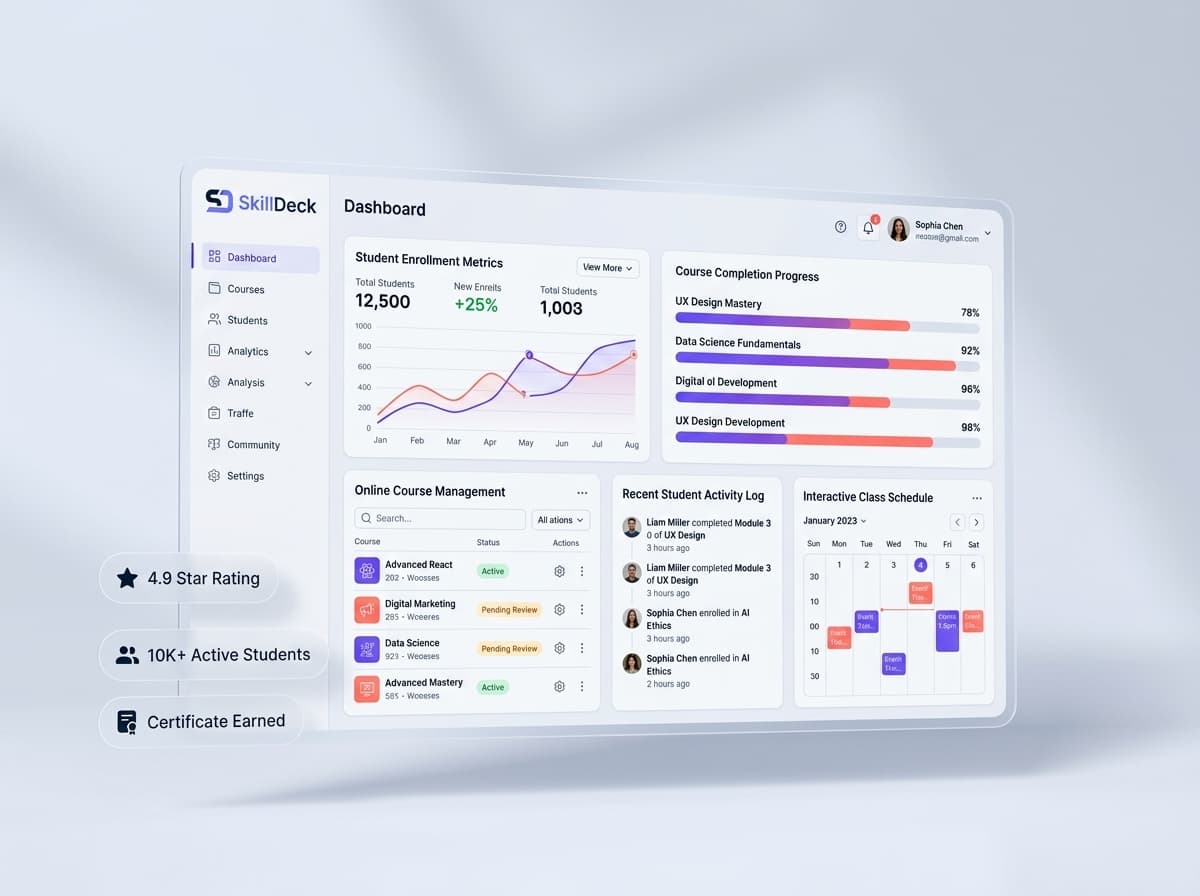
Skilldeck provides a connected platform that combines learning management with website, CRM, and automation capabilities. This can help training organizations and learning businesses reduce the complexity of managing multiple disconnected systems.
For organizations delivering training across different learner groups or markets, a connected environment can help bring learner acquisition, enrollment, course delivery, communication, and learning operations closer together.
Instead of treating the LMS as an isolated tool, Skilldeck can provide a broader technology environment where different parts of the training operation can work together.
This can be particularly valuable for growing training businesses that serve learners across multiple markets and need to manage different programs without creating unnecessary technology complexity.
The objective is not simply to provide a platform for uploading courses. It is to create a more organized digital environment for managing the broader learner journey and supporting growth across markets.
Global LMS vs Separate Regional LMS Platforms
Area | Separate Regional LMS Platforms | Global LMS |
|---|---|---|
Platform Management | Multiple systems to maintain | Centralized environment |
Learner Records | Distributed across platforms | Centralized learner management |
Course Management | Managed independently by regions | Global catalog with regional organization |
Reporting | Separate regional reports | Global and regional visibility |
Training Standards | Can vary between locations | Easier to standardize |
Localization | Managed independently | Can be structured within one environment |
Administration | Multiple platform workflows | Centralized and regional administration |
Compliance Tracking | Region-specific visibility | Broader organizational visibility |
Expansion | New regions may require new systems | New learner groups can be added to the existing environment |
Technology Management | Higher platform complexity | More consolidated infrastructure |
Final Thoughts
Global learning requires more than simply making courses available online. Organizations operating across countries and regions need a learning environment that can accommodate different learner groups, languages, time zones, training requirements, and administrative structures while maintaining consistent organizational standards.
A Global LMS provides that foundation.
It can help organizations centralize learning operations, organize learners by region and role, deliver localized content, manage compliance and certification programs, track progress, and gain visibility into training across geographically distributed teams.
The right platform should provide a balance between global consistency and local flexibility. It should also be scalable enough to support new markets, learners, departments, and programs as the organization grows.
For training and learning businesses looking to reduce fragmented technology, Skilldeck offers a connected environment where LMS capabilities can work alongside CRM, website management, and automation. This creates a more unified approach to managing learning operations and the wider learner journey.