As organizations grow, employee learning becomes more complex. Training may involve different departments, job roles, locations, business units, trainers, and learning requirements. Managing these activities through spreadsheets, emails, separate course platforms, and manual reporting can make it difficult for L&D teams to understand what is happening across the organization.
An Enterprise LMS provides a centralized environment for managing learning at organizational scale. It brings courses, learners, assessments, training programs, certifications, progress information, and learning reports into one structured system.
For businesses managing continuous employee development, onboarding, compliance programs, technical training, or leadership development, an Enterprise LMS can provide the infrastructure needed to deliver and monitor learning more consistently.
What Is an Enterprise LMS?
An Enterprise Learning Management System is a centralized software platform designed to manage learning and development across a large organization.
Unlike a basic LMS used for a small group of learners, an enterprise LMS needs to support more complex organizational structures. Different teams may have different courses, managers may need visibility into their employees, administrators may manage multiple programs, and employees may require learning based on their role or department.
An enterprise LMS can bring these activities together by providing controlled access to learning resources, structured training programs, assessments, completion tracking, certifications, and organizational reporting.
It can support both mandatory and optional learning, allowing organizations to build a more consistent approach to employee development.
Why Businesses Need an Enterprise LMS
Corporate learning involves much more than uploading courses. Organizations need to know who has been assigned training, who has started it, who has completed it, where employees are struggling, and which programs require attention.
An Enterprise LMS helps create a structured learning environment where these activities can be managed from a centralized platform.
It can be particularly useful when an organization has:
- Multiple departments with different learning requirements
- Employees working across different locations
- Large numbers of learners
- Mandatory compliance training
- Regular employee onboarding
- Role-based training programs
- Internal certification requirements
- Continuous upskilling initiatives
- External or partner training programs
- Multiple trainers or L&D administrators
Instead of managing each activity independently, organizations can create a connected learning workflow that gives employees, managers, trainers, and administrators access to the information relevant to their roles.
Enterprise LMS Features for Large Organizations
1. Centralized Learning Management
An Enterprise LMS provides one location for managing organizational learning activities. Administrators can organize courses, learning materials, assessments, programs, and learner records without depending on multiple disconnected systems.
This creates a consistent foundation for managing training across different business functions.
2. Department and Business Unit Management
Large organizations often have different learning requirements for sales, technology, operations, HR, finance, customer support, and management teams.
An enterprise LMS can organize learning according to departments, teams, business units, or other organizational structures. This makes it easier to provide relevant training without treating every employee as part of the same learning group.
3. Role-Based Learning
Employees in different roles may require different skills and training programs.
Role-based learning allows organizations to associate courses and programs with particular job functions. New employees can receive relevant onboarding content, while existing employees can be directed toward learning aligned with their responsibilities and career development.
4. Employee Learning Profiles
A centralized learner profile can provide a broader view of an employee's learning activity.
It may include assigned courses, completed training, assessment results, certifications, learning progress, and other relevant information. This gives learners and authorized administrators a clearer understanding of development activity.
5. Training Assignment
L&D teams can assign learning programs to specific employees, departments, teams, or other learner groups.
This is useful for structured onboarding, compliance programs, mandatory annual training, technical enablement, and organization-wide development initiatives.
6. Learning Paths
Employees often need to complete several courses before developing proficiency in a particular area.
Learning paths allow organizations to arrange courses in a logical sequence. For example, an employee may begin with foundational training, move into role-specific learning, complete an assessment, and then progress toward advanced content.
7. Employee Onboarding
An LMS can support a structured onboarding experience for new employees.
Organizations can create onboarding programs covering company policies, systems, workplace processes, role expectations, product knowledge, security awareness, and other introductory requirements.
Instead of depending entirely on manual instructions, new employees can follow a defined learning journey.
8. Assessments and Knowledge Checks
Training effectiveness often depends on more than course completion.
An Enterprise LMS can include quizzes, assessments, tests, and knowledge checks to evaluate learner understanding. Organizations can use assessment results to identify areas where additional training may be required.
9. Certification Management
Employees may need certifications after completing internal or external training programs.
An enterprise learning platform can maintain certification records, associate certifications with learners, and provide visibility into completed requirements. This can be particularly useful when organizations need to monitor training credentials across large employee groups.
10. Compliance Training
Compliance programs can involve mandatory learning that employees must complete within specific periods.
An LMS can help organizations assign compliance courses, monitor completion, identify outstanding learners, and maintain training records. This provides L&D and management teams with better visibility into required learning activities.
11. Progress Tracking
Administrators and managers need to understand whether employees are progressing through assigned learning.
An Enterprise LMS can track course starts, progress, completion, assessment activity, and other learning milestones. This helps teams identify learners who may need additional support or reminders.
12. Manager Visibility
Managers may need learning visibility for the employees they supervise.
With appropriate permissions, managers can review assigned training, completion status, and learning progress for their teams. This connects employee development with day-to-day management rather than keeping learning information limited to the L&D department.
13. Automated Learning Reminders
Employees may overlook assigned training when they are balancing daily responsibilities.
Automated reminders can help notify learners about pending courses, upcoming deadlines, incomplete assessments, or other learning activities. This reduces the need for L&D teams to manually contact every learner.
14. Learning Reports and Analytics
Enterprise learning generates significant amounts of operational data.
Reporting capabilities can help organizations understand course completion, learner participation, assessment performance, department-level progress, certification activity, and other learning indicators.
These insights can help L&D teams evaluate programs and make more informed training decisions.
15. Multi-Administrator Access
Large learning environments are rarely managed by one person.
An Enterprise LMS can support different administrative responsibilities so that L&D managers, trainers, department administrators, and other authorized users can manage relevant activities while maintaining appropriate access controls.
16. Online and Blended Learning
Enterprise training can combine self-paced digital learning with instructor-led sessions.
An LMS can support online courses as well as structured classroom or virtual training workflows, allowing organizations to create blended learning programs based on the requirements of different teams.
Benefits of Using an Enterprise LMS
Consistent Training Across the Organization
A centralized learning platform makes it easier to deliver standardized training programs across departments and locations. Employees can access the same approved learning resources while organizations maintain greater control over training content.
Better Visibility Into Employee Development
Instead of relying on separate spreadsheets or manually collected updates, L&D teams can access centralized learning information. This makes it easier to understand participation, completion, and training progress.
More Structured Employee Onboarding
A defined onboarding learning path can give new employees a clearer starting point. Organizations can organize required training into a structured sequence rather than depending entirely on informal communication.
Reduced Administrative Work
Automated assignments, reminders, progress tracking, and reporting can reduce repetitive administrative activities. L&D teams can spend more time improving learning programs instead of maintaining fragmented records.
Easier Compliance Monitoring
Organizations can quickly identify employees who have completed required training and those who still have pending requirements. This can make recurring compliance programs easier to manage.
Scalable Learning Operations
As employee numbers increase, manually managing learning becomes increasingly difficult. An Enterprise LMS provides a centralized structure that can support larger learner populations and more complex training operations.
Stronger Employee Development
When employees can access relevant learning programs and understand their progress, organizations can create a more organized approach to upskilling and professional development.
Where an Enterprise LMS Can Be Used
An Enterprise LMS can support different corporate learning requirements, including:
Employee Onboarding: Provide new hires with structured training during their initial transition into the organization.
Upskilling and Reskilling: Help employees develop new technical, functional, and professional capabilities.
Compliance Training: Deliver mandatory learning programs and monitor completion across teams.
Leadership Development: Create structured programs for managers, team leaders, and future organizational leaders.
Product Training: Train employees on products, services, processes, and organizational offerings.
Technical Training: Support continuous development for technology and specialized teams.
Customer-Facing Training: Prepare sales, support, and service teams with relevant knowledge and skills.
Partner Training: Organizations can also use enterprise learning environments to provide selected training to partners, vendors, or other external audiences when required.
Challenges of Managing Enterprise Learning Without an LMS
Managing large-scale learning without a centralized platform can create several operational difficulties.
Training information may be spread across spreadsheets, emails, shared drives, video platforms, and other tools. This makes it harder to maintain a reliable view of employee learning activity.
L&D teams may also spend significant time following up with employees about incomplete courses, preparing reports, updating records, and coordinating training across departments.
Another challenge is consistency. When different teams use different processes, employees may receive different learning experiences and administrators may struggle to compare results.
As the organization grows, these issues become more difficult to manage. A centralized Enterprise LMS can provide the structure needed to bring these learning activities into a connected environment.
How to Choose the Right Enterprise LMS
Choosing an enterprise learning platform requires more than comparing the number of features.
Organizations should first understand their current learning structure and future requirements.
Consider the following areas:
Organizational Structure
Check whether the LMS can support departments, teams, locations, business units, and other organizational groups relevant to the business.
Learner Management
Evaluate how easily employees can be added, organized, assigned learning, and monitored throughout their learning journey.
Course and Program Management
Look for flexible options for creating courses, learning paths, training programs, assessments, and certifications.
Automation
Consider whether routine activities such as assignments, reminders, notifications, and completion workflows can be automated.
Reporting
Review whether administrators and managers can access the reports they need to evaluate participation, completion, assessments, and learning outcomes.
Access Control
Large organizations require appropriate permissions. Check whether different users can receive access based on their responsibilities.
Integration
Consider how the LMS will work with existing business systems, employee records, communication tools, CRM platforms, HR systems, or other technology used by the organization.
Scalability
The platform should be capable of supporting organizational growth without forcing the business to redesign its entire learning operation.
Why Skilldeck for Enterprise Learning Management?
For organizations that manage training as part of a broader business operation, an LMS becomes more valuable when it works alongside other operational systems.
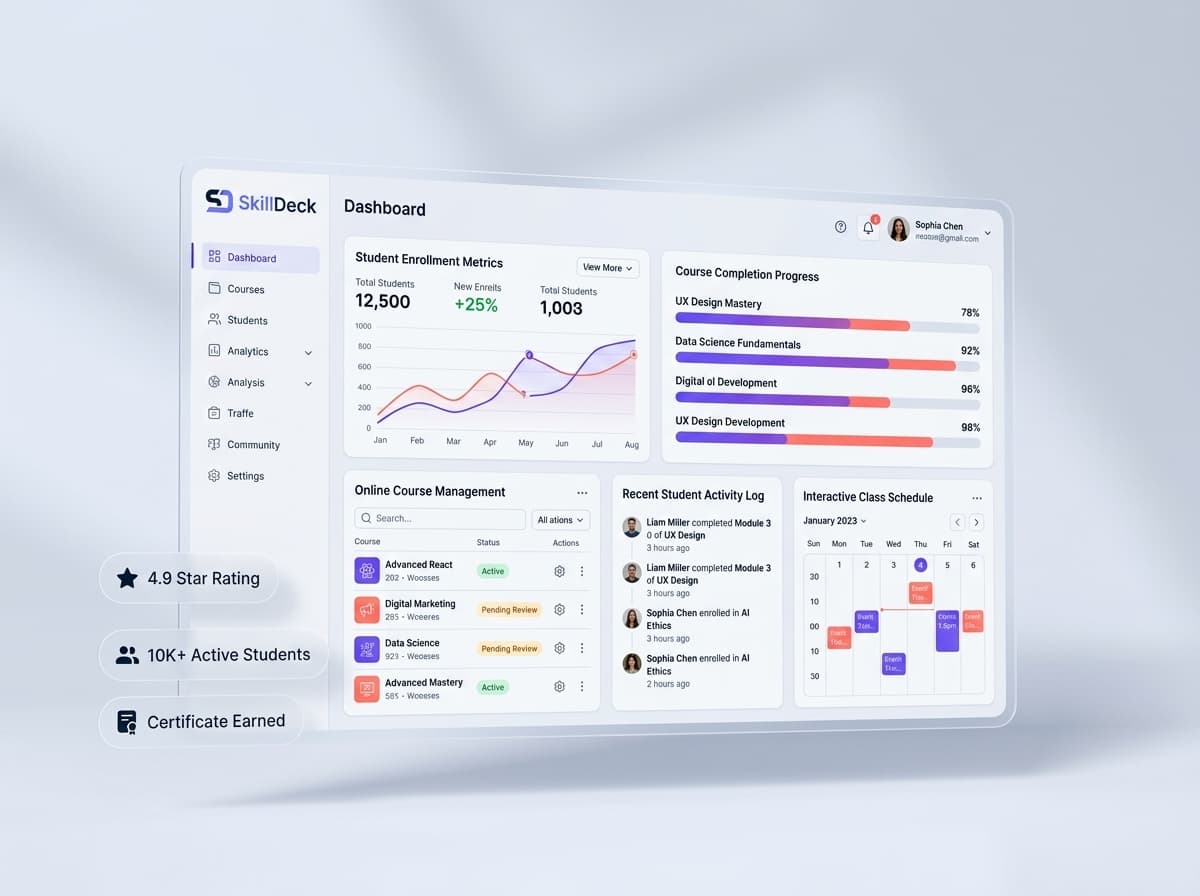
Skilldeck brings learning management into a connected environment where businesses can manage their website, learner acquisition, CRM activities, learning operations, and automation without relying on multiple disconnected platforms.
This can be useful for organizations that deliver professional training, corporate learning, certification programs, or structured employee development.
With connected LMS capabilities, training businesses and learning organizations can manage courses and learners while maintaining a broader view of their operational journey. Marketing and enquiry activities can connect with learner management, while learning information can be organized within the same technology environment.
This approach can reduce the technology burden created by managing separate systems for websites, CRM, LMS, and operational workflows.
For growing organizations, the advantage is not simply having another learning tool. It is having a more connected environment where learning operations can work alongside the other processes that support the business.
Enterprise LMS vs Traditional Training Management
Area | Traditional Training Management | Enterprise LMS |
|---|---|---|
Learner Records | Often maintained across multiple files | Centralized learner profiles |
Course Delivery | Multiple tools or manual coordination | Structured digital learning environment |
Training Assignment | Manual communication | Organized assignments and workflows |
Progress Tracking | Manual updates | Centralized progress visibility |
Assessments | Separate tools or paper-based processes | Integrated learning assessments |
Certifications | Manual record maintenance | Centralized certification tracking |
Reminders | Manual emails and follow-ups | Automated learning notifications |
Reporting | Spreadsheet-based reporting | Centralized learning reports |
Department Management | Difficult to coordinate at scale | Structured organizational groups |
Scalability | Increasingly difficult as learners grow | Designed for larger learning operations |
Final Thoughts
Enterprise learning requires a different level of organization than small-scale training management. As employee numbers, departments, locations, courses, and compliance requirements increase, disconnected learning processes can create unnecessary administrative work and reduce visibility.
An Enterprise LMS provides a centralized foundation for managing employee learning, from onboarding and role-based training to assessments, certifications, compliance programs, and continuous development.
For organizations looking beyond basic course delivery, the right platform should support the entire learning operation while remaining flexible enough to grow with the business.
Skilldeck can help create a connected environment where learning management works alongside CRM, website, and automation capabilities, giving organizations a more streamlined approach to managing training and learner operations.