The first few weeks can shape how quickly a new employee understands the organization, becomes comfortable with their role, and starts contributing to the team. Yet onboarding is often managed through a mixture of emails, documents, meetings, presentations, shared folders, and manual checklists. When every new hire receives information differently, important activities can easily be missed. An LMS for employee onboarding provides a structured digital environment where organizations can organize onboarding content, assign learning activities, guide new employees through required training, and monitor their progress. Instead of relying on a collection of disconnected resources, new hires can follow a defined learning journey that introduces them to the company, their responsibilities, internal processes, and the tools they need for their role. For HR and L&D teams, the LMS also creates better visibility into onboarding progress without requiring constant manual follow-ups.
What Is an LMS for Employee Onboarding?
An LMS for employee onboarding is a learning management system used to introduce new employees to an organization and prepare them for their roles. It allows companies to create structured onboarding programs containing courses, videos, documents, assessments, activities, and other learning resources. These programs can be assigned to new employees based on their department, job role, location, or other organizational requirements. A typical onboarding program may include: Company introduction Organizational policies Workplace guidelines Employee responsibilities Product or service knowledge Role-specific training Technology and software training Security awareness Compliance-related learning Team processes Communication guidelines Assessments and knowledge checks Required acknowledgements The exact structure can vary depending on the organization and the responsibilities of each employee.
Why Employee Onboarding Needs a Structured Learning System
Traditional onboarding often depends heavily on HR teams and individual managers. A new employee may receive an email containing several documents, attend a few meetings, complete some forms, and then wait for their manager to explain the next steps. This approach can work for a small organization, but it becomes harder to maintain as the workforce grows. An LMS provides a repeatable structure for onboarding. HR teams can build a standard foundation that every new employee receives while adding role-specific learning where necessary. For example, all employees may complete company orientation and workplace policies, while developers receive additional technical onboarding and sales employees receive product and sales training. This combination of standardized onboarding and role-specific learning can create a more consistent experience without making every employee follow exactly the same program.
Key Features of an LMS for Employee Onboarding
Centralized Onboarding Content
New employees often need access to a large amount of information during their first few weeks. An LMS can bring onboarding courses and learning resources into one organized environment. Instead of searching through emails or shared folders, employees can access relevant material through their assigned onboarding program. This also gives HR and L&D teams a central location to maintain training content and update it when processes change.
Structured Onboarding Learning Paths
A learning path can turn onboarding into a sequence rather than a random collection of courses. For example, an organization might structure a new-hire journey as: Welcome and company introduction Organizational policies Workplace and security awareness Product or service overview Department introduction Role-specific training Knowledge assessment Initial role-readiness activities Employees can progress through these stages in a logical order, depending on how the organization designs the program.
Department-Specific Onboarding
A company may have one general onboarding process but different training requirements for each department. An LMS can help create different onboarding tracks for: Sales teams Marketing teams Technology teams Human resources Finance Customer support Operations Management This prevents employees from receiving unnecessary training while ensuring that important role-related learning is included.
Role-Based Course Assignments
Job responsibilities can vary significantly even within the same department. Role-based assignments allow organizations to provide training according to an employee's position. A new sales executive, for example, may require product knowledge, sales processes, CRM training, and customer communication learning. A technical employee may instead need development tools, technical processes, security practices, and project-specific training.
Welcome and Orientation Programs
The first stage of onboarding is often about helping employees understand where they have joined. Organizations can use onboarding courses to introduce: Company history Mission and values Organizational structure Products and services Workplace expectations Communication practices Internal processes A structured digital orientation gives employees a reference point they can revisit instead of depending entirely on one-time presentations.
Learning Content Delivery
Onboarding content can come in different formats. An LMS can organize learning materials into courses and modules so employees can access them according to the organization's onboarding schedule. Depending on the platform, training may include videos, documents, presentations, quizzes, assignments, and other digital resources. This makes it possible to combine informational content with interactive learning activities.
Assessments and Knowledge Checks
Simply providing information does not necessarily mean that a new employee has understood it. Assessments can be used after important onboarding modules to check employee understanding. For example, a company may include a short assessment after security awareness, product training, or organizational policy learning. Assessment results can give HR and managers additional visibility into areas where employees may need clarification or additional support.
Progress Tracking
One of the biggest advantages of an onboarding LMS is the ability to monitor employee progress. HR and L&D teams can track whether new employees have: Started their onboarding program Completed assigned courses Passed assessments Finished required modules Completed role-specific learning Received certificates where applicable Completed pending activities This reduces the need to manually contact every new hire for progress updates.
Automated Reminders
New employees have many things to manage during their first few weeks. Training activities can easily be overlooked. Automated reminders can notify employees about pending courses, upcoming deadlines, assessments, or incomplete learning activities. This helps maintain momentum throughout the onboarding process while reducing repetitive administrative follow-ups.
Onboarding Completion Records
Organizations may need to maintain records showing that employees completed specific onboarding activities. An LMS can centralize these records and provide a clearer history of employee learning activity. This can be useful when HR teams need to review an individual's onboarding status or training history.
Certificates and Completion Recognition
Some onboarding programs include certificates or completion acknowledgements for specific training programs. Where supported, an LMS can record course completion and certification information. This gives employees a visible indication of completed learning while helping administrators maintain organized training records.
How an LMS Changes the New-Hire Experience
A well-designed onboarding LMS can turn onboarding from a collection of administrative tasks into a guided learning experience. Instead of asking a new employee to determine what they need to learn next, the organization can provide a defined path. The employee can understand: What training is required What has already been completed What needs to be completed next Which assessments are pending How far they have progressed Which learning activities are specific to their role This clarity can be especially valuable during the first few weeks when employees are already processing a significant amount of new information.
Benefits of Using an LMS for Employee Onboarding
Faster Access to Essential Information
New employees can access important learning resources from a centralized platform rather than waiting for individual documents or instructions.
More Consistent Onboarding
Organizations can establish a common onboarding foundation so that employees receive essential information through a repeatable process.
Reduced HR Administration
Automated assignments, reminders, progress tracking, and reporting can reduce repetitive onboarding work for HR and L&D teams.
Better New-Hire Visibility
Managers and administrators can understand where employees are in their onboarding journey and identify incomplete activities.
Improved Learning Organization
Instead of distributing training content across different channels, organizations can organize it into courses and structured learning paths.
Scalable Onboarding
A digital onboarding process can support organizations that regularly hire employees across different departments, teams, and locations.
Better Accountability
Completion records and progress information provide greater visibility into whether required onboarding learning has been completed.
Building an Effective Employee Onboarding Journey
An onboarding LMS is only as useful as the learning experience built inside it. Organizations should avoid turning onboarding into a large collection of documents that employees are expected to read without direction. A better approach is to divide the journey into meaningful stages.
Before the First Day
Organizations can provide introductory information that helps employees understand what to expect. This could include a welcome message, basic company information, or an introduction to the onboarding process.
First Week
The initial learning stage can focus on company orientation, policies, workplace practices, tools, and essential processes.
Role Familiarization
Once employees understand the organization, onboarding can move toward role-specific learning. Employees can learn about their responsibilities, systems, workflows, products, or services.
Knowledge Validation
Assessments and practical activities can help determine whether employees understand important concepts.
Continued Development
Onboarding does not necessarily end after the first few days. Organizations can extend the learning journey into the first 30, 60, or 90 days, depending on the role and business requirements.
30-60-90 Day Onboarding With an LMS
A structured LMS can support a longer onboarding framework instead of limiting learning to the employee's first day.
First 30 Days
Focus on company orientation, policies, tools, role fundamentals, team processes, and essential knowledge.
Days 31–60
Introduce deeper role-specific skills, department workflows, product knowledge, and practical responsibilities.
Days 61–90
Move toward independent work, advanced role learning, performance expectations, and continued professional development. This structure can help organizations treat onboarding as a gradual transition into productivity rather than a single orientation session.
Challenges of Managing Employee Onboarding Without an LMS
Manual onboarding can create several operational challenges. HR teams may spend time repeatedly sending the same documents and instructions. Managers may need to explain identical processes to every new employee. Training completion may be tracked through spreadsheets, while employees may struggle to determine which learning activities are still pending. Another issue is consistency. If different managers handle onboarding differently, new employees may receive different levels of information and preparation. When hiring volumes increase, maintaining this level of manual coordination becomes even more difficult. An LMS provides a centralized structure that can make repeatable onboarding processes easier to manage.
What to Consider When Choosing an Onboarding LMS
Organizations should evaluate an onboarding LMS based on the actual employee journey rather than simply counting features.
Ease of Course Creation
HR and L&D teams should be able to create and update onboarding content without unnecessary technical complexity.
Flexible Learning Paths
The platform should support different onboarding journeys for departments, job roles, locations, and employee groups.
Progress Visibility
Administrators and managers should have clear visibility into employee completion and pending activities.
Assessment Support
Knowledge checks and assessments should be easy to create and monitor.
Automation
Look for capabilities that can automate course assignments, reminders, notifications, and other repetitive onboarding activities.
Reporting
Reports should help HR and L&D teams understand onboarding completion and learning activity across employee groups.
Scalability
The platform should continue to support the organization as hiring volumes, departments, locations, and training requirements grow.
Why Skilldeck for Employee Onboarding?
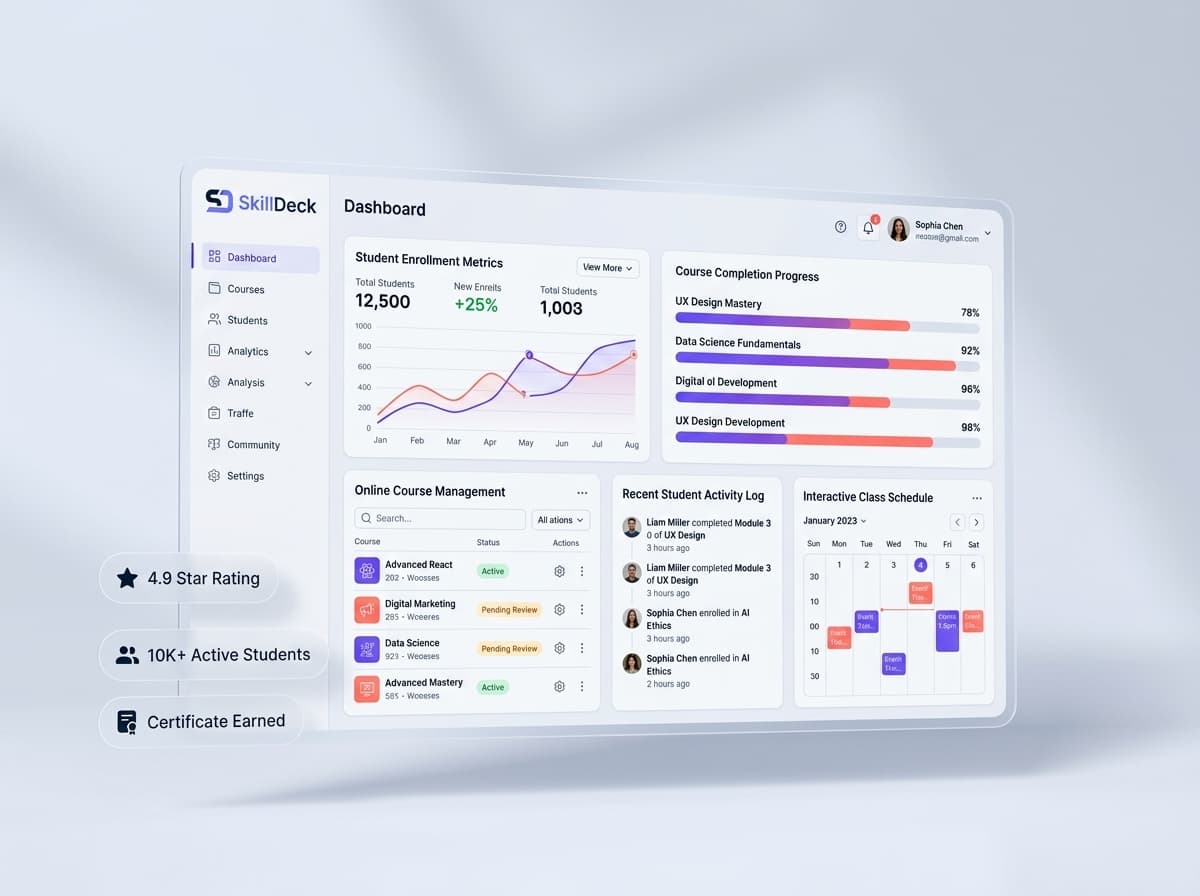
Skilldeck can help organizations create a more structured digital environment for employee onboarding and learning management. Rather than managing onboarding information through separate documents and communication channels, organizations can organize learning activities through a centralized platform. Skilldeck can support onboarding workflows involving courses, learner management, assessments, progress tracking, certificates, notifications, and reporting. Organizations can also structure learning around different employee groups and training requirements. This makes it possible to maintain a common onboarding foundation while providing department or role-specific learning where required. The broader platform approach can also help businesses connect employee learning with their wider operational processes. For organizations looking to reduce fragmented training administration, this can provide a more connected foundation for managing learning activities.
Manual Onboarding vs. LMS-Based Onboarding
Area Manual Employee Onboarding LMS-Based Employee Onboarding Training resources Spread across documents and tools Organized in a centralized learning environment Learning sequence Often communicated manually Structured through learning paths Course assignment HR or managers assign manually Courses can be assigned systematically Progress tracking Spreadsheets or individual updates Centralized learner progress Assessments Separate tools or forms Integrated into learning programs Reminders Manual messages and follow-ups Automated notifications Completion records Manually maintained Centralized training history Reporting Time-consuming to compile Organized onboarding reports
Final Thoughts
An LMS for employee onboarding can transform the way organizations introduce new employees to their workplace, responsibilities, systems, and culture. Instead of treating onboarding as a collection of emails, documents, and meetings, businesses can create a structured learning journey that employees can follow from their first day onward. The strongest onboarding programs combine company-wide orientation with role-specific learning, assessments, progress tracking, reminders, and continued development. This gives employees greater clarity while giving HR, managers, and L&D teams better visibility into the onboarding process. As organizations grow and hiring becomes more distributed across departments and locations, having a centralized onboarding LMS can make the learning experience more consistent, manageable, and scalable. Skilldeck can provide a connected environment for organizations looking to bring employee onboarding and learning operations into one structured digital platform.