Online courses have changed the way people learn new skills, prepare for careers, and continue their professional development. Training institutes, educators, academies, coaches, consultants, and businesses can now reach learners beyond a physical classroom and deliver courses through digital platforms. However, creating an online course is only one part of running a successful digital learning program. Course creators also need to organize learning content, enroll students, manage access, monitor progress, conduct assessments, issue certificates, communicate with learners, and understand how students are engaging with their courses. An LMS for online courses provides a centralized environment for managing these activities. Instead of using separate tools for course content, learner records, assessments, certificates, and progress tracking, an LMS can bring the learning experience together in one structured platform. For businesses that want to launch individual courses or build a larger online learning catalog, the right LMS can provide the foundation needed to deliver and manage learning at scale.
What Is an LMS for Online Courses?
An LMS for online courses is a learning management system designed to help educators, training providers, academies, and organizations create and deliver digital learning programs. The platform acts as a central location where course creators can organize learning material and learners can access their assigned or purchased courses. Depending on the platform, an online course LMS can support: Course creation and management Video-based learning Documents and digital resources Course modules and lessons Learner enrollment Self-paced learning Instructor-led online programs Assessments and quizzes Assignment management Progress tracking Certificates Notifications Learning reports Mobile learning Learner communication The purpose is not simply to host videos. It is to create a complete environment around the learning experience.
Why Use an LMS to Deliver Online Courses?
Publishing videos on a website or sharing course files through cloud storage may seem sufficient when starting out. As the number of learners and courses increases, however, managing the learning experience becomes more complicated. An LMS gives online course providers a structured way to manage the relationship between content and learners. For example, instead of manually sending course links to every student, an administrator can enroll learners into a specific course. Instead of asking students to report their progress, the LMS can record their learning activity. Instead of creating certificates manually, the platform can support certificate workflows based on course completion. This creates a more organized system for both the learner and the course provider.
Build and Organize Online Courses
One of the core requirements of an online course platform is the ability to organize educational content logically. An LMS can allow course creators to divide a program into modules, lessons, topics, and activities. For example, a digital course could be structured as: Module 1: Introduction Module 2: Core Concepts Module 3: Practical Learning Module 4: Advanced Topics Module 5: Assessment Module 6: Final Project This structure makes longer courses easier to navigate and allows learners to understand what they need to complete. Course creators can also update individual lessons without having to rebuild the entire learning experience.
Video Hosting for Online Learning
Video is one of the most common formats used in online education. Recorded lectures, demonstrations, tutorials, interviews, and practical explanations can make complex subjects easier to understand. An LMS with video learning capabilities can organize video lessons alongside supporting resources and assessments. Instead of presenting learners with a collection of unrelated video links, course providers can place videos within structured lessons. A typical video lesson might include: Instructional video Lesson notes Downloadable resources Knowledge check Related activity Next lesson This creates a more complete learning experience than video hosting alone.
Self-Paced Online Learning
One of the major advantages of online courses is flexibility. Learners may not always be available at a particular time for a live class. Self-paced learning allows them to access course material according to their own schedules. An LMS can help organize self-paced programs by allowing learners to move through lessons and track what they have completed. This model is useful for: Professional development Skill-based courses Certification preparation Technical training Recorded workshops Employee learning Academic support Career-focused programs Course providers can establish their own progression rules while giving learners flexibility where appropriate.
Learner Enrollment and Access Management
Once a course is created, learners need a structured way to access it. An LMS can manage learner enrollment and provide access to the relevant courses. Administrators can organize learners according to programs, batches, groups, or other requirements. This becomes particularly useful for training businesses that offer multiple courses. Instead of maintaining separate spreadsheets for each program, administrators can manage learner information and course participation through a centralized system.
Course Progress Tracking
Knowing whether learners are actually progressing through a course is important for both educators and training businesses. An LMS can provide visibility into course activity, including: Lessons completed Courses started Courses completed Pending modules Assessment results Overall progress Learning activity For learners, progress indicators provide a clear understanding of how much of the course remains. For course providers, the information can help identify learners who may have stopped progressing or require additional support.
Assessments and Online Quizzes
Online courses become more meaningful when learners have opportunities to demonstrate what they have learned. An LMS can incorporate quizzes, tests, assignments, and other assessment activities into courses. For example, a course creator can place a short quiz after each module and a final assessment at the end of the program. Assessments can help: Check knowledge retention Identify difficult topics Reinforce important concepts Measure learning outcomes Determine course completion This allows online education to move beyond passive content consumption.
Assignments and Practical Learning
Some subjects require learners to apply knowledge rather than simply watch videos or answer multiple-choice questions. An online course LMS can support assignments and practical activities where learners need to submit work or complete specific tasks. This can be particularly useful for technical, professional, creative, and project-based courses. For example, a course on programming may include coding exercises, while a digital marketing program may require learners to create a campaign plan. Practical activities can make online learning more connected to real-world application.
Certificates for Online Courses
Certificates can provide learners with a record of completing a course or learning program. An LMS can support certificate issuance based on defined completion or assessment requirements. Course providers can establish the conditions under which a learner becomes eligible for certification. This can be useful for academies, professional trainers, corporate learning teams, and education businesses that provide completion certificates. Centralizing certificate records also makes it easier for administrators to manage learner completion information.
Mobile Learning
Learners increasingly expect online education to fit around their schedules rather than requiring them to remain at a desktop. Mobile-friendly learning allows students to access courses from smartphones and tablets where supported by the LMS. This can make short lessons, revision sessions, videos, and assessments easier to access during flexible learning periods. For course providers, mobile accessibility can also expand the situations in which learners can engage with their programs.
Notifications and Learner Communication
Learners may need reminders about new lessons, pending assessments, upcoming deadlines, or incomplete courses. An LMS can support notifications that keep learners informed about important learning activities. Communication can also be used to guide learners through a course and reduce confusion around what they need to complete next. For training providers managing large numbers of learners, structured communication can reduce the need for repeated individual messages.
Online Course Analytics
Course creators need more than enrollment numbers to understand whether their programs are working effectively. Learning analytics can provide insight into learner participation and course activity. Depending on the LMS, administrators may be able to review: Enrollment numbers Course completion Learner progress Assessment performance Course activity Pending learning Certificate completion Learner engagement These insights can help course providers identify content that may need improvement and understand where learners may be struggling.
Benefits of Using an LMS for Online Courses
One Place to Manage Learning
Course content, learner information, assessments, progress, and certificates can be organized within one learning environment.
Easier Course Administration
An LMS can reduce repetitive administrative work related to enrollment, progress monitoring, reminders, and completion records.
Better Learner Experience
Learners can access their courses, track progress, complete assessments, and view learning information through a structured interface.
Scalable Course Delivery
A centralized LMS can make it easier to manage multiple online courses and larger learner groups as the training business grows.
Consistent Course Structure
Course providers can establish a consistent format for lessons, modules, assessments, and completion requirements.
Improved Learning Visibility
Administrators and instructors can gain better visibility into learner participation and progress.
Reduced Tool Fragmentation
Instead of managing content, learner records, assessments, and certificates through separate systems, organizations can consolidate many learning activities within one platform.
Types of Online Courses That Can Use an LMS
An LMS is flexible enough to support different course models and educational businesses.
Professional Skill Courses
Organizations and instructors can deliver courses focused on business, technology, communication, management, and other professional skills.
Technical Courses
Programming, software development, cloud computing, data science, cybersecurity, and other technical subjects can be organized into structured digital learning programs.
Certification Courses
Training providers can build courses that include assessments and defined completion requirements.
Recorded Training Programs
Previously recorded workshops and classroom sessions can be organized into digital course modules.
Corporate Online Training
Businesses can use online courses to provide employee training, onboarding, product education, and professional development.
Academy and Institute Programs
Training institutes can use an LMS to deliver courses to students beyond physical classroom sessions.
Self-Paced vs Instructor-Led Online Courses
An online course LMS does not have to support only one learning model. Self-paced courses allow learners to progress independently through recorded content and assessments. Instructor-led programs may include scheduled classes, live sessions, assignments, and trainer interaction. Some providers combine both approaches. For example, learners may watch recorded lessons independently and then attend a live session for discussion or practical guidance. This blended approach can provide flexibility without removing instructor involvement.
How to Create a Better Online Course Experience
Technology alone does not make an online course effective. The course itself should be designed around how learners consume and apply information.
Divide Long Content Into Manageable Lessons
Large lessons can become difficult to complete. Breaking content into focused modules can make the learning journey easier to navigate.
Combine Different Content Formats
Use videos, reading material, quizzes, assignments, and practical activities where appropriate rather than relying entirely on one format.
Define Learning Outcomes
Learners should understand what they are expected to know or do after completing a course or module.
Add Knowledge Checks
Short assessments can reinforce important concepts and give learners opportunities to evaluate their understanding.
Create a Logical Progression
Lessons should build on one another where the subject requires a particular sequence.
Keep Learners Moving
Progress indicators, reminders, clear next steps, and organized learning paths can help reduce confusion and encourage course completion.
Challenges of Managing Online Courses Without an LMS
Running online courses through disconnected tools can create several challenges. Course content may be distributed across video platforms, cloud storage, websites, and communication applications. Learner information may be stored separately in spreadsheets. Assessments might use another tool, while certificates are created manually. This fragmentation can make it difficult to understand the complete learner journey. Course providers may also spend unnecessary time sending access information, tracking completion, answering questions about pending lessons, and compiling reports. As the number of courses and learners grows, these administrative tasks can become increasingly difficult to manage. An LMS provides a central structure for bringing these activities together.
What to Consider When Choosing an LMS for Online Courses
The right LMS should be selected according to the way the organization plans to deliver and manage its courses.
Course Creation Capabilities
Check whether the platform provides the content organization and course-building capabilities required for your programs.
Video and Media Support
If video is a major part of your courses, evaluate how the platform handles video-based learning and related resources.
Learner Management
The LMS should make it easy to enroll learners, organize groups, and manage course access.
Assessment Options
Consider the types of quizzes, tests, assignments, and evaluation methods required for your courses.
Progress and Reporting
Look for useful reporting that helps instructors and administrators understand learner activity and course performance.
Certificate Management
If your programs include completion certificates, evaluate how easily certificates can be managed and tracked.
Mobile Accessibility
If learners are expected to study from smartphones or tablets, mobile learning should be part of the platform evaluation.
Scalability
The LMS should support growth in course volume, learner numbers, instructors, and learning programs without making administration unnecessarily complicated.
Why Skilldeck for Online Courses?
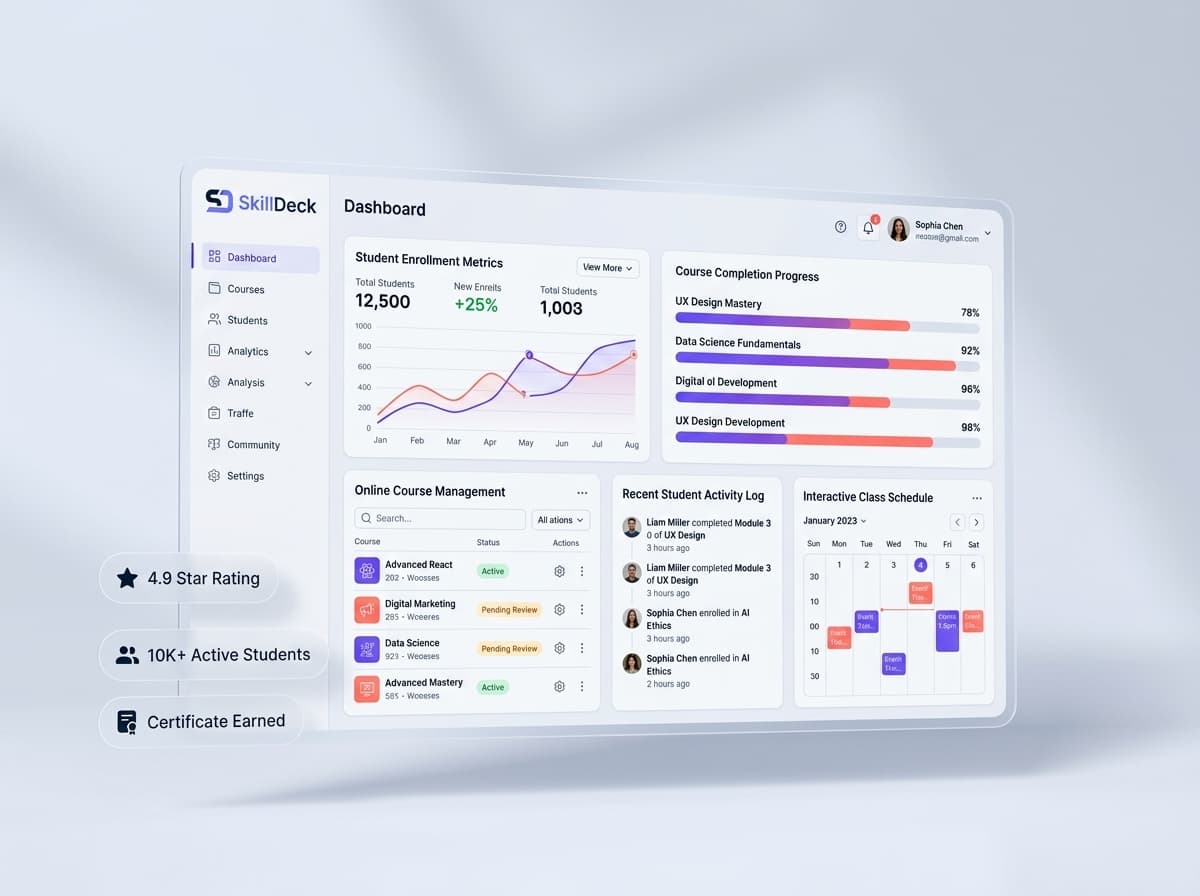
Skilldeck can provide a centralized learning environment for businesses, training institutes, academies, and education providers that want to manage online courses digitally. Instead of managing course content, learners, assessments, progress, certificates, and communication through separate tools, organizations can bring key learning activities into one platform. Skilldeck can support structured course management, learner organization, assessments, progress tracking, certificates, notifications, and reporting. This can help course providers create a more organized experience for both administrators and learners. For training businesses that are expanding their online course catalog, a centralized platform can also make day-to-day course administration easier to manage. The broader Skilldeck environment can be useful for organizations that want their learning operations to connect with other business activities instead of operating as an isolated course-hosting system.
Online Course Management With Multiple Tools vs LMS
Area Multiple Separate Tools Online Course LMS Course content Distributed across platforms Organized within the learning environment Learner enrollment Often managed separately Centralized learner management Video lessons Separate hosting and course links Integrated into course delivery Assessments External forms or applications Connected to course learning Progress tracking Manual or limited Centralized learner progress Certificates Created and maintained separately Managed within the learning workflow Communication Multiple channels Structured learner notifications Reporting Data collected from different tools Centralized learning reports
Final Thoughts
An LMS for online courses provides the infrastructure needed to turn digital content into a structured learning experience. It helps course providers move beyond simply hosting videos and documents by bringing together course organization, learner enrollment, assessments, progress tracking, certificates, communication, and reporting. For individual instructors, academies, training institutes, and growing education businesses, this structure can make online course management more organized and scalable. The best platform will depend on the type of courses being delivered, the number of learners, the learning model, content requirements, and future growth plans. A solution such as Skilldeck can provide a centralized environment for organizations looking to manage online learning while reducing the complexity of working across disconnected tools.