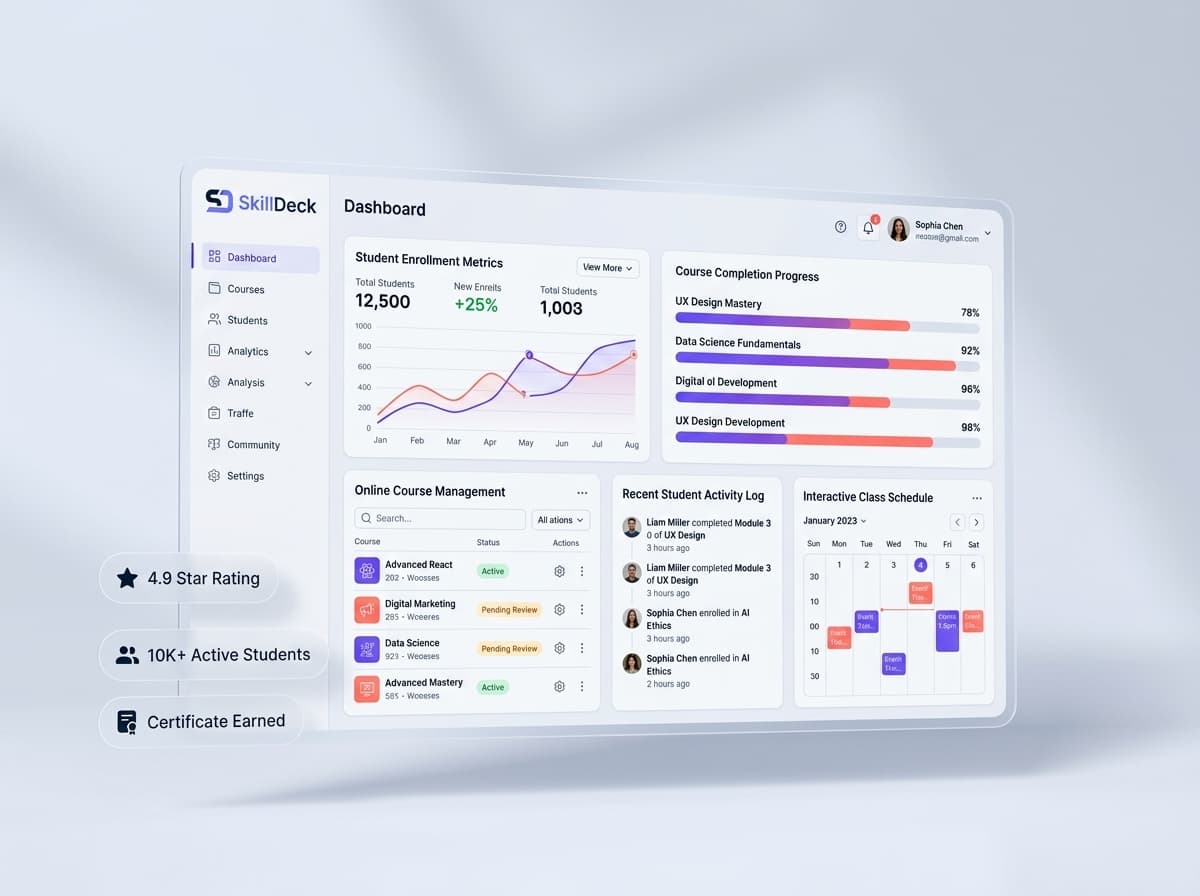
For an EdTech company or professional training provider, the learning platform is more than a place where learners access courses. It becomes part of the brand experience. When learners log in, browse courses, attend training, complete assessments, receive certificates, or interact with instructors, every part of that journey contributes to how they perceive the organization. A white-label LMS allows businesses to deliver this experience under their own brand instead of presenting learners with a third-party learning platform identity. The platform can be customized around the organization's branding and business model while providing the infrastructure required to manage digital learning. This allows EdTech businesses, training institutes, academies, corporate training providers, and professional education companies to establish a dedicated learning environment without having to build an LMS completely from the ground up.
What Is a White-Label LMS?
A white-label LMS is a learning management platform that can be branded and presented as a company's own learning platform. Instead of directing learners to a platform dominated by another provider's branding, the business can create a learning environment aligned with its own identity. Depending on the platform, white-label capabilities may include customization of: Brand logo Colors and visual identity Platform name Domain or subdomain Login experience Course presentation Learner-facing pages Communication Certificates Other branded learning elements The underlying LMS technology manages the learning infrastructure, while the training business can focus on its courses, learners, instructors, marketing, and growth.
Why Businesses Choose a White-Label LMS
Building a complete learning management platform internally requires considerable development effort. A company would need to think about user management, course delivery, assessments, reporting, authentication, certificates, content management, notifications, security, maintenance, and ongoing improvements. For an EdTech business, these technology requirements can take attention away from the actual education product. A white-label LMS provides an alternative. Instead of developing every learning-management component independently, the business can use an existing LMS foundation and create a branded learning experience around it. This allows the organization to spend more time improving its educational content and learner relationships while relying on the platform for core learning operations.
Build a Learning Platform Around Your Brand
Brand consistency is one of the main advantages of a white-label approach. A learner should be able to move from a company's website to its learning environment without feeling as though they have been redirected to an unrelated service. The visual identity of the LMS can be aligned with the organization's existing brand. This can create consistency across: Website Course catalog Learner portal Training communications Certificates Learning materials Login experience For companies that invest heavily in building their education brand, this continuity can be particularly valuable.
Customized Learner Experience
White-labeling is not only about replacing a logo. The broader objective is to create a learning environment that feels like an extension of the organization's existing digital experience. The learner may interact with the platform through branded pages, course catalogs, dashboards, learning resources, assessments, and certificates. This gives businesses more control over how their learning programs are presented. For example, an EdTech company offering professional certification programs can create a learning environment that reflects its own educational identity rather than making the technology provider the most visible brand.
Use Your Own Domain
Domain customization can make the learning platform easier to connect with the company's digital presence. Instead of requiring learners to remember an unrelated platform address, businesses can use their own domain or a dedicated learning subdomain where supported. This can make the transition between the organization's main website and learning environment more natural. It can also simplify communication because learners see a familiar brand when accessing their courses.
White-Label LMS for EdTech Companies
EdTech businesses often compete through their courses, instructors, learning methodology, community, and brand. The technology supporting the learning experience should help strengthen those elements rather than distract from them. A white-label LMS can allow an EdTech company to provide: Branded course catalogs Dedicated learner accounts Structured learning paths Assessments Certificates Instructor-led programs Self-paced courses Learner progress tracking Training reports Course enrollment Digital learning resources The EdTech company can therefore operate its learning environment under its own identity while using an established LMS infrastructure.
White-Label LMS for Training Providers
Professional training providers often deliver programs for different learner groups and industries. Their business may include technical courses, certification preparation, corporate training, career development, workshops, and specialized professional programs. A white-label LMS allows these providers to create a central digital learning environment around their training brand. They can manage courses, learners, instructors, assessments, certificates, and other learning activities without making the underlying LMS provider the primary face of the learner experience. This is particularly useful for training businesses that want to build long-term relationships with learners instead of treating every course as an isolated transaction.
Course Management Under Your Brand
A branded platform needs strong course management behind the visual experience. Administrators should be able to create and organize courses into a structure that makes sense for their learners. A course may contain: Modules Lessons Videos Documents Quizzes Assignments Practical activities Assessments Completion requirements Training businesses can then present these programs through their own learning environment. This creates a consistent connection between the educational content and the company's brand.
Manage Different Types of Learning Programs
A white-label LMS does not need to be limited to one training format. Businesses can use the platform for different learning models depending on their audience.
Self-Paced Courses
Learners can access recorded lessons and resources according to their own schedules.
Instructor-Led Training
Training providers can organize programs around instructors, batches, schedules, and live learning activities.
Blended Learning
Businesses can combine live sessions with recorded content, assessments, assignments, and digital resources.
Cohort-Based Programs
Structured cohorts can be organized around defined start dates, learner groups, instructors, and program milestones.
Corporate Training
Professional training providers can deliver customized learning programs for organizations and their employees.
Manage Learners From One Platform
Branding is only one part of a successful learning platform. Behind the learner-facing experience, administrators need tools to manage users effectively. A white-label LMS can provide a centralized environment for handling learner profiles, enrollments, course access, learning activity, assessments, completion, and certificates. This allows administrators to maintain a clearer view of the learner lifecycle. As the learner base grows, centralized learner management becomes increasingly important.
Instructor and Trainer Management
Many training companies rely on multiple instructors and subject-matter experts. A branded LMS can provide a structured environment where instructors are connected with their courses and learning responsibilities. Depending on the platform configuration, instructors may be able to: Access assigned programs Manage course content Review learners Conduct assessments Review assignments Monitor learner progress Communicate with learners This gives the training company greater control over its instructor-led learning operations.
Assessments and Certifications
A professional learning platform needs to measure more than course access. Assessments can help businesses determine whether learners have understood the training material. An LMS can support quizzes, tests, assignments, and other evaluation methods depending on the learning model. Certificates can also become part of the branded learner journey. When learners complete a program and receive a certificate carrying the training provider's identity, the certificate can reinforce the connection between the learner's achievement and the organization's brand.
Monetize Your Learning Platform
For EdTech businesses and commercial training providers, the LMS can also become part of the revenue model. Businesses can use their branded learning environment to organize and deliver paid educational programs. Potential models include: Individual paid courses Course bundles Subscription learning Cohort programs Certification programs Corporate training Premium learning memberships Workshops A white-label LMS can help connect the commercial side of the business with the actual learning experience. The exact payment and monetization functionality depends on the platform, but the broader objective is to create a branded environment where learners can discover, purchase, access, and complete learning programs.
Build More Than a Course Library
A strong branded LMS should not simply become a collection of uploaded videos. Businesses can use the platform to create structured learning journeys. For example, a professional training company might design a pathway that moves learners through: Foundation Course → Intermediate Program → Practical Assessment → Advanced Program → Certification This creates opportunities for learners to continue their relationship with the training provider after completing their first course. For EdTech businesses, this can also support a broader product ecosystem instead of relying on individual course sales alone.
Automate Routine Learning Operations
Growing training businesses often spend considerable time handling repetitive administrative tasks. A white-label LMS can help streamline activities such as: Learner enrollment Course assignments Training reminders Assessment notifications Progress updates Completion tracking Certificate workflows Learner communication Automation allows administrative teams to spend less time repeating routine actions and more time improving programs and supporting learners.
Monitor Learner Progress
A branded learning environment should provide administrators with visibility into what learners are actually doing. Progress information can help businesses understand: Which courses are being completed Which learners are falling behind Which assessments have been completed Where learners are stopping Which programs have higher engagement Which learners have achieved completion This information can help training providers improve course structures and identify learners who may need additional support.
Reporting for Your Training Business
Reporting becomes increasingly important as the number of courses and learners grows. Administrators may need to review enrollment, completion, assessment performance, learner activity, certificates, and training participation. Centralized reporting can make this information easier to access and analyze. For corporate training providers, reports can also help demonstrate training activity and completion to their clients. For EdTech businesses, learning analytics can provide insight into learner engagement and course performance.
White-Label LMS vs Building an LMS From Scratch
Building an LMS internally gives a business complete responsibility for the technology. That can provide flexibility, but it also means handling development, testing, security, maintenance, infrastructure, updates, and feature improvements. A white-label approach shifts much of the underlying platform responsibility to the LMS provider while allowing the business to focus on its own branded learning experience. Area Build From Scratch White-Label LMS Initial development Requires internal development Existing LMS foundation Branding Fully controlled Customized around business brand Maintenance Managed internally Platform provider handles core platform Feature development Requires development resources Available through platform capabilities Learning operations Built and configured separately Ready learning environment Scalability Requires ongoing technical planning Designed to support platform growth Business focus Significant technology involvement Greater focus on courses and learners The right choice depends on the organization's technical resources, budget, customization requirements, and long-term strategy.
Key Benefits of a White-Label LMS
Stronger Brand Ownership
Businesses can present their learning experience under their own identity.
Faster Platform Launch
Organizations can start with an existing LMS foundation instead of developing every learning feature from the beginning.
Lower Technology Burden
The LMS provider manages much of the underlying platform infrastructure and ongoing technology requirements.
Consistent Learner Experience
Courses, learning activities, communications, and certificates can be presented within a unified branded environment.
Greater Business Focus
EdTech and training companies can concentrate on content, instructors, marketing, learner success, and business development.
Scalable Learning Operations
Businesses can expand their course catalog and learner base without having to build an entirely new learning platform.
Professional Digital Presence
A branded LMS can make the learning operation feel like a dedicated product rather than an external service.
What to Consider Before Choosing a White-Label LMS
Not every white-label LMS provides the same level of customization. Businesses should evaluate the platform based on both branding and operational requirements.
Brand Customization
Check which elements can be customized, including logos, colors, domain, learner-facing pages, communications, and certificates.
Course Management
Make sure the platform supports the types of programs your business delivers.
User and Role Management
Evaluate how administrators, instructors, learners, and other users are managed.
Learning Delivery
Consider support for self-paced, live, instructor-led, blended, and cohort-based learning.
Assessment and Certification
Review how quizzes, assignments, assessments, completion requirements, and certificates are managed.
Automation
Determine which repetitive training and communication activities can be automated.
Reporting
Check whether the platform provides the reports and learner insights required by your business.
Scalability
Consider whether the platform can support your expected growth in courses, learners, instructors, and programs.
Technology Responsibility
Understand which platform maintenance, updates, infrastructure, and technical responsibilities are handled by the provider.
Who Can Use a White-Label LMS?
A white-label LMS can be useful for a broad range of learning businesses.
EdTech Companies
Build a branded learning environment around digital courses, certification programs, and educational products.
Training Institutes
Manage courses, batches, instructors, learners, assessments, and certificates under the institute's identity.
Professional Training Providers
Deliver technical and professional development programs through a dedicated branded platform.
Corporate Training Businesses
Provide employee learning programs to business clients through a professional training environment.
Coaching and Skill Academies
Create a centralized digital learning experience for learners participating in structured skill-development programs.
Certification Providers
Deliver certification-focused courses, assessments, and completion workflows through a branded platform.
Why Skilldeck for White-Label LMS?
Skilldeck helps businesses create a more connected digital learning environment around their own training brand. For EdTech companies and training providers, the objective is not simply to host courses. It is to build an environment where learners can discover programs, enroll, learn, complete assessments, track their progress, and interact with the training organization. Skilldeck can bring these learning activities together while reducing the technology burden associated with developing and maintaining a learning platform independently. Training businesses can focus on their educational offerings, learner relationships, instructors, and growth while using a centralized platform for learning operations. For organizations planning to expand their course catalog or learner community, a white-label approach can provide a practical foundation for creating a branded learning business without taking on the entire responsibility of LMS development.
From Training Brand to Digital Learning Business
A white-label LMS can help businesses move beyond simply delivering training and start building a recognizable digital learning product. A training company can create its own course catalog, establish structured learning journeys, develop certification programs, introduce paid learning products, and maintain ongoing relationships with learners. Over time, the platform can become an important part of the company's business ecosystem. This is particularly valuable for organizations that want learners to associate the entire digital learning experience with their own brand.
Final Thoughts
A white-label LMS gives EdTech companies and training providers an opportunity to create a branded learning platform without taking on the complete technical responsibility of developing an LMS from scratch. It combines the infrastructure of a learning management system with the ability to create a learning experience that reflects the organization's own brand. From courses and learner management to instructors, assessments, certificates, automation, reporting, and monetization, the platform can support the operational requirements behind a growing training business. For companies that want to build long-term relationships with learners, branding matters. A consistent learning environment can help connect the course experience with the identity of the organization delivering it. Before selecting a white-label LMS, businesses should therefore look beyond branding alone. Customization, learning functionality, automation, reporting, scalability, integrations, and technology responsibility should all be evaluated. With the right platform, an organization can create a professional digital learning environment that feels like its own, while spending more time on what matters most building valuable learning programs and growing its education business.