Running a training company involves much more than creating courses and delivering classes. Training businesses have to manage learners, batches, instructors, schedules, course catalogs, enrollments, assessments, certificates, payments, communication, and day-to-day administration. When these activities are managed through spreadsheets, messaging applications, separate video tools, payment systems, and disconnected records, keeping everything synchronized can become difficult. A growing training company may have multiple courses running at the same time, different instructors handling different batches, and learners joining programs through several channels. An LMS for training companies provides a centralized environment for bringing these activities together. It allows training businesses to manage learning delivery while also creating a more organized way to handle the operational side of their programs. Whether the business offers technical training, professional development, certification programs, corporate training, or skill-based courses, an LMS can provide the structure required to deliver programs consistently and manage learners at scale.
What Is an LMS for Training Companies?
An LMS for training companies is a learning management platform designed to help professional training providers create, sell, deliver, and manage learning programs. Unlike a basic course-hosting system, a training-focused LMS needs to support the operational realities of a training business. A typical training company may use an LMS to manage: Course catalogs Online courses Offline and blended programs Learner registrations Batches Instructors Course schedules Learning materials Assessments Certificates Attendance Learner progress Payments and enrollments Notifications Training reports Course monetization The objective is to connect these activities so that the training company can manage its programs from a more centralized system.
Why Training Companies Need an LMS
Training companies often operate multiple programs simultaneously. One instructor may be handling a weekday batch, another may be teaching a weekend program, while learners from different locations may be accessing recorded courses. Managing all of this manually creates unnecessary administrative work. An LMS can provide a common environment where administrators can see which courses are active, which learners belong to particular batches, which instructors are responsible for programs, and how learners are progressing. It can also make it easier to repeat successful training programs. Once a course structure has been created, the training company can reuse and adapt it for future batches instead of rebuilding the entire learning process each time. For growing training businesses, this repeatability can become an important part of operational scalability.
Manage the Complete Course Catalog
Training companies often have more than one type of course. Their catalog may include beginner programs, advanced courses, certification preparation, short-term workshops, corporate programs, and long-duration career courses. An LMS can provide a centralized location for organizing these offerings. Administrators can structure courses with details such as: Course title and description Learning objectives Modules and lessons Duration Instructor information Course format Assessments Completion requirements Certificate information Enrollment details A well-organized catalog makes it easier for both administrators and learners to understand the available training programs.
Batch Management for Training Programs
Batches are a central part of many training businesses, particularly those offering instructor-led or blended programs. A single course may run several batches at different times. Each batch can have its own learners, instructor, schedule, capacity, and progress. An LMS can help training companies organize these details without maintaining separate spreadsheets for every batch. Administrators can create batch structures based on: Course Start and end date Class schedule Instructor Learner group Training format Location or delivery mode This gives the training team a clearer picture of how programs are being delivered.
Instructor Management
Training companies frequently work with multiple instructors, trainers, mentors, and subject-matter experts. Managing instructor responsibilities manually can become challenging when the number of programs increases. An LMS can help administrators associate instructors with courses or batches and provide them with access to the learning activities relevant to their responsibilities. Depending on the platform's capabilities, instructors may be able to: Access assigned courses Manage learning content View learners Conduct assessments Monitor learner progress Communicate with learners Review assignments Track training activities This can help separate instructor responsibilities from administrative tasks while keeping both within the same learning environment.
Learner Enrollment Management
Every training company needs an efficient way to manage learner registrations. Learners may join through a website, marketing campaign, referral, corporate request, direct inquiry, or other channels. Once they enroll, their information needs to be connected to the appropriate course or batch. An LMS can centralize learner enrollment and course access. Administrators can maintain learner profiles and associate them with relevant programs, making it easier to understand who is enrolled in what training. For training companies offering multiple programs, this creates a more organized learner database.
Online, Offline, and Blended Training
Training companies do not necessarily follow a single delivery model. Some programs may be completely online, while others may involve classroom sessions. Many businesses combine recorded learning with live instructor sessions. An LMS can provide a common learning environment for different delivery approaches. For example, a blended program could include: Recorded lessons Live instructor sessions Downloadable resources Assignments Quizzes Practical activities Final assessments This allows training providers to design programs around the subject and learner requirements instead of being restricted to one delivery format.
Instructor-Led Training Management
Instructor-led programs require additional coordination compared with self-paced courses. Training administrators need to know which instructor is handling a particular batch, when classes are scheduled, and which learners are participating. An LMS can bring learning information together with batch and instructor details, helping the training team maintain a clearer operational view. This is particularly useful when a training company runs multiple instructor-led programs simultaneously.
Course Content and Learning Materials
Training companies usually use several types of learning resources. An LMS can organize these resources within course modules so that learners know where to find the material associated with each topic. Depending on the platform, course content may include: Video lessons PDFs Presentations Reading material Recorded sessions Quizzes Assignments Practical exercises Reference resources Instead of sending individual resources through email or messaging applications, the training company can provide learners with a more structured learning environment.
Assessments and Assignments
Assessments allow training companies to evaluate whether learners are understanding the material. An LMS can support quizzes, tests, assignments, and other evaluation activities as part of a course. Training providers can use assessments at different stages of a program. A short quiz can be placed after a module, while a final assessment can be used before course completion or certification. Assignments are particularly useful for practical programs where learners need to demonstrate how they can apply what they have learned.
Attendance and Participation
For instructor-led programs, attendance can be an important part of training administration. An LMS can help training teams record and review learner participation where attendance functionality is available. This can provide administrators with a better understanding of whether learners are regularly attending sessions and may help identify learners who require additional follow-up. When attendance is connected with course and batch information, the training company can maintain a more complete picture of learner participation.
Track Learner Progress
Training companies need visibility into what happens after enrollment. An LMS can help administrators and instructors monitor learner progress across courses and batches. Useful information may include: Course completion Module completion Assessment results Assignment status Learning activity Attendance Pending courses Certificate eligibility This can help training teams identify learners who are progressing normally and those who may need additional support.
Certificates and Course Completion
Certificates are often an important part of professional training programs. An LMS can support certificate workflows based on defined completion requirements. Once learners meet the relevant criteria, the platform can help training providers manage their certification records. Certificates can be useful for learners who want evidence of completing a particular program, while centralized records can make certificate administration easier for the training company.
Monetizing Training Programs
For commercial training companies, an LMS can also play a role in course monetization. Instead of using a separate collection of tools to publish courses and manage learner access, a training business can create structured programs and connect enrollment with its learning environment. Possible training models include: Paid online courses Subscription-based learning Cohort-based programs Instructor-led courses Certification programs Corporate training packages Short workshops Premium learning programs The exact payment and monetization capabilities will depend on the LMS configuration, but the key advantage is connecting the commercial side of training with course delivery.
Manage Different Pricing Models
Training companies may not charge every learner in the same way. A public online course could have a fixed price, while a corporate training program may use a customized package. Cohort-based programs may have different pricing from self-paced courses. An LMS that supports flexible enrollment and monetization workflows can help training providers manage different types of learning offerings more systematically. This can be especially useful when the business expands from a small course catalog into multiple training products.
Communication With Learners
Communication continues throughout the learner lifecycle. Before a course starts, learners may need enrollment information and instructions. During the program, they may need class reminders, assessment notifications, or updates. After completion, they may receive certification information or details about advanced programs. An LMS can support structured learner notifications and communication around these activities. This can reduce dependence on manually sending the same information to every learner.
Reports for Training Business Operations
Training companies need to understand both learning activity and program performance. An LMS can provide reports that help administrators review information such as: Course enrollments Batch participation Learner completion Instructor activity Assessment performance Attendance Certificate completion Pending learning Course activity These reports can help training businesses understand which programs are active, where learners are dropping off, and which areas require operational attention.
How an LMS Helps Training Companies Scale
Scaling a training company does not simply mean enrolling more learners. It means being able to manage additional courses, batches, instructors, and learners without increasing administrative complexity at the same rate. An LMS can help by making repeatable processes more structured. A training company can create a course once, adapt it for different batches, assign instructors, enroll learners, deliver content, monitor progress, and maintain completion records through the same environment. This can make expansion more manageable. For example, a training provider that initially operates five batches may eventually run dozens of programs. A centralized LMS can provide a stronger operational foundation for this growth than a collection of manually maintained spreadsheets.
Benefits of Using an LMS for Training Companies
Centralized Training Operations
Course, batch, instructor, learner, and learning information can be managed through one connected environment.
More Organized Batch Management
Training teams can structure different batches according to schedules, instructors, learner groups, and programs.
Reduced Administrative Effort
Enrollment, assignments, reminders, progress tracking, and reporting can be streamlined through digital workflows.
Better Instructor Coordination
Training providers can organize instructor responsibilities around courses and batches.
Improved Learner Experience
Learners can access their courses, resources, assessments, progress information, and other learning activities from a centralized platform.
Scalable Course Delivery
The same course framework can be reused and adapted across multiple batches and learner groups.
Greater Visibility Into Training Performance
Reports can help administrators understand course participation, learner progress, assessments, and other training activities.
Support for Revenue-Generating Courses
Training providers can organize paid programs and connect course enrollment with the learning environment where supported.
Training Companies That Can Benefit From an LMS
An LMS is useful across different types of professional training businesses.
Technical Training Companies
Organizations providing programming, software, cloud, data, cybersecurity, engineering, or other technical training can use an LMS to organize courses and practical learning.
Professional Development Providers
Businesses offering management, communication, leadership, productivity, or career-development programs can manage their digital learning programs centrally.
Certification Training Providers
Organizations preparing learners for professional certifications can combine structured lessons with assessments and completion tracking.
Corporate Training Providers
Training businesses delivering programs to corporate clients can organize learners, courses, assessments, and completion records.
Coaching and Skill Academies
Academies that operate multiple batches and instructors can use an LMS to bring their learning operations into a common platform.
Online Course Businesses
Digital education businesses can use an LMS to build course catalogs, enroll learners, deliver content, and manage monetized programs.
Challenges of Running a Training Company Without an LMS
As a training business grows, manual management can create operational bottlenecks. Course information may be maintained in one location, learner details in another, instructor schedules in spreadsheets, and payment information in a separate system. This makes it harder to get a complete view of the training operation. Batch changes can also create additional work. If a learner moves to another batch or an instructor changes, multiple records may need to be updated manually. Another issue is learner communication. Training teams may repeatedly send class schedules, course links, assessment information, and reminders through separate channels. An LMS can reduce this fragmentation by creating a central environment for learning operations.
What to Consider When Choosing an LMS for a Training Company
A training business should evaluate an LMS according to its operational model rather than selecting a platform based only on the number of features advertised.
Course Management
Check whether the platform can support the types of courses your company actually delivers, including self-paced, instructor-led, or blended programs.
Batch Management
If your business operates cohorts or batches, make sure the LMS can organize learners, schedules, and instructors around different programs.
Instructor Management
Evaluate whether trainers can access the tools they need without receiving unnecessary administrative permissions.
Learner Management
The platform should provide a practical way to manage learner profiles, enrollments, course access, and learning history.
Monetization Capabilities
If selling courses is part of the business model, evaluate the available payment, enrollment, pricing, and access workflows.
Reporting
Training businesses should have access to reports that help them understand both learner activity and operational performance.
Automation
Look for automation that can reduce repetitive work around enrollment, reminders, assignments, notifications, and completion tracking.
Scalability
Consider whether the platform can support additional courses, batches, instructors, and learners as the business grows.
Why Skilldeck for Training Companies?
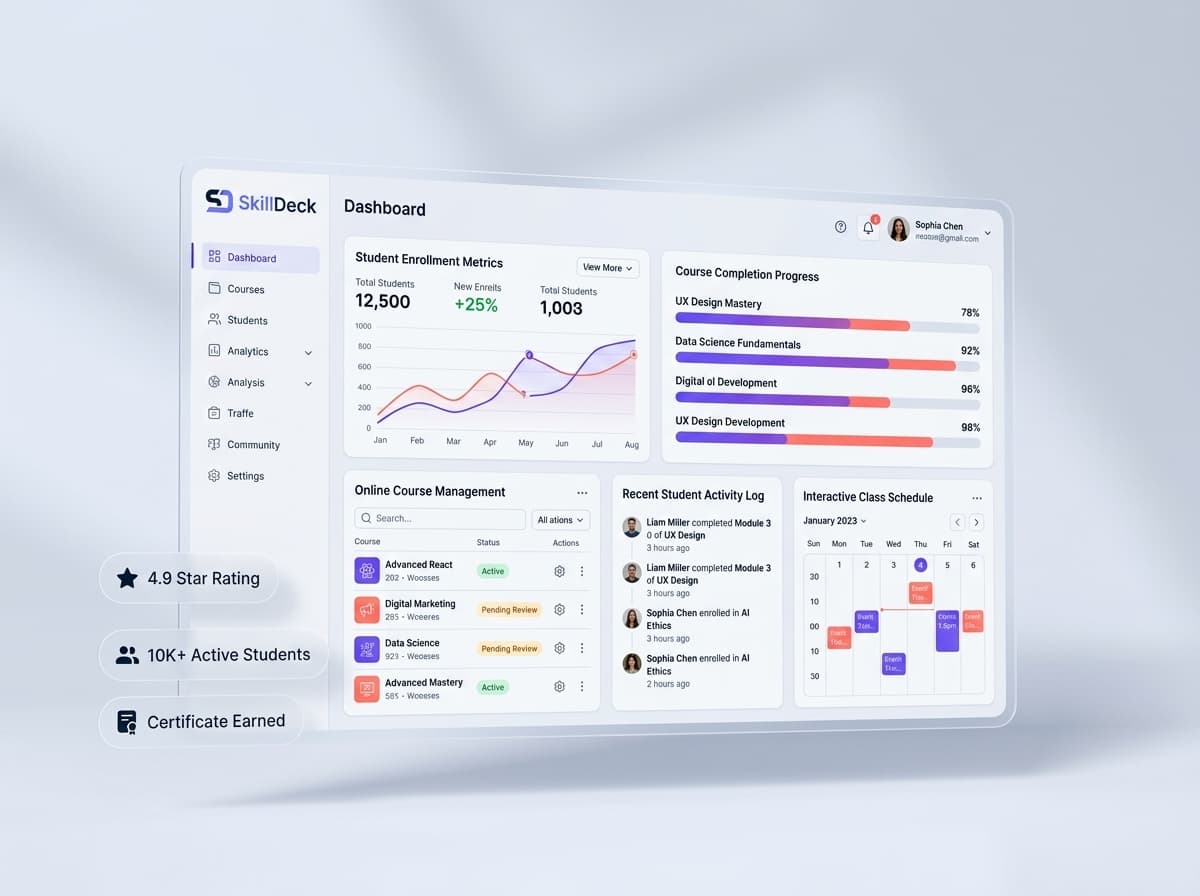
Skilldeck is designed to provide training businesses with a more connected environment for managing their learning operations. A training company can use the platform to organize courses, learners, batches, instructors, assessments, certificates, communication, and related training activities through a centralized system. This is particularly useful for businesses that have moved beyond managing a small number of courses and now need better coordination across multiple programs. Skilldeck can also support the broader operational needs of training businesses by bringing learning management together with other business processes. This can help reduce the need to maintain separate systems for different parts of the learner journey. For training companies focused on growth, the ability to manage course delivery and learner operations from a connected platform can provide a more practical foundation for expanding programs and training communities.
Training Management With Multiple Tools vs. an LMS
Area Multiple Separate Tools LMS for Training Companies Course management Managed across different systems Centralized course management Batch coordination Spreadsheets and manual records Structured batch management Instructor assignment Separate schedules or messages Connected with courses and batches Learner enrollment Manual data entry across tools Centralized learner enrollment Assessments External applications Connected to learning programs Progress tracking Manually compiled Centralized learner activity Certificates Separate certificate processes Integrated completion workflow Monetization Separate payment and course systems Connected enrollment and learning workflow Reporting Data collected from multiple sources Centralized training reports
Final Thoughts
An LMS for training companies is not simply a platform for uploading educational content. It can become the operational foundation for managing courses, batches, instructors, learners, assessments, certificates, communication, and monetized training programs. For a small training provider, it can bring structure to daily operations. For a growing training business, it can help create repeatable processes for managing more courses and learner groups without relying entirely on manual administration. The right LMS should match the way the training company actually operates. Course delivery models, batch structures, instructor workflows, learner volume, monetization plans, reporting requirements, and future growth should all be considered before making a decision. With a centralized platform such as Skilldeck, training companies can create a more connected approach to learning management while building a stronger digital foundation for delivering and scaling their training programs.